Strong writing depends not only on ideas but also on vocabulary variety. One of the most common issues in essays, articles, and professional reports is word repetition.
When the same word appears multiple times in close proximity, writing begins to feel repetitive and less engaging.
Using synonyms strategically helps writers maintain clarity while improving style, tone, and readability.
This is particularly important in academic writing, blogging, journalism, and professional communication, where vocabulary diversity demonstrates linguistic competence.
Students preparing for IELTS, TOEFL, and university essays are often evaluated on their ability to paraphrase and vary vocabulary effectively.
Similarly, bloggers and content writers benefit from synonym usage because it enhances SEO performance and reader engagement.
One commonly used word in descriptive writing is imagery. It plays an important role in literature, storytelling, academic analysis, and visual description.
However, repeating the term too often can weaken the flow of writing. Learning suitable alternatives allows writers to maintain precision while expanding expression.
This guide presents 14 imagery synonyms, organized by context, with clear meanings, usage explanations, and example sentences.
It also includes comparison tables, exam tips, and practice exercises to help writers use these words accurately.
Definition and Core Meaning of “Imagery”
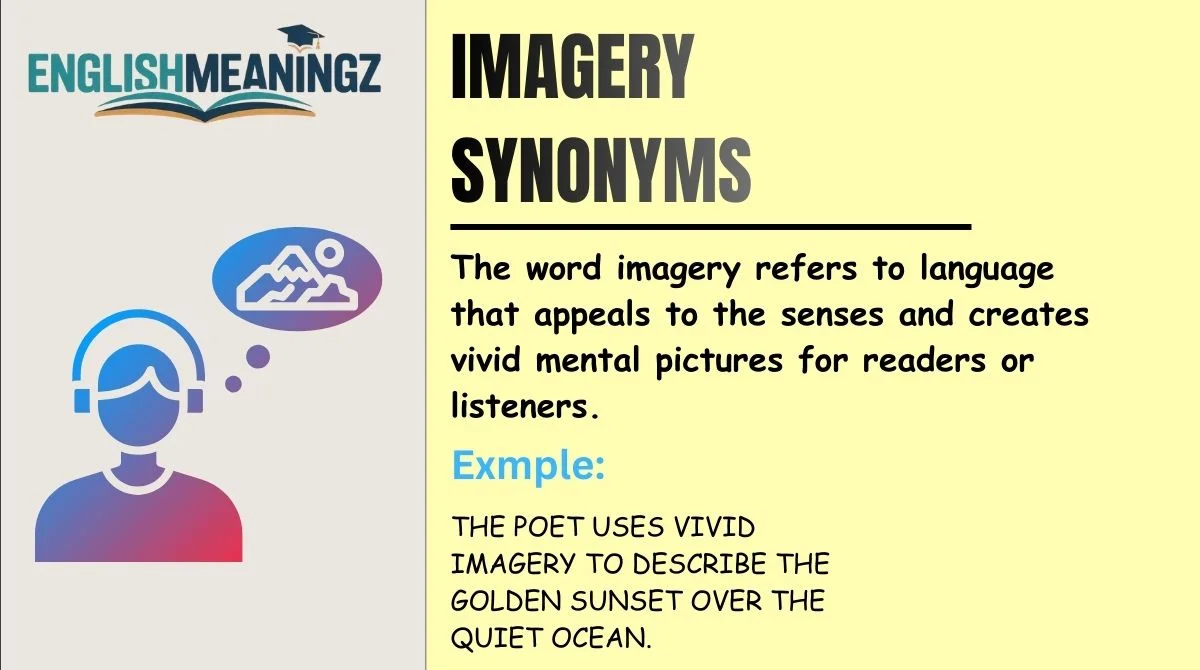
The word imagery refers to language that appeals to the senses and creates vivid mental pictures for readers or listeners. It is widely used in literature, poetry, academic analysis, and creative writing.
In literary studies, imagery describes descriptive language that stimulates sensory experience such as sight, sound, smell, taste, or touch. Authors employ imagery to help readers visualize scenes, understand emotions, and connect with narratives.
For example:
The poet uses vivid imagery to describe the golden sunset over the quiet ocean.
In broader contexts, imagery may also refer to visual representations, symbolic descriptions, or collections of images used to communicate ideas.
Because the word appears frequently in academic analysis and descriptive writing, writers often benefit from learning alternative expressions that convey similar meanings without unnecessary repetition.
14 Synonyms Grouped by Context
General Use
These synonyms work well in everyday writing, storytelling, and descriptive explanations.
Picture
Meaning: A mental or visual representation of something.
Context Explanation:
“Picture” is one of the simplest alternatives to imagery. It is commonly used in general writing and everyday communication to describe how language helps readers visualize scenes.
Example Sentence:
The novel paints a powerful picture of life in a small coastal village.
Image
Meaning: A visual representation or mental impression.
Context Explanation:
“Image” is closely related to imagery but slightly broader. It can refer to both literal visuals and mental impressions created by language.
Example Sentence:
The author creates a haunting image of abandoned streets after the storm.
Scene
Meaning: A visual setting or moment described in detail.
Context Explanation:
“Scene” emphasizes the environment or situation being described, often in storytelling or narrative writing.
Example Sentence:
The opening chapter presents a dramatic scene of travelers crossing a frozen mountain pass.
Vision
Meaning: A vivid mental image or imaginative perception.
Context Explanation:
“Vision” often suggests something imaginative or symbolic rather than purely descriptive.
Example Sentence:
The poet shares a dreamlike vision of a peaceful future society.
Formal & Academic Writing
These synonyms are particularly useful in essays, literary analysis, and research papers.
Representation
Meaning: A depiction or portrayal of something.
Context Explanation:
“Representation” is widely used in academic writing to describe how ideas, objects, or experiences are portrayed in texts or media.
Example Sentence:
The novel provides a powerful representation of social inequality in urban environments.
Depiction
Meaning: A detailed description or portrayal.
Context Explanation:
“Depiction” highlights how writers carefully illustrate scenes or ideas through descriptive language.
Example Sentence:
The author’s depiction of rural life reveals the challenges faced by farming communities.
Illustration
Meaning: An example or visual explanation used to clarify ideas.
Context Explanation:
In academic contexts, “illustration” refers to language that helps readers understand a concept more clearly.
Example Sentence:
The passage serves as an effective illustration of the character’s internal conflict.
Portrayal
Meaning: The way something or someone is presented in writing or art.
Context Explanation:
“Portrayal” often refers to the characterization of people, emotions, or environments.
Example Sentence:
The film offers a realistic portrayal of historical events.
Informal Usage
These alternatives are commonly used in casual writing, blogs, and creative storytelling.
Snapshot
Meaning: A brief but vivid description of a moment.
Context Explanation:
“Snapshot” suggests a quick yet powerful glimpse of a situation or experience.
Example Sentence:
The article provides a snapshot of daily life in a rapidly growing city.
Glimpse
Meaning: A quick or partial view.
Context Explanation:
“Glimpse” emphasizes limited but intriguing descriptive detail.
Example Sentence:
The opening paragraph gives readers a glimpse of the protagonist’s troubled past.
Sketch
Meaning: A rough or simplified description.
Context Explanation:
“Sketch” is often used when describing brief or preliminary descriptions.
Example Sentence:
The author offers a short sketch of the historical background before continuing the story.
Technical or Subject-Specific Use
These synonyms appear frequently in media studies, technology, science, and analytical writing.
Visualization
Meaning: The process of forming mental images.
Context Explanation:
“Visualization” is common in psychology, education, and data analysis.
Example Sentence:
Effective storytelling encourages readers’ visualization of complex environments.
Rendering
Meaning: A detailed visual representation, often used in design or digital media.
Context Explanation:
In technical contexts such as architecture or computer graphics, “rendering” refers to the creation of realistic visual representations.
Example Sentence:
The software produces a 3D rendering of the proposed building design.
Symbolism
Meaning: The use of symbols to represent deeper meanings.
Context Explanation:
While not identical to imagery, symbolism frequently overlaps with it in literary analysis.
Example Sentence:
The storm serves as symbolism for the character’s emotional turmoil.
Visualization Pattern
Meaning: A structured way of presenting visual information.
Context Explanation:
In data science and communication studies, patterns of visualization help audiences interpret information.
Example Sentence:
The report uses clear visualization patterns to present complex data effectively.
Word Intensity & Tone Comparison Table
| Word | Formal Level | Emotional Strength | Typical Context |
|---|---|---|---|
| Image | Neutral | Moderate | General writing |
| Picture | Informal | Moderate | Everyday language |
| Scene | Neutral | Strong | Storytelling |
| Vision | Slightly formal | Strong | Creative writing |
| Representation | Formal | Moderate | Academic writing |
| Depiction | Formal | Strong | Literary analysis |
| Illustration | Formal | Mild | Explanatory writing |
| Portrayal | Formal | Strong | Character analysis |
| Snapshot | Informal | Mild | Journalism |
| Glimpse | Informal | Mild | Narrative writing |
This comparison helps writers select words based on tone, context, and audience expectations.
Common Mistakes When Using These Synonyms
Mistake 1: Using Informal Words in Academic Essays
Incorrect:
The poem gives a cool snapshot of sadness.
Correct:
The poem provides a vivid depiction of sadness.
Mistake 2: Confusing Imagery with Symbolism
Incorrect:
The rose imagery represents love because it is a symbol.
Correct:
The rose serves as symbolism, while the surrounding descriptions create imagery.
Mistake 3: Replacing Words Without Considering Context
Incorrect:
The research paper contains beautiful visions of economic growth.
Correct:
The research paper presents a detailed representation of economic growth.
Mistake 4: Overusing Synonyms
Replacing every instance of a word can make writing confusing.
Incorrect:
The author creates a picture, depiction, portrayal, and visualization of the forest.
Correct:
The author creates vivid imagery to describe the forest.
Synonyms in Academic Writing
Example Paragraph 1
In modern literature, descriptive language plays an essential role in shaping readers’ interpretations of narratives. Through detailed depictions of natural environments, authors can influence emotional responses and highlight thematic elements. For example, many writers use environmental representations to mirror characters’ internal struggles.
Example Paragraph 2
Visual language contributes significantly to literary meaning. Careful portrayals of landscapes, colors, and sensory experiences allow readers to construct mental images while engaging with complex themes. Such descriptive techniques demonstrate how language can transform simple scenes into powerful narrative experiences.
IELTS & Exam Writing Tips
1. Avoid Repetition
Instead of repeating “imagery” several times, use variations such as depiction, representation, or portrayal.
Example:
Weak:
The poem uses imagery. This imagery creates strong imagery of sadness.
Improved:
The poem uses imagery, and this depiction creates a powerful sense of sadness.
2. Do Not Replace Technical Terms
Sometimes the original word is the most accurate term.
For example:
Correct in literary analysis:
The poem contains powerful imagery related to nature.
Replacing it unnecessarily may weaken clarity.
3. Match the Tone
Formal exams like IELTS prefer words such as:
- depiction
- representation
- portrayal
- illustration
Informal terms like “snapshot” should be used carefully.
Similar Words vs True Synonyms
Some words appear similar to imagery but are not exact replacements.
Description
A general explanation of something.
Imagery specifically involves sensory language.
Symbolism
Represents deeper meaning through symbols.
Imagery focuses on sensory description.
Visualization
Refers to the mental process of forming images rather than the language itself.
Understanding these distinctions helps writers maintain precision in academic contexts.
Practice Sentences
Fill in the blanks with an appropriate synonym.
- The author’s vivid ______ of the desert landscape makes the story memorable.
- The report offers a detailed ______ of social inequality.
- The first chapter provides a brief ______ of the protagonist’s childhood.
- The poem creates a powerful ______ of a stormy night.
- The article gives readers a quick ______ of life in the capital city.
Possible answers include: depiction, representation, sketch, image, snapshot.
FAQs
What are the best synonyms for imagery in academic writing?
Common academic alternatives include depiction, representation, portrayal, and illustration because they maintain a formal tone.
Is “image” the same as imagery?
Not exactly. An image refers to a single mental picture, while imagery describes the broader use of descriptive language that creates multiple sensory impressions.
Can I replace imagery in every sentence?
No. In literary analysis, the term imagery is sometimes the most precise word, so replacing it unnecessarily may reduce clarity.
Which synonym is best for storytelling?
Words like scene, vision, and glimpse work well in storytelling because they emphasize narrative perspective and atmosphere.
Why is vocabulary variety important for exams like IELTS?
Vocabulary diversity demonstrates language proficiency and helps writers avoid repetition, which can improve lexical resource scores.
Conclusion
Expanding vocabulary is one of the most effective ways to improve writing quality.
Words like imagery are essential in descriptive and analytical writing, but relying on a single term repeatedly can weaken clarity and engagement.
Learning alternatives such as depiction, representation, portrayal, scene, and visualization allows writers to adapt language to different contexts, from academic essays to creative storytelling.
For students, bloggers, and professionals alike, mastering synonyms not only strengthens communication but also improves exam performance and reader engagement.
Consistent practice, contextual understanding, and careful word choice will gradually build a richer and more versatile vocabulary.