In modern writing, vocabulary diversity is one of the strongest indicators of language mastery.
Whether someone is writing academic essays, professional reports, blog articles, or exam responses, the ability to vary word choice significantly improves readability and overall writing quality.
Students preparing for international exams such as IELTS or TOEFL often lose marks because they repeat the same words throughout their essays.
Similarly, bloggers and content creators struggle to maintain reader engagement when their writing lacks lexical variety.
Professionals also benefit from refined vocabulary because precise language strengthens communication in reports, presentations, and workplace correspondence.
Using synonyms correctly is one of the easiest ways to elevate writing. However, not all synonyms are interchangeable in every situation. Each alternative carries subtle differences in tone, formality, or context.
This article explores 14 powerful synonyms for the word “vocabulary.” Each synonym will be explained with clear meanings, contextual usage, and example sentences.
The goal is to help students, writers, and professionals expand their lexical range and apply the right word in the right situation.
Definition and Core Meaning of “Vocabulary”
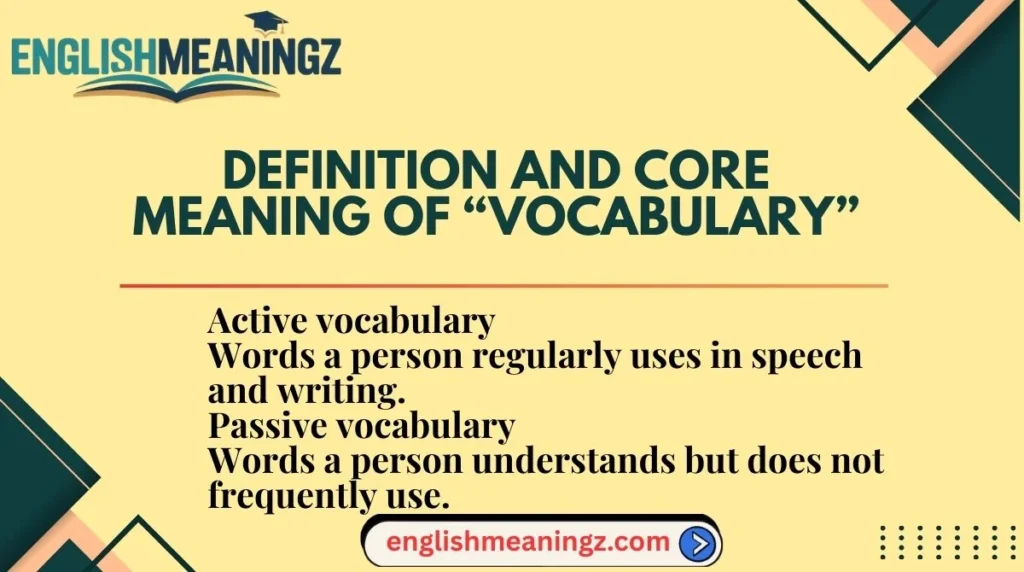
The term vocabulary refers to the collection of words that a person knows, understands, and uses in a language. It represents an individual’s linguistic resources for communication.
In linguistic studies, vocabulary is often divided into two major categories:
Active vocabulary
Words a person regularly uses in speech and writing.
Passive vocabulary
Words a person understands but does not frequently use.
In education and language learning, vocabulary development plays a central role because it directly influences comprehension, writing clarity, and expressive ability. A richer vocabulary allows individuals to communicate ideas with precision, nuance, and confidence.
From an academic perspective, vocabulary also reflects cognitive and educational development. Researchers often evaluate vocabulary size to measure language proficiency, reading ability, and literacy levels.
In everyday communication, vocabulary simply refers to the words available for expressing thoughts, emotions, and information.
14 Synonyms Grouped by Context
General Use
1. Lexicon
Meaning:
The complete set of words used in a language or by a particular person or field.
Context Explanation:
“Lexicon” is widely used in linguistics and general discussions about language. It refers to the entire vocabulary system of a language or subject.
Example Sentence:
Digital communication has introduced many new terms into the modern English lexicon.
2. Word Bank
Meaning:
A collection of words available for use, often in learning environments.
Context Explanation:
This term is commonly used in education, language learning, and writing exercises.
Example Sentence:
Students were encouraged to create a personal word bank to improve their essay writing.
3. Word Stock
Meaning:
The supply of words known and used by an individual or group.
Context Explanation:
“Word stock” highlights the quantity of available words rather than stylistic complexity.
Example Sentence:
Reading regularly helps expand a learner’s word stock significantly.
4. Verbal Resources
Meaning:
The linguistic tools available for expression.
Context Explanation:
This phrase emphasizes communication ability rather than the words themselves.
Example Sentence:
A skilled speaker uses verbal resources effectively to convey complex ideas.
Formal & Academic Writing
5. Terminology
Meaning:
A set of specialized words used within a particular field or discipline.
Context Explanation:
Common in academic writing, research papers, science, and technical subjects.
Example Sentence:
Understanding medical terminology is essential for students studying healthcare.
6. Diction
Meaning:
The choice and use of words in speech or writing.
Context Explanation:
In literature and rhetoric, diction describes how words are selected to create tone and style.
Example Sentence:
The author’s diction reflects a formal and academic style.
7. Phraseology
Meaning:
The particular way words and phrases are structured or expressed.
Context Explanation:
Often used in linguistics and language analysis.
Example Sentence:
Legal phraseology can be difficult for ordinary readers to understand.
8. Linguistic Repertoire
Meaning:
The range of language elements a person can use.
Context Explanation:
Common in sociolinguistics and language education.
Example Sentence:
Multilingual individuals often possess a broad linguistic repertoire.
Informal Usage
9. Word List
Meaning:
A simple collection of words compiled for learning or reference.
Context Explanation:
Frequently used in schools and language courses.
Example Sentence:
The teacher provided a weekly word list for spelling practice.
10. Lingo
Meaning:
Informal language used by a particular group.
Context Explanation:
Often refers to slang or specialized conversational language.
Example Sentence:
Technology experts often use industry lingo that outsiders may not understand.
11. Slang Set
Meaning:
A group of informal expressions commonly used in casual speech.
Context Explanation:
Common among younger speakers or within specific communities.
Example Sentence:
Social media platforms constantly create new slang sets.
Technical or Subject-Specific Use
12. Glossary
Meaning:
An alphabetical list of specialized terms with definitions.
Context Explanation:
Commonly found in textbooks, academic articles, and technical manuals.
Example Sentence:
The research report included a glossary to explain complex scientific terms.
13. Register
Meaning:
A variety of language used in a particular social context.
Context Explanation:
In linguistics, register refers to language variation depending on audience and purpose.
Example Sentence:
Academic writing requires a formal register.
14. Semantic Inventory
Meaning:
The full set of meanings and words available within a language system.
Context Explanation:
Used primarily in advanced linguistic studies.
Example Sentence:
The semantic inventory of English continues to expand through technological innovation.
Word Intensity & Tone Comparison Table
| Synonym | Formality Level | Emotional Strength | Typical Usage |
|---|---|---|---|
| Lexicon | High | Neutral | Linguistics, academia |
| Terminology | Very High | Neutral | Science, research |
| Diction | High | Moderate | Literature, writing analysis |
| Phraseology | High | Neutral | Language studies |
| Linguistic Repertoire | Very High | Neutral | Academic linguistics |
| Word Bank | Medium | Neutral | Education |
| Word List | Low | Neutral | Classroom learning |
| Lingo | Informal | Moderate | Casual speech |
| Glossary | High | Neutral | Academic texts |
This comparison shows that synonyms vary significantly in formality. Writers should choose words that match the tone of their document.
Common Mistakes When Using These Synonyms
Even though these words appear similar, they cannot always replace “vocabulary” directly. Misuse can make writing sound unnatural.
Mistake 1: Using “slang” in formal writing
Incorrect:
The research paper demonstrates the author’s strong slang.
Correct:
The research paper demonstrates the author’s strong vocabulary.
Mistake 2: Confusing terminology with vocabulary
Incorrect:
Her terminology in everyday conversation is impressive.
Correct:
Her vocabulary in everyday conversation is impressive.
Explanation:
Terminology usually refers to specialized fields.
Mistake 3: Misusing glossary
Incorrect:
His glossary is excellent in spoken English.
Correct:
His vocabulary is excellent in spoken English.
Explanation:
Glossary refers to a list of defined terms, not personal language ability.
Synonyms in Academic Writing
Example Paragraph 1
Academic success often depends on the strength of a student’s lexicon. A broad lexicon allows writers to express complex ideas clearly while avoiding unnecessary repetition. In academic essays, precise diction improves clarity and strengthens arguments, enabling readers to understand nuanced concepts more easily.
Example Paragraph 2
In professional research writing, specialized terminology plays a critical role in communicating discipline-specific knowledge. Scholars rely on precise terminology to ensure accuracy and maintain consistency across studies. As a result, mastering subject-specific vocabulary becomes essential for effective academic communication.
IELTS & Exam Writing Tips
1. Avoid Repetition
Repeating the same word multiple times weakens writing quality.
Example:
Weak sentence:
Students must improve their vocabulary because vocabulary improves writing.
Improved version:
Students must improve their vocabulary because a richer lexicon strengthens writing quality.
2. Use Synonyms Carefully
Not every synonym fits every sentence. Choose alternatives that match the meaning and tone.
3. Maintain Clarity
Excessive synonym replacement can confuse readers. Sometimes repeating a word is better than forcing an unnatural alternative.
4. Understand Context
Words like terminology and register are context-specific and should only be used when appropriate.
5. Practice Paraphrasing
Exams such as IELTS reward the ability to restate ideas using varied vocabulary without changing meaning.
Similar Words vs True Synonyms
Many words that appear similar to vocabulary actually have slightly different meanings.
Vocabulary vs Terminology
Vocabulary refers to general word knowledge, while terminology refers to specialized words used in a particular field.
Vocabulary vs Diction
Vocabulary is the total number of words known, whereas diction refers to the deliberate choice of words in writing or speech.
Vocabulary vs Register
Vocabulary refers to words themselves, while register relates to how language changes depending on context, audience, or social situation.
Understanding these distinctions allows writers to choose words more precisely and avoid semantic confusion.
Practice Sentences
Choose the most suitable synonym for vocabulary.
- The scientist used precise __________ to explain the medical procedure.
- Reading books helps expand a student’s __________.
- The textbook includes a __________ to explain complex scientific terms.
- Journalists must maintain careful __________ to remain objective.
- Learning industry __________ helps employees communicate effectively at work.
Suggested Answers:
- terminology
- lexicon
- glossary
- diction
- lingo
Practicing exercises like these improves understanding of contextual word usage.
FAQs
What is the best synonym for vocabulary?
The most accurate synonym is lexicon, especially in academic or linguistic contexts.
Is terminology the same as vocabulary?
No. Terminology refers specifically to specialized words used in a particular discipline, while vocabulary refers to general word knowledge.
How can students improve vocabulary quickly?
Students can improve vocabulary by reading widely, practicing writing regularly, and learning synonyms within context.
Why is vocabulary important in exams like IELTS?
A wide vocabulary allows candidates to express ideas clearly, avoid repetition, and achieve higher lexical resource scores.
How many words are considered a strong vocabulary?
Research suggests educated adults typically understand between 20,000 and 35,000 words, though the exact number varies by individual and language exposure.
Conclusion
Vocabulary development remains one of the most powerful ways to strengthen communication.
Whether writing academic essays, professional documents, or online content, varied word choice improves clarity, credibility, and reader engagement.
Understanding synonyms such as lexicon, terminology, diction, phraseology, and linguistic repertoire enables writers to select words that precisely match their context and purpose.
For students preparing for exams, bloggers aiming to improve readability, and professionals seeking stronger communication skills, expanding vocabulary is an ongoing process.
Reading regularly, practicing writing, and studying contextual synonyms can gradually build a richer linguistic toolkit.
By mastering these alternatives to the word “vocabulary,” writers can communicate ideas more effectively and elevate the overall quality of their language.