Vocabulary variety is one of the most powerful tools for improving writing quality. Whether you are a student writing essays, a blogger creating engaging content, or a professional preparing reports, using diverse vocabulary strengthens clarity and sophistication. Repeating the same word throughout a paragraph can make writing appear limited and less polished.
One word that frequently appears in academic, journalistic, and analytical writing is “precarious.” It is commonly used to describe unstable situations, risky conditions, or uncertain outcomes. However, relying on the same word repeatedly can weaken the overall impact of writing.
Learning synonyms of “precarious” allows writers to express subtle differences in meaning. Some alternatives convey physical instability, while others describe economic uncertainty, emotional vulnerability, or risky decisions.
In academic contexts, varied vocabulary improves essay scores by demonstrating language flexibility and lexical resource.
In professional communication, it creates precision and credibility. Bloggers also benefit because diversified language keeps readers engaged and improves search readability.
This guide explains the definition of “precarious,” explores 26 useful synonyms grouped by context, and demonstrates how to use them effectively in writing, exams, and professional communication.
Definition and Core Meaning of “Precarious”
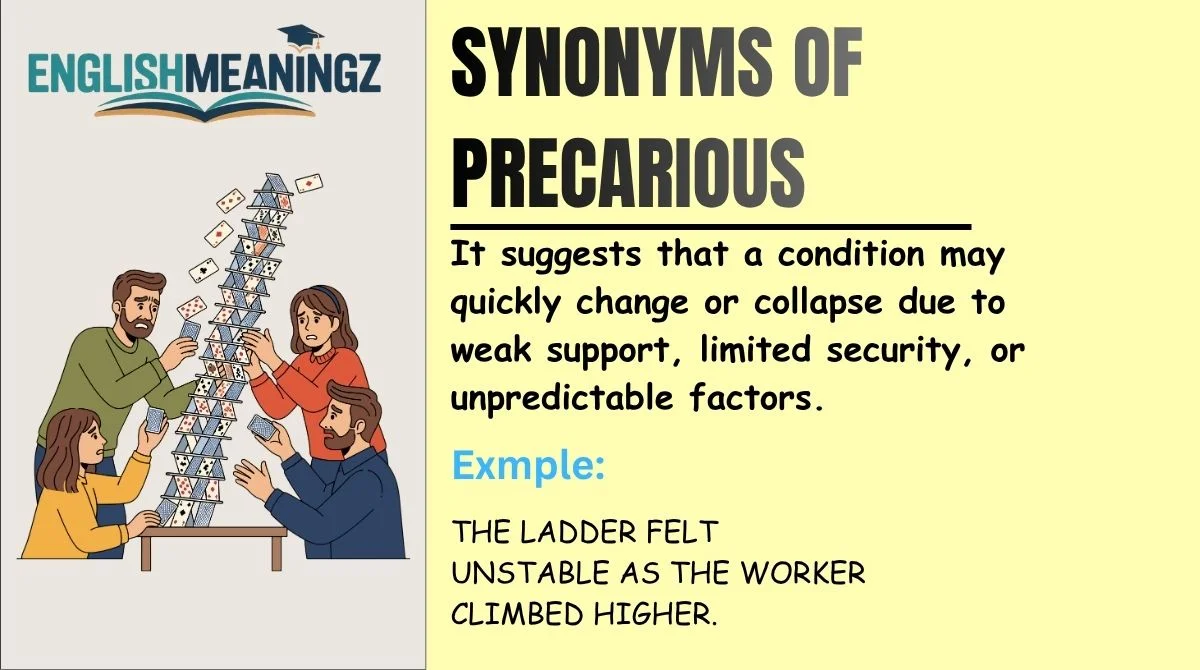
The word precarious describes a situation that is unstable, uncertain, risky, or likely to fail. It suggests that a condition may quickly change or collapse due to weak support, limited security, or unpredictable factors.
The term can apply to several contexts:
Physical instability:
A structure or object that could fall or collapse.
Economic uncertainty:
Financial situations where stability is not guaranteed.
Social or political vulnerability:
Conditions where stability depends on fragile support.
Personal circumstances:
Situations involving risk, danger, or uncertainty.
Example:
The company’s financial situation became increasingly precarious after several months of declining revenue.
In academic writing, the word is often used in discussions about economics, politics, environmental risks, and social systems.
26 Synonyms Grouped by Context
General Use
Unstable
Meaning: lacking stability or balance.
Context: used for physical structures, systems, or situations that may collapse.
Example:
The ladder felt unstable as the worker climbed higher.
Insecure
Meaning: not safe or firmly established.
Context: commonly used in social, economic, or emotional contexts.
Example:
Many workers experience insecure employment in temporary job markets.
Risky
Meaning: involving potential danger or failure.
Context: everyday situations involving decisions or actions.
Example:
Investing all your savings in a single project is risky.
Dangerous
Meaning: capable of causing harm or injury.
Context: physical environments or hazardous situations.
Example:
Driving during severe storms can be dangerous.
Uncertain
Meaning: not definite or guaranteed.
Context: used for outcomes, predictions, and plans.
Example:
The future of the project remains uncertain.
Fragile
Meaning: easily damaged or broken.
Context: both physical objects and delicate relationships.
Example:
The fragile peace agreement required constant negotiation.
Vulnerable
Meaning: open to harm or attack.
Context: individuals, systems, or environments exposed to risk.
Example:
Coastal communities are vulnerable to climate change.
Formal & Academic Writing
Hazardous
Meaning: involving serious risk or danger.
Context: scientific or technical discussions about safety.
Example:
Workers must wear protective equipment in hazardous environments.
Perilous
Meaning: extremely dangerous or risky.
Context: often used in formal descriptions of high-risk situations.
Example:
Explorers faced a perilous journey across the mountains.
Unsteady
Meaning: not firmly fixed or balanced.
Context: physical or metaphorical instability.
Example:
The economy showed signs of unsteady recovery.
Volatile
Meaning: likely to change rapidly or unpredictably.
Context: economics, politics, and financial markets.
Example:
The stock market remained volatile during the crisis.
Unreliable
Meaning: not dependable or consistent.
Context: systems, people, or data.
Example:
Outdated equipment produced unreliable results.
Tentative
Meaning: uncertain or not fully confirmed.
Context: plans, agreements, or proposals.
Example:
The committee announced a tentative schedule.
Unpredictable
Meaning: difficult to foresee or anticipate.
Context: behavior, events, or environmental conditions.
Example:
Weather patterns have become increasingly unpredictable.
Informal Usage
Shaky
Meaning: weak or unstable.
Context: casual speech or informal writing.
Example:
His explanation sounded a little shaky.
Wobbly
Meaning: physically unstable or unsteady.
Context: often used for objects or structures.
Example:
The table was wobbly because one leg was shorter.
Dicey
Meaning: uncertain or risky.
Context: informal conversation about risky situations.
Example:
The plan seemed a bit dicey from the beginning.
Touch-and-go
Meaning: uncertain whether success will occur.
Context: situations with unpredictable outcomes.
Example:
For a moment, the rescue operation was touch-and-go.
Technical or Subject-Specific Use
Critical
Meaning: at a decisive or dangerous stage.
Context: medical, scientific, or crisis situations.
Example:
The patient remained in critical condition.
Delicate
Meaning: requiring careful handling due to risk.
Context: negotiations, diplomacy, or technical work.
Example:
The diplomat handled the delicate negotiations carefully.
Unstable Equilibrium
Meaning: a condition where slight disturbance causes major change.
Context: physics, economics, or systems theory.
Example:
The ecosystem existed in an unstable equilibrium.
Precarious Balance
Meaning: a delicate state of stability.
Context: political, economic, or environmental discussions.
Example:
The region maintained a precarious balance of power.
Vulnerable Position
Meaning: a state where protection is limited.
Context: strategy, politics, or business competition.
Example:
The company found itself in a vulnerable position after the merger.
High-Risk
Meaning: involving a strong possibility of failure or harm.
Context: finance, health, or engineering.
Example:
High-risk investments require careful analysis.
Uncertain Foundation
Meaning: built on weak or unreliable support.
Context: theoretical arguments or unstable systems.
Example:
The theory was criticized for resting on an uncertain foundation.
Temporary Stability
Meaning: stability that may not last.
Context: economics, politics, and environmental systems.
Example:
The ceasefire created temporary stability in the region.
Word Intensity & Tone Comparison Table
| Word | Formal Level | Emotional Strength | Typical Context |
|---|---|---|---|
| Unstable | Neutral | Medium | General situations |
| Risky | Informal | Medium | Everyday decisions |
| Hazardous | Formal | Strong | Safety or science |
| Perilous | Formal | Very Strong | Extreme danger |
| Volatile | Academic | Medium | Markets, politics |
| Fragile | Neutral | Medium | Relationships or systems |
| Vulnerable | Academic | Medium | Social or environmental issues |
| Dicey | Informal | Medium | Casual conversation |
| Critical | Formal | Strong | Medical or crisis contexts |
| Tentative | Formal | Low | Plans and proposals |
This comparison helps writers choose the right synonym based on tone and audience.
Common Mistakes When Using These Synonyms
Even though many words appear similar, their meanings and contexts differ. Misusing them can weaken clarity.
Mistake 1: Using informal synonyms in academic writing
Incorrect:
The economy is in a dicey situation.
Correct:
The economy is in a volatile situation.
Mistake 2: Confusing physical instability with uncertainty
Incorrect:
The project proposal is unstable.
Correct:
The project proposal is uncertain.
Mistake 3: Overusing dramatic synonyms
Incorrect:
The meeting created a perilous discussion.
Correct:
The meeting created a delicate discussion.
Mistake 4: Replacing words without considering tone
Incorrect:
The patient is in a risky condition.
Correct:
The patient is in critical condition.
Synonyms in Academic Writing
Example Paragraph 1
Economic stability can quickly deteriorate when markets become volatile. During financial crises, investors often face uncertain outcomes and unstable investment environments. Governments attempt to stabilize markets through regulatory measures, but recovery can remain fragile for extended periods.
Example Paragraph 2
Environmental researchers warn that ecosystems may enter a precarious state due to climate change. As biodiversity declines, ecological systems become increasingly vulnerable. This instability threatens not only wildlife populations but also human communities that rely on environmental resources.
IELTS & Exam Writing Tips
Avoid Repetition
In exam essays, repeating the same word repeatedly lowers lexical variety scores.
Example:
Weak:
The situation is precarious. The precarious situation affects workers.
Improved:
The situation is precarious. This unstable condition affects workers.
Use Synonyms Carefully
Some words should not replace “precarious” if the context changes meaning.
For example:
Precarious economy
Better alternatives: volatile, unstable.
Precarious ladder
Better alternatives: unstable, wobbly.
Maintain Precision
Do not replace words simply to appear advanced. Accuracy always matters more than complexity.
Similar Words vs True Synonyms
Some words are related but not identical.
Fragile vs Precarious
Fragile emphasizes delicacy. Precarious emphasizes instability.
Volatile vs Precarious
Volatile suggests rapid change, especially in markets.
Dangerous vs Precarious
Dangerous focuses on harm, while precarious highlights instability.
Understanding these subtle distinctions helps writers maintain accuracy.
Practice Sentences
Fill in the blanks with an appropriate synonym.
- The company’s finances became ______ after several failed investments.
- The scientist warned that the chemical mixture was extremely ______.
- The chair felt ______ because one leg was loose.
- The political agreement remained ______ despite international pressure.
- The future of the project is still ______.
Possible answers: unstable, hazardous, wobbly, fragile, uncertain.
FAQs
What does precarious mean in simple terms?
Precarious means unstable, uncertain, or risky, suggesting that a situation could quickly worsen or fail.
What is the closest synonym of precarious?
Words like unstable, risky, and uncertain are among the closest synonyms depending on context.
Can precarious be used in academic writing?
Yes. It is widely used in academic discussions involving economics, politics, environmental systems, and social structures.
Which synonym is best for IELTS essays?
Formal options such as volatile, unstable, vulnerable, and uncertain work best in exam writing.
Is precarious always negative?
Generally yes. The word usually describes risk, instability, or insecurity, which carry negative implications.
Conclusion
Expanding vocabulary is essential for effective communication. Words like precarious describe instability and uncertainty, but relying on a single word can limit expression.
By learning a range of synonyms—such as unstable, volatile, vulnerable, fragile, and perilous—writers gain the ability to communicate ideas more precisely. This flexibility improves academic essays, professional reports, and online writing.
Students preparing for language exams benefit particularly from lexical variety, while bloggers and professionals can enhance readability and engagement through thoughtful word choice.
Continuous vocabulary development strengthens writing confidence and clarity. Mastering synonyms not only improves language skills but also allows writers to express complex ideas with greater accuracy and impact.