Vocabulary variety is a crucial element of strong writing. Whether in academic essays, professional communication, or online content creation, repeating the same word multiple times can weaken the impact of a text.
Writers who use a diverse vocabulary appear more knowledgeable, precise, and persuasive.
For students preparing essays, research papers, or standardized tests such as IELTS and TOEFL, synonym flexibility directly improves writing scores.
Examiners often evaluate lexical resource—the ability to use varied and accurate vocabulary.
Similarly, bloggers and content creators benefit from synonym variation because it improves readability and helps search engines understand the topic better.
Professionals also gain advantages from vocabulary precision. In business reports, financial writing, and analytical documents, selecting the correct synonym conveys tone, formality, and nuance more effectively.
One commonly used word that often appears in essays and everyday language is “frugal.” While useful, overusing it can make writing repetitive.
Learning alternative expressions allows writers to express similar ideas with more clarity and sophistication.
This guide explores 12 powerful synonyms for “frugal,” explains their meanings, contexts, and usage examples, and provides practical tips for using them correctly in academic and professional writing.
Definition and Core Meaning of “Frugal”

The word frugal describes a person who is careful with money and resources. A frugal individual avoids unnecessary spending and prefers efficiency, practicality, and moderation when managing finances.
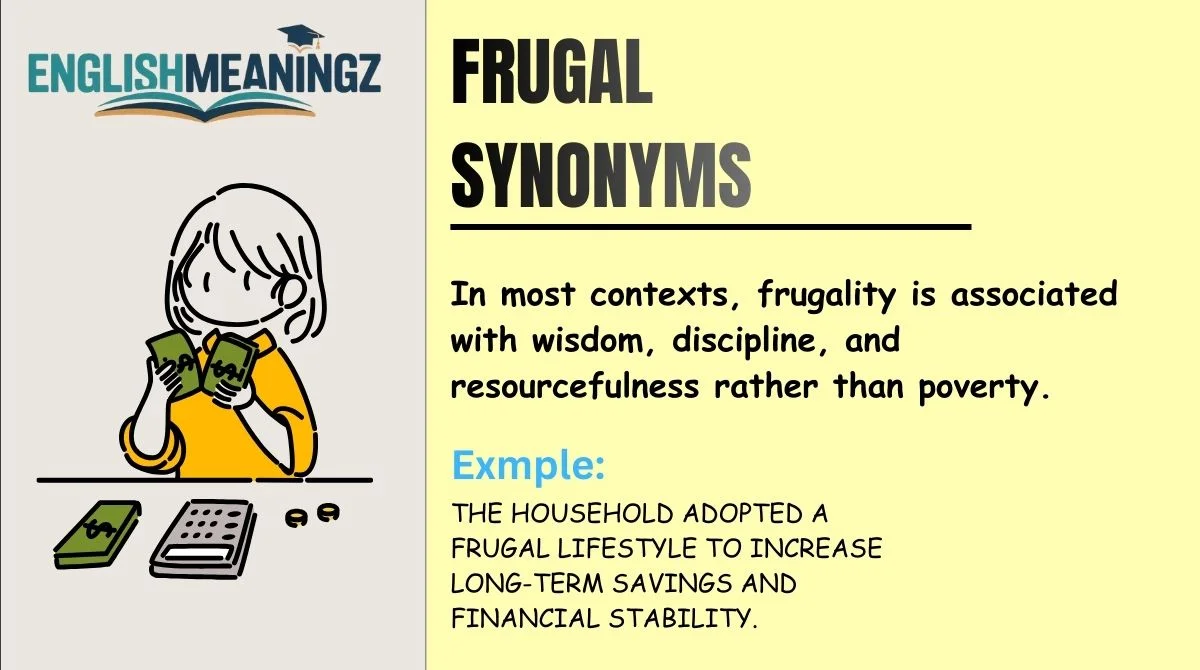
In most contexts, frugality is associated with wisdom, discipline, and resourcefulness rather than poverty. A frugal person may have sufficient financial resources but chooses to spend cautiously and prioritize value.
In academic discussions, especially in economics, sociology, and behavioral studies, frugality can refer to:
- Efficient resource management
- Minimal consumption behavior
- Financial prudence
- Conservative spending habits
For example:
The household adopted a frugal lifestyle to increase long-term savings and financial stability.
Understanding the broader concept behind the word allows writers to select the most appropriate synonym depending on tone, formality, and context.
12 Synonyms Grouped by Context
General Use Synonyms
These words can replace “frugal” in most everyday and writing situations.
Economical
Meaning: Using money or resources carefully to avoid waste.
Context Explanation:
“Economical” emphasizes efficiency rather than strict saving. It often appears in discussions about products, systems, or lifestyles that minimize unnecessary spending.
Example Sentence:
The family adopted an economical approach to grocery shopping by planning meals in advance.
Thrifty
Meaning: Careful and responsible with money.
Context Explanation:
“Thrifty” suggests practical budgeting and intelligent purchasing decisions. It often has a positive tone, implying good financial habits.
Example Sentence:
Her thrifty spending habits allowed her to save a significant portion of her salary.
Cost-Conscious
Meaning: Aware of expenses and actively trying to minimize them.
Context Explanation:
This phrase is commonly used in consumer behavior, marketing, and financial discussions.
Example Sentence:
Cost-conscious consumers often compare prices before making large purchases.
Budget-Minded
Meaning: Focused on staying within financial limits.
Context Explanation:
This synonym is widely used in financial planning and personal finance articles.
Example Sentence:
Budget-minded travelers often search for affordable accommodations.
Formal & Academic Writing Synonyms
These alternatives are especially suitable for research papers, academic essays, and professional reports.
Prudent
Meaning: Acting with careful judgment and foresight, particularly in financial matters.
Context Explanation:
“Prudent” is widely used in academic and financial contexts to describe wise decision-making.
Example Sentence:
Adopting prudent financial strategies helps individuals manage economic uncertainty.
Conservative
Meaning: Avoiding unnecessary risk or excessive spending.
Context Explanation:
In economics and finance, “conservative” often describes cautious investment or spending behavior.
Example Sentence:
The organization maintained a conservative budget to ensure long-term sustainability.
Moderate
Meaning: Avoiding extremes in spending or consumption.
Context Explanation:
In academic discussions, “moderate” describes balanced behavior rather than strict cost-cutting.
Example Sentence:
Moderate spending habits contribute to stable financial management.
Informal Usage Synonyms
These alternatives are more common in everyday conversation and casual writing.
Penny-Pinching
Meaning: Extremely careful or even excessive about saving small amounts of money.
Context Explanation:
Sometimes carries a slightly negative tone, suggesting over-cautious spending.
Example Sentence:
His penny-pinching attitude prevented him from enjoying simple pleasures.
Cheap
Meaning: Unwilling to spend money.
Context Explanation:
This word often has a negative implication, suggesting stinginess rather than sensible saving.
Example Sentence:
Some people mistakenly label disciplined savers as cheap.
Tightfisted
Meaning: Extremely reluctant to spend money.
Context Explanation:
This term is more critical and usually describes excessive unwillingness to spend.
Example Sentence:
The tightfisted manager refused to approve even essential office supplies.
Technical or Subject-Specific Synonyms
These alternatives appear frequently in economics, sustainability, and resource management.
Resource-Efficient
Meaning: Using resources in the most effective and sustainable way.
Context Explanation:
Common in environmental studies and business efficiency discussions.
Example Sentence:
Resource-efficient manufacturing methods reduce operational costs.
Minimalist
Meaning: Preferring simplicity and minimal consumption.
Context Explanation:
In lifestyle studies and design fields, minimalism reflects reduced material consumption.
Example Sentence:
A minimalist lifestyle encourages intentional spending and reduced clutter.
Word Intensity & Tone Comparison Table
| Synonym | Formal Level | Tone | Emotional Strength | Typical Context |
|---|---|---|---|---|
| Economical | Medium | Neutral | Mild | Everyday writing |
| Thrifty | Medium | Positive | Mild | Personal finance |
| Cost-conscious | Medium | Neutral | Mild | Consumer behavior |
| Budget-minded | Medium | Neutral | Mild | Financial planning |
| Prudent | High | Positive | Moderate | Academic writing |
| Conservative | High | Neutral | Moderate | Economics |
| Moderate | High | Neutral | Low | Academic discussions |
| Penny-pinching | Low | Negative | Moderate | Informal speech |
| Cheap | Low | Negative | Strong | Casual criticism |
| Tightfisted | Low | Negative | Strong | Informal criticism |
Understanding tone helps writers select words that match the intended message.
Common Mistakes When Using These Synonyms
1. Using Negative Synonyms in Positive Contexts
Incorrect:
The professor praised her cheap financial habits.
Correct:
The professor praised her prudent financial habits.
Explanation: “Cheap” implies stinginess, not responsible spending.
2. Replacing Words Without Considering Tone
Incorrect:
The research highlights penny-pinching government policies.
Correct:
The research highlights conservative government spending policies.
Explanation: Informal language weakens academic writing.
3. Confusing Efficiency with Frugality
Incorrect:
The company adopted a frugal production system.
Better Alternative:
The company adopted a resource-efficient production system.
Explanation: Some contexts require technical precision.
Synonyms in Academic Writing

Example Paragraph 1
Prudent financial behavior plays a significant role in long-term economic stability. Individuals who adopt conservative spending habits often develop stronger savings patterns and demonstrate greater resilience during economic downturns. Such financially responsible practices contribute to sustainable household budgeting and improved financial security.
Example Paragraph 2
Consumer behavior research frequently highlights the importance of cost-conscious decision-making. Budget-minded individuals typically prioritize value over impulse purchases, leading to more efficient allocation of financial resources. These spending patterns illustrate how moderate consumption can support long-term economic well-being.
IELTS & Exam Writing Tips
1. Avoid Repetition
Repeated vocabulary reduces lexical score.
Example:
Weak writing:
Frugal people save money. Frugal consumers spend less.
Improved writing:
Thrifty individuals save money, while cost-conscious consumers prioritize affordable choices.
2. Maintain Context Accuracy
Not every synonym works in every sentence.
For example, replacing “frugal lifestyle” with “cheap lifestyle” changes the meaning and tone.
3. Use Formal Synonyms in Academic Writing
Preferred options include:
- Prudent
- Economical
- Conservative
- Moderate
Avoid overly informal terms like “penny-pinching.”
4. Do Not Replace Key Terminology
In some essays, repeating the main term improves clarity.
Example:
Frugal consumption patterns contribute to sustainable economic behavior.
Replacing every occurrence with a synonym may confuse readers.
Similar Words vs True Synonyms
Some words appear similar to “frugal” but have slightly different meanings.
Frugal vs Economical
- Frugal: Personal habit of careful spending
- Economical: Efficient use of resources
Frugal vs Cheap
- Frugal: Positive, responsible spending
- Cheap: Negative unwillingness to spend
Frugal vs Minimalist
- Frugal: Focus on saving money
- Minimalist: Focus on simplicity and reduced possessions
Recognizing these distinctions helps writers maintain accuracy.
Practice Sentences
Choose the best synonym for “frugal.”
- The company implemented a ______ budgeting strategy to reduce operational costs.
- ______ shoppers often compare multiple prices before purchasing electronics.
- His ______ lifestyle allowed him to retire early.
- The report recommended ______ spending policies for the upcoming fiscal year.
- A ______ approach to resource management can improve sustainability.
Suggested answers:
- conservative
- cost-conscious
- thrifty
- prudent
- resource-efficient
FAQs
What is the best synonym for “frugal”?
“Thrifty” and “economical” are among the closest and most commonly used synonyms.
Is “cheap” the same as “frugal”?
No. “Cheap” often has a negative meaning, suggesting stinginess, while “frugal” implies responsible spending.
Which synonym works best in academic writing?
Words such as prudent, economical, and conservative are suitable for formal contexts.
Can “minimalist” replace “frugal”?
Sometimes. However, “minimalist” emphasizes simplicity and reduced possessions rather than financial caution.
Why should writers learn synonyms?
Using varied vocabulary improves clarity, readability, and academic writing scores.
Conclusion
Expanding vocabulary is one of the most effective ways to improve writing quality.
Words such as economical, thrifty, prudent, and cost-conscious allow writers to communicate ideas about careful spending with greater precision and sophistication.
Students benefit from synonym variety in essays and exam writing, while bloggers and professionals enhance readability and engagement.
However, choosing the correct synonym requires understanding tone, context, and subtle differences in meaning.
By practicing these alternatives and applying them thoughtfully, writers can develop stronger, clearer, and more persuasive communication skills.