Strong vocabulary plays a crucial role in effective communication. Whether you are writing essays, blog posts, business reports, or research papers, repeating the same word multiple times can weaken the quality of your writing.
One word that frequently appears in academic and professional content is “engage.” While it is a useful and versatile word, overusing it can make writing sound repetitive and less sophisticated.
Using a variety of synonyms improves readability, enhances clarity, and demonstrates strong language skills. For students preparing for exams such as IELTS, TOEFL, or academic assessments, vocabulary diversity can significantly improve writing scores.
Examiners often reward writers who can express ideas with precision while maintaining variety.
Bloggers and content creators also benefit from synonym variety because it improves search engine optimization (SEO) and keeps readers interested. Professionals, researchers, and marketers use varied vocabulary to maintain a polished and persuasive tone in their work.
This comprehensive guide explores 25 powerful synonyms for “engage,” organized by context. Each synonym includes meaning, explanation, and example sentences so you can confidently use them in your writing.
Definition and Core Meaning of “Engage”
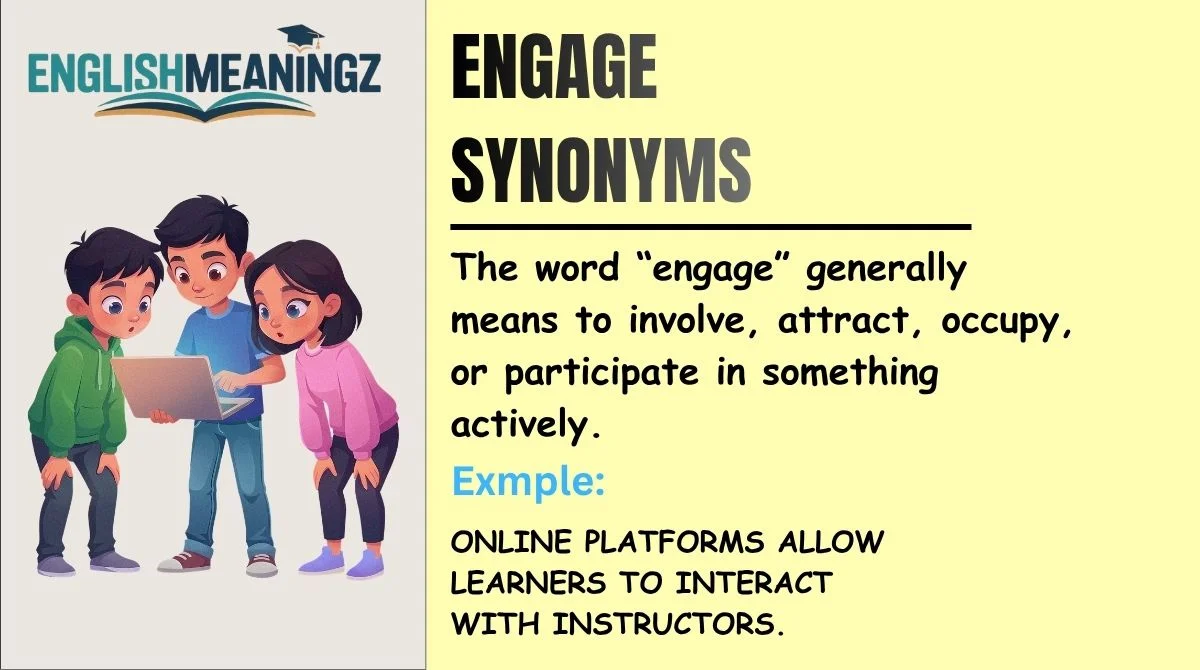
The word “engage” generally means to involve, attract, occupy, or participate in something actively. It often refers to capturing attention, participating in an activity, or establishing a connection.
In everyday communication, the word can have several meanings depending on context:
- To attract attention or interest
- To involve someone in an activity
- To participate actively in a task or discussion
- To establish interaction or communication
In academic and professional writing, “engage” frequently appears in sentences such as:
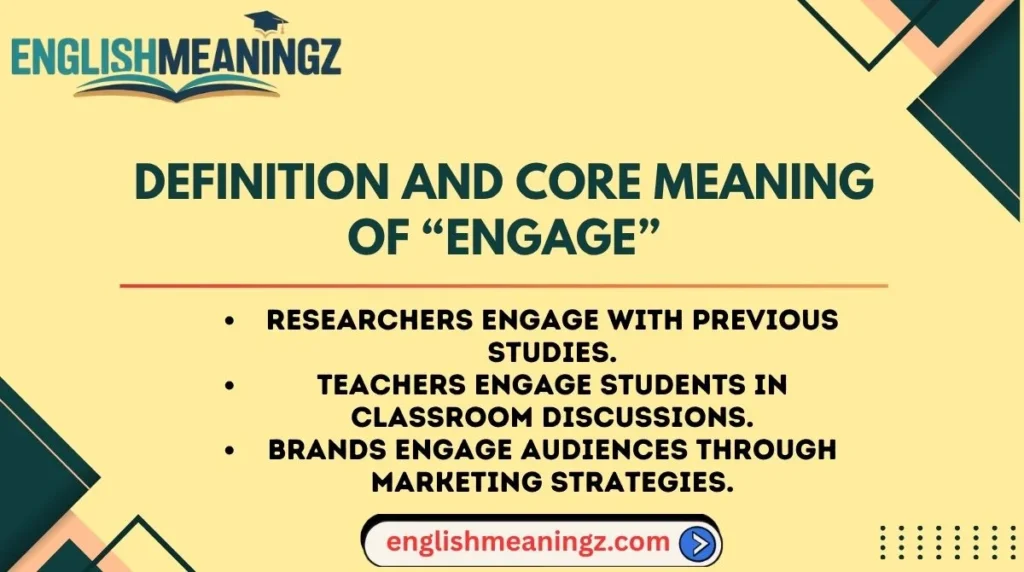
- Researchers engage with previous studies.
- Teachers engage students in classroom discussions.
- Brands engage audiences through marketing strategies.
Because the word has multiple uses, choosing the correct synonym depends on the context in which it appears.
25 Synonyms Grouped by Context
General Use Synonyms
1. Involve
Meaning: To include someone in an activity or process.
Context Explanation:
“Involve” is one of the closest synonyms to “engage.” It suggests participation or inclusion in an action.
Example Sentence:
Teachers should involve students in group discussions to improve critical thinking.
2. Participate
Meaning: To take part in an activity or event.
Context Explanation:
This synonym emphasizes active involvement rather than passive observation.
Example Sentence:
Students are encouraged to participate in classroom debates.
3. Connect
Meaning: To establish communication or relationship with someone.
Context Explanation:
Often used in interpersonal communication or social contexts.
Example Sentence:
Effective storytelling helps writers connect with their audience.
4. Interact
Meaning: To communicate or work together.
Context Explanation:
Frequently used in social, technological, or educational contexts.
Example Sentence:
Online platforms allow learners to interact with instructors.
5. Occupy
Meaning: To keep someone busy or interested.
Context Explanation:
Used when attention or time is captured by an activity.
Example Sentence:
Interactive exercises occupy students’ attention during lectures.
6. Capture
Meaning: To attract or hold attention.
Context Explanation:
Often used in marketing, storytelling, and presentations.
Example Sentence:
A powerful headline captures the reader’s interest instantly.
7. Attract
Meaning: To draw interest or attention.
Context Explanation:
Commonly used in advertising, communication, and research discussions.
Example Sentence:
Visual graphics attract readers to important information.
Formal & Academic Writing Synonyms
8. Involve Actively
Meaning: To require participation in a structured activity.
Context Explanation:
Often used in academic research or institutional communication.
Example Sentence:
The study involved actively engaging participants in surveys.
9. Collaborate
Meaning: To work jointly with others.
Context Explanation:
Common in academic research and professional projects.
Example Sentence:
Researchers collaborate across disciplines to solve complex problems.
10. Integrate
Meaning: To combine or include something as part of a whole.
Context Explanation:
Used in academic discussions about systems, theories, or educational strategies.
Example Sentence:
Teachers integrate digital tools to enhance student participation.
11. Facilitate
Meaning: To make a process easier or more effective.
Context Explanation:
Often used when describing actions that encourage participation.
Example Sentence:
Interactive tasks facilitate student involvement.
12. Stimulate
Meaning: To encourage interest or activity.
Context Explanation:
Used frequently in research writing and psychology.
Example Sentence:
Group discussions stimulate intellectual curiosity.
13. Motivate
Meaning: To inspire someone to act or participate.
Context Explanation:
Common in education, leadership, and psychology contexts.
Example Sentence:
Positive feedback motivates students to participate actively.
14. Encourage
Meaning: To support or promote participation.
Context Explanation:
Widely used in educational and professional communication.
Example Sentence:
Teachers encourage students to ask questions during lectures.
Informal Usage Synonyms
15. Get Involved
Meaning: To become part of an activity.
Context Explanation:
Common in everyday communication and informal writing.
Example Sentence:
Students should get involved in extracurricular activities.
16. Join
Meaning: To become a member or participant.
Context Explanation:
Often used in casual or conversational contexts.
Example Sentence:
Many volunteers joined the community project.
17. Take Part
Meaning: To participate in something.
Context Explanation:
A simple phrase commonly used in general communication.
Example Sentence:
Children were eager to take part in the science competition.
18. Dive Into
Meaning: To start something with enthusiasm.
Context Explanation:
More informal but effective in creative writing.
Example Sentence:
Students dove into the research project with excitement.
Technical or Subject-Specific Synonyms
19. Activate
Meaning: To initiate or start functioning.
Context Explanation:
Often used in technology, science, and engineering contexts.
Example Sentence:
The system activates user participation through interactive tools.
20. Employ
Meaning: To make use of something.
Context Explanation:
Common in research and technical writing.
Example Sentence:
Researchers employed digital surveys to gather responses.
21. Implement
Meaning: To put a plan or strategy into action.
Context Explanation:
Used frequently in policy, management, and academic writing.
Example Sentence:
Schools implemented strategies to engage students online.
22. Utilize
Meaning: To use effectively for a purpose.
Context Explanation:
Often appears in scientific or formal writing.
Example Sentence:
Teachers utilize multimedia tools to capture attention.
23. Address
Meaning: To deal with or focus on an issue.
Context Explanation:
Used in research papers or analytical writing.
Example Sentence:
The study addresses challenges in student participation.
24. Initiate
Meaning: To begin a process or activity.
Context Explanation:
Common in project management and technical writing.
Example Sentence:
The professor initiated a discussion about climate change.
25. Mobilize
Meaning: To organize people or resources for action.
Context Explanation:
Often used in political, organizational, or social contexts.
Example Sentence:
Community leaders mobilized volunteers for the campaign.
Word Intensity & Tone Comparison Table
| Word | Formal Level | Emotional Strength | Best Context |
|---|---|---|---|
| Involve | Medium | Moderate | General writing |
| Participate | Medium | Neutral | Education |
| Connect | Medium | Emotional | Communication |
| Collaborate | High | Neutral | Academic research |
| Facilitate | High | Low | Professional reports |
| Motivate | Medium | High | Leadership, education |
| Stimulate | High | Moderate | Research |
| Join | Low | Neutral | Informal communication |
| Implement | High | Neutral | Policy and strategy |
| Mobilize | High | Strong | Social movements |
Common Mistakes When Using These Synonyms
Many writers misuse synonyms because they assume all similar words are interchangeable. However, context determines the correct choice.
Incorrect Example:
The teacher implemented the students in a debate.
Correct Version:
The teacher involved the students in a debate.
Incorrect Example:
The article motivates readers’ attention.
Correct Version:
The article captures readers’ attention.
Incorrect Example:
Students collaborated the class discussion.
Correct Version:
Students participated in the class discussion.
Synonyms in Academic Writing
Example Paragraph 1
Modern education increasingly relies on interactive teaching methods. Teachers encourage students to participate in collaborative activities that stimulate critical thinking. By integrating digital learning tools, educators can involve learners more effectively and facilitate deeper understanding of complex topics.
Example Paragraph 2
Research institutions collaborate internationally to address global challenges. These partnerships motivate scholars to share knowledge and utilize advanced technology. As a result, interdisciplinary projects engage researchers in innovative problem-solving approaches.
IELTS & Exam Writing Tips
Vocabulary diversity is essential for high scores in IELTS and other academic exams.
Tip 1: Avoid repetition
Instead of repeating “engage,” use alternatives like involve, encourage, or stimulate.
Tip 2: Maintain clarity
Do not replace words if the synonym changes the meaning.
Tip 3: Use context-appropriate words
Academic essays require formal vocabulary such as collaborate or facilitate.
Tip 4: Practice paraphrasing
Rewriting sentences with synonyms improves flexibility in writing.
Tip 5: Do not force synonyms
If a synonym sounds unnatural, it is better to keep the original word.
Similar Words vs True Synonyms
Some words appear similar to “engage,” but their meanings differ slightly.
Engage vs Participate
“Engage” emphasizes capturing attention or involvement, while “participate” focuses on taking part in an activity.
Engage vs Attract
“Attract” refers to drawing attention, but it does not necessarily mean active participation.
Engage vs Collaborate
“Collaborate” implies working together with others, which is more specific than simply engaging.
Understanding these subtle differences helps writers choose the most precise word.
Practice Sentences
Complete the sentences using appropriate synonyms.
- Teachers should ______ students in critical discussions.
- Researchers often ______ across universities to conduct studies.
- Interactive content helps ______ readers’ attention.
- Volunteers were encouraged to ______ in community programs.
- The organization ______ a new strategy to increase participation.
Possible Answers: involve, collaborate, capture, participate, implement.
FAQs
What is the best synonym for “engage” in academic writing?
Words such as involve, facilitate, stimulate, and collaborate are commonly used in academic writing because they maintain a formal tone.
Can “engage” and “participate” be used interchangeably?
Sometimes they can, but not always. “Participate” focuses on taking part in an activity, while “engage” can also mean attracting attention or creating interaction.
Why should writers use synonyms instead of repeating the same word?
Using synonyms improves readability, enhances vocabulary diversity, and demonstrates strong language skills in academic and professional writing.
Are synonyms important for IELTS writing?
Yes. IELTS examiners evaluate lexical resource, which includes vocabulary range and variation.
How can I learn synonyms effectively?
Reading regularly, practicing vocabulary exercises, and writing sentences using new words are effective methods for learning synonyms.
Conclusion
Expanding vocabulary is one of the most effective ways to improve writing quality. The word “engage” is useful but can become repetitive when used too frequently.
By learning and applying the 25 synonyms explored in this guide, writers can express ideas more precisely and maintain reader interest.
Students preparing for academic exams, bloggers creating SEO-optimized content, and professionals writing reports all benefit from vocabulary variety.
Understanding the context, tone, and intensity of each synonym allows writers to communicate clearly and confidently.
Consistent practice, careful word selection, and exposure to diverse reading materials will gradually strengthen vocabulary skills. Over time, this improvement will lead to more persuasive, engaging, and effective writing.