Many students search “bibliography meaning” right before deadlines, usually confused while writing essays, assignments, or research papers. Some even mix it up with “references” or “citations” and end up losing marks for formatting mistakes.
If you’ve ever stared at a research paper thinking, “Do I list every source? Or only the books I read?”—you’re not alone. That confusion is exactly why this term gets searched so often.
The keyword bibliography meaning is important because it shows up in school, college, blogs, research work, and even professional reports. But most explanations online sound too technical or too robotic, making it harder instead of easier.
In simple terms, a bibliography is just a structured list of sources used while creating any piece of writing.
In this guide, you’ll get a clear breakdown of what bibliography really means, how it works in real life, how it differs from similar terms, and how to use it correctly without stress.
Everything is explained in simple English so you can understand it fast and actually use it in your work with confidence.
What Does “bibliography meaning” Mean in Text?
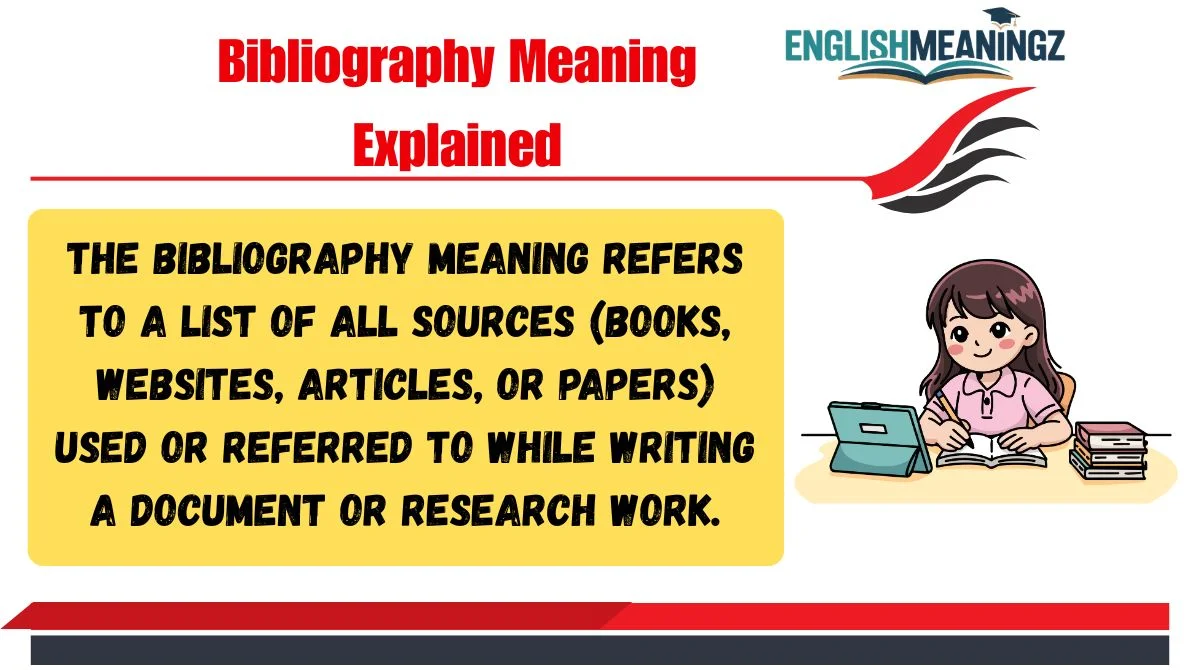
The bibliography meaning refers to a list of all sources (books, websites, articles, or papers) used or referred to while writing a document or research work. It usually appears at the end of an assignment, report, or book.
In simple terms:
A bibliography is a source list that shows where information came from.
Common interpretations include:
- A list of books used in research
- A list of all references in academic writing
- A record of reading materials used for study
- A source credit section in projects or reports
So whenever someone asks “what is bibliography meaning?”, they are basically asking how writers show proof of their research sources.
The Most Common Meanings of “bibliography meaning”
The phrase “bibliography meaning” can be understood in a few practical ways depending on context.
1. Academic Meaning
In schools and universities, bibliography means a list of all sources used in an assignment or thesis.
Example: Books, journals, websites used for research.
Used when:
- Writing essays
- Submitting research papers
- Preparing dissertations
2. Research Meaning
In research work, a bibliography shows the depth of study done by the author. It helps readers verify information and trust the content.
Used when:
- Scientific studies
- Academic journals
- Case studies
3. General Writing Meaning
In blogs, articles, or reports, bibliography may refer to sources that helped shape the content, even if not directly quoted.
Used when:
- Blogging
- Content writing
- Reports or documentation
4. Digital/Web Meaning
Online, bibliography often includes website links, online journals, and digital resources instead of just books.
Used when:
- SEO articles
- Online research
- Digital publishing
How “bibliography meaning” Is Used in Real Conversations
Friends & Casual Texting
Students often use it like:
- “Bro what’s bibliography meaning again?”
- “Need help with bibliography for assignment”
Here, it’s usually about homework stress or formatting confusion.
Instagram & Snapchat
On social media, you may see:
- Study pages explaining bibliography formats
- Notes shared in captions like “don’t forget bibliography”
It’s mostly used in an educational vibe, not casual slang.
Dating Apps
Rare, but sometimes appears when students talk about studies:
- “I’m stuck on bibliography lol”
It usually signals academic stress, not romantic intent.
Gaming & Online Communities
In gaming or Discord study servers:
- “Add bibliography or your project won’t pass”
Used in teamwork, school guilds, or study groups.
Work or Professional Chat
In professional environments:
- “Please include a proper bibliography in the report”
It is formal and required in documentation-heavy tasks.
Is “bibliography meaning” Rude, Flirty, or Offensive?
The phrase bibliography meaning is completely neutral. It is not rude, flirty, or offensive.
Tone analysis:
- Neutral academic term
- Used in education and research
- No emotional or slang meaning attached
When it feels positive:
- When helping students
- When used in learning context
- When explaining research
When it feels negative:
- Only when someone is stressed about assignments
- Or frustrated while formatting work
Psychologically, it triggers “academic pressure” more than emotion or attitude.
How to Respond When Someone Says “bibliography meaning”
Casual Replies
- “It’s just a list of your sources.”
- “Books and websites you used.”
Funny Replies
- “Basically your homework’s evidence list.”
- “Where your assignment proves it didn’t come from thin air.”
Neutral Replies
- “Bibliography means list of references used in writing.”
- “It shows where you got your information from.”
Professional Replies
- “A bibliography is a structured list of all sources cited or consulted in academic work.”
- “It provides credibility and traceability of research material.”
Common Misunderstandings About “bibliography meaning”
1. Confusing it with citations
Many think bibliography and citations are the same, but citations are in-text mentions, while bibliography is the full list at the end.
2. Thinking it includes only quoted sources
A bibliography may include all sources used, even if not directly quoted.
3. Believing it is optional
In academic work, it is often mandatory, not optional.
4. Mixing it with “reference list”
Some styles treat them differently, but many students assume they are identical.
Similar Slang Terms You Should Know
Even though “bibliography meaning” is academic, here are related terms you’ll often see:
- Citation – In-text source mention
- Reference list – Similar to bibliography, structured sources
- Plagiarism – Copying without credit
- Source list – General term for bibliography
- Footnotes – Notes at bottom of page
- Endnotes – Notes at end of document
- Quotation – Exact copied text with credit
- Paraphrasing – Rewriting in your own words
- APA style – Common citation format
- MLA style – Academic formatting style
- Harvard referencing – Popular citation system
- DOI – Digital source identifier
When You Should Avoid Using “bibliography meaning”
Professional settings
Don’t casually drop the phrase in business chats unless relevant.
Cross-cultural chats
Some people may not understand academic terms, so simplify instead.
Sensitive situations
Not useful in emotional or personal discussions.
Basically, use it only when talking about study, research, or writing.
Final Thoughts.
The bibliography meaning is simple once you break it down: it is just a list of sources used in writing or research. It helps show credibility, avoids plagiarism, and gives credit to original authors.
Even though it sounds academic and complicated at first, it’s actually just a “where I got my info from” list. Once you understand the difference between citations and bibliography, academic writing becomes much easier and less stressful.
If you’re a student or content creator, mastering this term helps you write smarter, avoid mistakes, and look more professional in your work.
FAQs
What is the simple meaning of bibliography?
A bibliography is a list of all sources like books, websites, and articles used in writing or research.
Is bibliography and reference the same?
Not always. A bibliography may include all sources used, while references include only cited ones.
Where is bibliography used?
It is used in essays, research papers, reports, books, and academic projects.
Why is bibliography important?
It gives credit to original authors and makes your work trustworthy and verifiable.
What comes in a bibliography?
Author name, title, publication date, publisher, and sometimes website links.
Do blogs need a bibliography?
Not always, but adding sources improves credibility and SEO trust.
What is the difference between citation and bibliography?
Citation appears inside the text, while bibliography appears at the end as a full list of sources.
Conclusion
The bibliography meaning is not just an academic requirement but a foundation of honest writing.
It connects your work to real sources and shows readers that your information is backed by research.
Whether you are writing an essay, report, or online article, understanding bibliography helps you stay accurate, professional, and credible in any field.