When people hear the phrase “1st degree murder,” they often think of crime shows, court cases, or news headlines. Yet many people are not completely sure what the term actually means.
Is it simply the most serious type of murder? Does it always involve planning? How is it different from other murder charges?
That confusion is exactly why so many people search for 1st degree murders meaning online. The phrase appears in legal discussions, news reports, social media debates, documentaries, and everyday conversations. However, understanding the term requires more than just knowing that it is a criminal charge.
In simple terms, first-degree murder is generally considered the most serious form of unlawful killing. It usually involves intent, planning, and deliberate actions before the crime takes place. Laws can vary by location, but the core idea remains similar.
This guide explains the meaning of first-degree murder in clear and easy language. You will learn what it means, how it differs from other murder charges, common misconceptions, related legal terms, and the situations where the phrase is often used.
What Does “1st Degree Murders Meaning” Mean in Text?
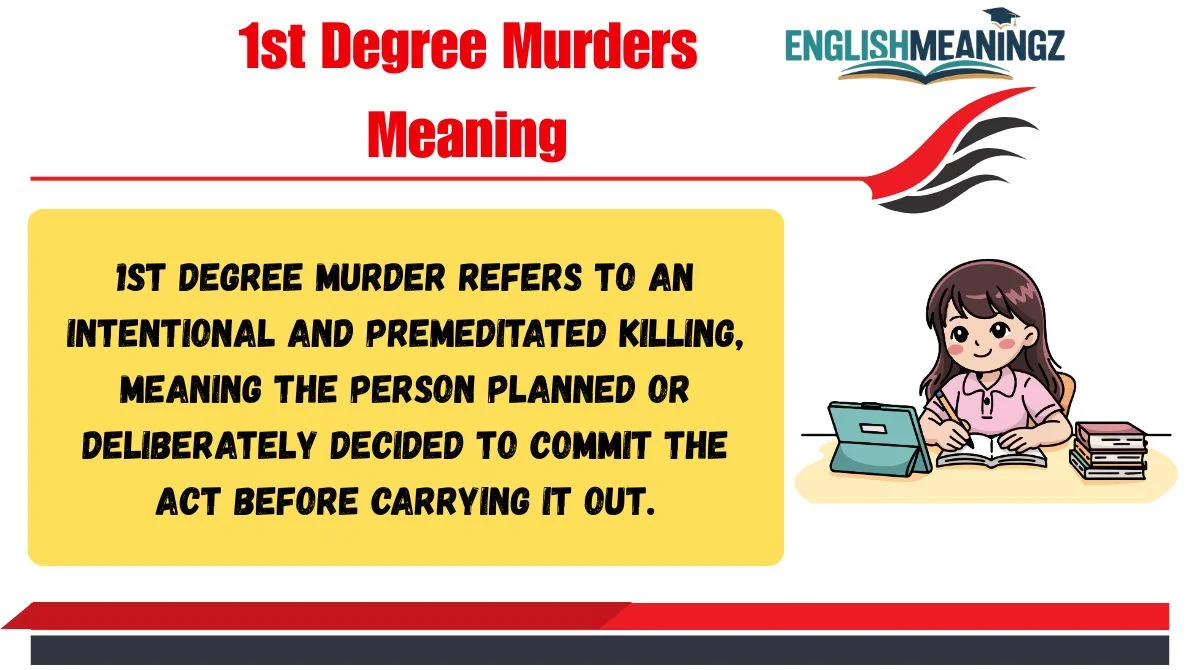
1st degree murder refers to an intentional and premeditated killing, meaning the person planned or deliberately decided to commit the act before carrying it out.
Common interpretations include:
- A planned murder
- An intentional killing
- The most serious murder charge in many legal systems
- A crime that often carries severe penalties
The exact legal definition may vary depending on the country or state, but the idea of planning and intent is usually central to the charge.
The Most Common Meanings of “1st Degree Murders Meaning”
Premeditated Killing
This is the most widely recognized meaning.
A person thinks about committing the act beforehand and then carries it out intentionally.
Example:
- Someone carefully plans an attack days before committing it.
Deliberate and Intentional Murder
The act is not accidental or spontaneous. The person knowingly intends to cause death.
Example:
- A person intentionally targets someone and acts with the purpose of killing them.
Highest-Level Murder Charge
In many legal systems, first-degree murder is treated as the most serious category of homicide.
Example:
- News reports often mention first-degree murder when discussing severe criminal cases.
Murder Involving Certain Aggravating Factors
Some jurisdictions classify specific circumstances as first-degree murder even when planning is not the primary factor.
Examples may include:
- Killing a law enforcement officer
- Murder during certain serious crimes
- Multiple victims in a single incident
The exact rules depend on local laws.
How “1st Degree Murders Meaning” Is Used in Real Conversations
Friends & Casual Texting
People may discuss true-crime stories, documentaries, or news events.
Examples:
- “The suspect was charged with first-degree murder.”
- “The case involved a planned killing.”
In casual conversations, the phrase usually refers to a serious and intentional crime.
Instagram & Snapchat
Users often comment on trending criminal cases or viral news stories.
Examples:
- “They upgraded the charge to first-degree murder.”
- “The court says it was premeditated.”
Social media discussions frequently focus on legal outcomes and evidence.
Dating Apps
The phrase is rarely used seriously on dating platforms.
Occasionally, people reference crime documentaries or true-crime interests.
Example:
- “I watch documentaries about first-degree murder cases.”
Any joking use should be handled carefully because the topic involves serious criminal behavior.
Gaming & Online Communities
The phrase may appear metaphorically or humorously.
Examples:
- “That combo was first-degree murder.”
- “You completely destroyed the competition.”
In these cases, users are not referring to actual crime. Instead, they use exaggeration for dramatic effect.
Work or Professional Chat
The term may appear in journalism, legal work, education, law enforcement, or academic discussions.
Examples:
- “The report covers several first-degree murder convictions.”
- “The court hearing is scheduled next week.”
Professional use focuses on factual and legal meanings.
Is “1st Degree Murders Meaning” Rude, Flirty, or Offensive?
The phrase itself is neither flirty nor inherently rude. However, it is connected to a serious criminal act involving the loss of human life.
When It Feels Neutral
The phrase is generally neutral when used in:
- Legal discussions
- Educational settings
- News reporting
- Academic research
Example:
- “The defendant faces a first-degree murder charge.”
When It Feels Negative
The term can feel disturbing or offensive when used casually around sensitive topics.
Example:
- Making jokes about real victims or tragedies.
When It Feels Inappropriate
Using the phrase for humor in serious situations may upset others.
Example:
- Joking about a recent criminal case involving real people.
Psychological Context
People often react strongly to the term because it represents intentional violence. Context matters greatly. A legal discussion feels very different from a joke or exaggerated comment online.
How to Respond When Someone Says “1st Degree Murder”
Your response depends on the situation and context.
Casual Replies
- “That sounds like a serious charge.”
- “Was it considered premeditated?”
- “What happened in the case?”
Funny Replies
Only appropriate when the phrase is clearly being used as harmless exaggeration.
- “That gaming move should be illegal.”
- “You absolutely destroyed the competition.”
Avoid joking when discussing real crimes.
Neutral Replies
- “I understand.”
- “That’s an important detail.”
- “Interesting case.”
Professional Replies
- “The charge indicates alleged premeditation.”
- “The legal definition may vary by jurisdiction.”
- “Additional evidence will likely be reviewed.”
These responses keep the discussion factual and respectful.
Common Misunderstandings About “1st Degree Murders Meaning”
Assuming All Murders Are First-Degree
Not every homicide qualifies as first-degree murder.
Different legal systems often separate crimes into categories based on intent, planning, and circumstances.
Thinking Planning Must Last for Months
Premeditation does not always require long-term planning.
In many jurisdictions, the decision can be formed in a relatively short period before the act occurs.
Confusing Murder With Manslaughter
Murder and manslaughter are different legal concepts.
Manslaughter often involves different levels of intent or circumstances.
Believing Every Country Uses the Same Definition
Laws differ around the world.
One country or state may define first-degree murder differently from another.
Assuming a Charge Equals Guilt
A criminal charge is an accusation.
Courts determine guilt through legal proceedings and evidence.
Confusing Movies With Real Law
Television dramas often simplify legal concepts.
Real criminal law is usually more complex than entertainment portrayals.
Similar Slang Terms You Should Know
While first-degree murder is a legal term rather than internet slang, several related terms frequently appear in discussions.
Homicide
The killing of one person by another.
Manslaughter
A less severe homicide charge in many legal systems.
Premeditation
Planning or thinking about an act before carrying it out.
Intent
The conscious purpose to perform an action.
Conviction
A legal finding that a person is guilty.
Acquittal
A court decision finding a defendant not guilty.
Defendant
The person accused of a crime.
Prosecutor
The lawyer representing the government in a criminal case.
Felony
A serious criminal offense.
Life Sentence
A prison sentence that can last for life, depending on the jurisdiction.
Capital Murder
A category of murder that may qualify for the most severe legal penalties in certain places.
Criminal Charge
A formal accusation that someone committed a crime.
When You Should Avoid Using “1st Degree Murder”
Professional Settings
Avoid casual jokes involving murder in workplaces.
Such comments can appear insensitive and unprofessional.
Cross-Cultural Chats
Different cultures may view discussions about violent crime differently.
What seems acceptable in one setting may feel offensive in another.
Sensitive Situations
Avoid using the term casually when discussing:
- Recent tragedies
- Victims of violence
- Ongoing criminal investigations
- Personal experiences with crime
Social Media Arguments
Using legal terms incorrectly can spread misinformation.
Make sure you understand the context before commenting.
Educational Discussions Without Context
If explaining the term, provide accurate information rather than assumptions or stereotypes.
Final Thoughts
The phrase 1st degree murders meaning refers to the most serious category of murder in many legal systems. It generally involves intentional and premeditated killing, meaning the act was planned or deliberately carried out rather than happening by accident.
Although the exact legal definition can vary depending on the jurisdiction, the core concepts of intent, deliberation, and seriousness remain consistent. Understanding these differences helps people interpret news reports, legal discussions, documentaries, and online conversations more accurately.
When discussing first-degree murder, context is important. Because the topic involves serious criminal conduct, it should be approached respectfully and factually.
FAQs
What is the simple meaning of first-degree murder?
First-degree murder generally means an intentional and premeditated killing that was planned before it happened.
Is first-degree murder the most serious murder charge?
In many legal systems, yes. It is often considered the highest level of murder offense.
Does first-degree murder always involve planning?
In most jurisdictions, premeditation is a key element, although specific legal rules can vary.
What is the difference between first-degree and second-degree murder?
First-degree murder usually involves planning and premeditation, while second-degree murder often involves intent without prior planning.
Can someone be charged with first-degree murder and later found not guilty?
Yes. A criminal charge is an accusation, and guilt must be proven in court.
Is first-degree murder the same everywhere?
No. Different countries and states may define the offense differently.
Why do people search for “1st degree murders meaning”?
People often encounter the term in news reports, court cases, documentaries, movies, and online discussions and want a clear explanation.
Conclusion
Understanding the 1st degree murders meaning is important because the term appears frequently in legal news, crime documentaries, social media discussions, and public conversations.
In most legal systems, it refers to an intentional and premeditated killing, making it one of the most serious criminal charges a person can face.
While laws vary by location, the concepts of planning, intent, and deliberate action are usually at the center of the definition.
By learning the correct meaning and avoiding common misunderstandings, readers can better understand legal reports and discuss the topic accurately and responsibly.