You may have seen the phrase “mens rea” in a TikTok comment, crime video, courtroom clip, Reddit thread, or even a text message and wondered what people actually mean by it. Some users throw it around during online arguments, while others use it seriously in legal discussions.
That confusion is exactly why so many people search for “mens rea meaning.”
The phrase sounds complex, but the basic idea is simple. In law, it relates to a person’s mindset when they do something wrong. Online, people sometimes use it jokingly, sarcastically, or to sound smart during debates. Depending on the situation, the meaning can shift slightly.
This guide breaks everything down in plain English. You’ll learn the real mens rea meaning, how people use it in texting and social media, whether it sounds rude or offensive, and how to reply when someone says it.
You’ll also see common misunderstandings and related slang terms people use online in 2026.
By the end, you’ll fully understand the term without needing a law degree.
What Does “Mens Rea Meaning” Mean in Text?
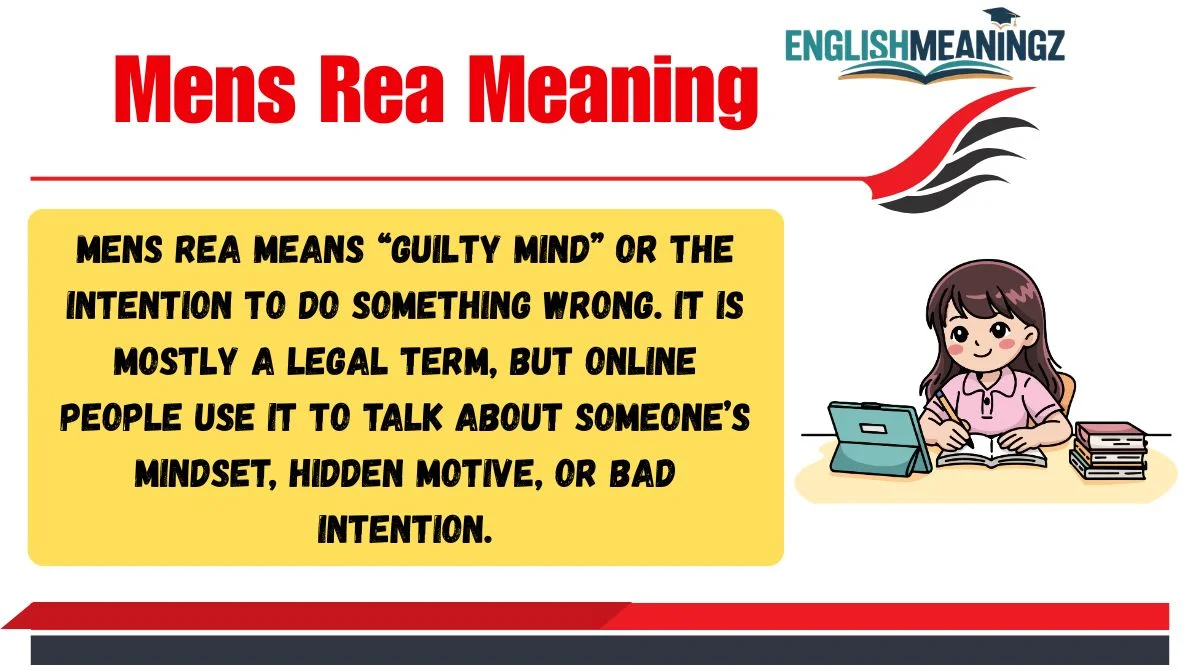
Mens rea means “guilty mind” or the intention to do something wrong. It is mostly a legal term, but online people use it to talk about someone’s mindset, hidden motive, or bad intention.
Common ways people use it include:
- Serious legal discussions
- Internet debates about intent
- Sarcastic jokes about bad decisions
- Meme culture involving crime or drama
The Most Common Meanings of “Mens Rea”
Legal Meaning
The original mens rea meaning comes from criminal law. It describes a person’s mental state when committing a crime.
In simple words, it asks:
“Did the person mean to do it?”
Courts often look at mens rea to decide how serious a crime is.
Example:
- “The prosecutor must prove mens rea.”
That means they must prove the person intended the act.
Online Debate Meaning
On social media, people use “mens rea” during arguments to discuss intention instead of action.
Example:
- “You’re ignoring the mens rea behind the comment.”
This means:
“You’re ignoring what the person actually meant.”
In these cases, users focus more on motive than words.
Sarcastic or Meme Usage
Gen Z users sometimes use legal words in funny ways online. “Mens rea” can appear in memes after someone makes a chaotic decision.
Example:
- “My mens rea was just boredom.”
This jokingly means:
“I had bad intentions because I was bored.”
It is often used ironically.
Smart-Sounding Internet Slang
Some people use “mens rea” just to sound intellectual during online discussions.
Example:
- “There was clear mens rea in that DM.”
This often appears in Reddit threads, Twitter debates, and true crime communities.
How “Mens Rea” Is Used in Real Conversations
Friends & Casual Texting
Friends may use the term jokingly after someone does something suspicious or chaotic.
Examples:
- “Bro definitely had mens rea.”
- “My mens rea was snacks at 2 AM.”
- “There was criminal intent behind that prank.”
Usually, the tone is playful.
Instagram & Snapchat
On Instagram and Snapchat, the phrase appears in captions, meme pages, and comment sections.
Examples:
- “The mens rea is obvious.”
- “POV: your mens rea gets exposed.”
- “Zero innocent intentions detected.”
People often use it dramatically for humor.
Dating Apps
Dating app users sometimes use “mens rea” while joking about flirting or manipulation.
Examples:
- “Your mens rea seems suspicious.”
- “That text had evil intent.”
- “I can sense criminal flirting.”
Here, it usually means:
“You clearly had a hidden motive.”
Gaming & Online Communities
Gaming communities use the phrase during arguments, trolling, or strategy discussions.
Examples:
- “There was mens rea behind that betrayal.”
- “He knew exactly what he was doing.”
- “Intentional sabotage confirmed.”
Gamers often use it sarcastically.
Work or Professional Chat
In professional settings, the term is rare unless discussing law, ethics, compliance, or investigations.
Example:
- “The issue was negligence, not mens rea.”
In office chats, it sounds formal and academic.
Is “Mens Rea” Rude, Flirty, or Offensive?
The phrase itself is not rude or offensive. However, the tone changes depending on context.
When It Feels Neutral
It sounds neutral when used in legal discussions or serious conversations.
Examples:
- Law school discussions
- Crime documentaries
- News analysis
- Courtroom debates
In these situations, it sounds professional.
When It Feels Funny
Online, the phrase often becomes humorous because it sounds dramatic.
Example:
- “My mens rea was wanting fries.”
This creates comedy by making a tiny action sound criminal.
When It Feels Negative
Sometimes the term can sound accusatory.
Example:
- “You clearly had mens rea.”
This may imply:
“You intentionally acted badly.”
In arguments, that can feel aggressive.
Can It Sound Flirty?
Rarely, yes.
Some users jokingly use crime-related language while flirting online.
Example:
- “Your mens rea is dangerously attractive.”
This is playful and sarcastic, not serious.
How to Respond When Someone Says “Mens Rea”
Casual Replies
These work with friends or online chats.
- “Caught me.”
- “You figured it out.”
- “I had my reasons.”
- “No comment.”
Funny Replies
Use these when the vibe is playful.
- “My lawyer advised silence.”
- “Allegedly.”
- “No criminal intent detected.”
- “I plead the fifth.”
Neutral Replies
These help keep the conversation calm.
- “That’s not what I meant.”
- “You misunderstood my intention.”
- “Fair point.”
- “I see why you think that.”
Professional Replies
Useful in serious discussions.
- “Intent matters in this case.”
- “The context should also be considered.”
- “There was no harmful intention.”
- “That interpretation may be inaccurate.”
Common Misunderstandings About “Mens Rea”
Thinking It Means “Crime”
A common mistake is assuming mens rea means the crime itself.
It does not.
The term refers to the person’s mental intention behind the act.
Assuming It Always Means Evil
Mens rea does not always mean someone is evil or malicious. Sometimes it simply means the person knowingly did something.
Legal systems separate accidents from intentional actions.
Confusing It With “Actus Reus”
People often mix up “mens rea” and “actus reus.”
Here’s the simple difference:
- Mens rea = guilty mind
- Actus reus = guilty action
One is the mindset.
The other is the act itself.
Misreading Online Tone
On social media, many people use the phrase jokingly. New users sometimes think the conversation is serious when it is actually sarcasm.
That misunderstanding can make replies awkward.
Thinking It Is Modern Slang
While internet users treat it like slang today, the term is actually very old legal language.
The online world simply gave it new meme energy.
Similar Slang Terms You Should Know
“Caught in 4K”
Means someone was clearly exposed doing something.
“Sus”
Short for suspicious.
“Villain Arc”
A joking way to describe someone acting differently or badly.
“Delulu”
Means delusional in a playful way.
“Gaslighting”
Manipulating someone into doubting reality.
“Plotting”
Secretly planning something.
“Red Flag”
Warning sign about behavior.
“Main Character Energy”
Acting overly dramatic or self-important.
“Chaos Mode”
Purposely creating drama or confusion.
“Down Bad”
Acting desperate, usually romantically.
“NPC Behavior”
Acting robotic or unoriginal.
“Brain Rot”
Internet slang for obsessive online behavior or content overload.
When You Should Avoid Using “Mens Rea”
Professional Settings
Avoid using the term casually at work unless the discussion is legal or academic.
Some coworkers may not understand it.
Cross-Cultural Conversations
Not everyone knows Latin legal terms. International audiences may feel confused.
Simple language is often better.
Sensitive Situations
Avoid joking about criminal intent during serious situations involving:
- Real crimes
- Trauma
- Legal investigations
- Workplace complaints
Humor can seem insensitive.
Heated Arguments
Using intellectual terms during fights may sound arrogant or passive-aggressive.
Instead of helping, it may escalate tension.
Academic Confusion
Some students misuse “mens rea” in essays or discussions because they learned it from memes instead of legal definitions.
Always use the correct meaning in school or professional writing.
Final Thoughts
The mens rea meaning is actually simple once you break it down. At its core, the phrase refers to intention or mindset, especially in legal situations. Online, though, people use it in funny, sarcastic, and meme-heavy ways to describe suspicious behavior, chaotic choices, or hidden motives.
Most of the time, the phrase is not offensive. It usually sounds smart, dramatic, or playful depending on the conversation. Still, context matters. A legal discussion, dating joke, and TikTok meme all use the term differently.
If someone says “mens rea” online, don’t panic. They are usually talking about intention, not accusing someone of an actual crime.
Understanding terms like this helps you read internet culture more clearly and communicate smarter in texts, comments, and online conversations.
FAQs
What does mens rea literally mean?
Mens rea literally means “guilty mind” in Latin.
Is mens rea a slang term?
Originally no. It is a legal term, but internet users now sometimes use it like slang.
Why do people say mens rea online?
People use it to joke about intention, hidden motives, suspicious behavior, or chaotic decisions.
Is mens rea offensive?
Usually not. The tone depends on context and delivery.
What is the difference between mens rea and actus reus?
Mens rea means guilty intention, while actus reus means the guilty action itself.
Can mens rea be used jokingly?
Yes. Meme culture often uses it sarcastically or dramatically.
Do you need mens rea for every crime?
Not always. Some crimes focus more on the act itself than the person’s intention.
At the provide me Conclusion paragraph.
The mens rea meaning has moved far beyond law books and courtrooms. In 2026, the phrase appears across TikTok, Reddit, Instagram, gaming chats, and texting culture.
While its original meaning is “guilty mind” or criminal intent, modern internet users often use it humorously to describe suspicious motives, chaotic behavior, or obvious intentions.
Knowing how the phrase works in different contexts helps you avoid misunderstandings and better understand online conversations.
Whether you see it in a legal debate or a meme comment section, you now know exactly what people mean when they say “mens rea.”