Why Is Everyone Searching for “Kendrick Lamar Not Like Us Meaning”?
If you’ve seen people quoting “Not Like Us” on TikTok, Instagram, X, YouTube, or in everyday conversations, you may be wondering what it actually means. Some people use it as a joke.
Others use it as a way to call someone fake, different, or outside a group. Because the phrase spread far beyond music fans, many people search for the Kendrick Lamar Not Like Us meaning to understand what everyone is talking about.
The song became one of the most discussed tracks in modern hip-hop. Its lyrics, cultural references, and direct message created huge conversations online. But while many people know the chorus, not everyone understands the deeper meaning behind it.
This guide explains the phrase in simple English. You’ll learn what it means, how people use it today, when it can sound funny or offensive, and how the expression has moved from a rap song into everyday internet slang.
What Does “Kendrick Lamar Not Like Us Meaning” Mean in Text?
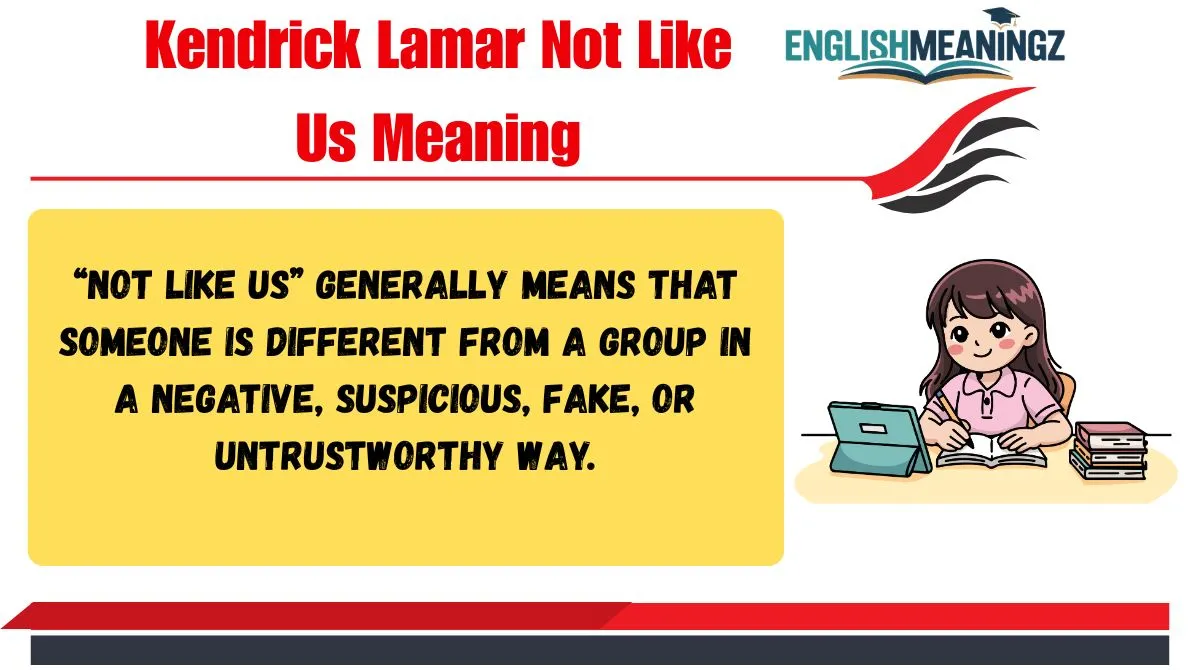
“Not Like Us” generally means that someone is different from a group in a negative, suspicious, fake, or untrustworthy way.
In online conversations, people commonly use the phrase to:
- Call out someone who seems fake
- Suggest a person doesn’t fit in
- Mock someone’s behavior
- Show loyalty to a specific group or community
- Separate “us” from “them”
The exact meaning depends heavily on context and tone.
The Most Common Meanings of “Kendrick Lamar Not Like Us Meaning”
Someone Doesn’t Belong in the Group
One of the most common interpretations is that a person is viewed as an outsider.
Example:
- “He keeps acting different. He’s not like us.”
This suggests the person doesn’t share the group’s values or behavior.
Someone Seems Fake
People often use the phrase when they think someone is pretending to be something they are not.
Example:
- “Everybody noticed the act. He’s not like us.”
The message is that the person lacks authenticity.
A Cultural or Community Statement
In many discussions, the phrase represents pride in a community, culture, or shared identity.
Example:
- “We support each other. They’re not like us.”
This creates a clear distinction between two groups.
A Joke or Meme
Many internet users now use the phrase humorously.
Example:
- “You put ketchup on pizza? You’re not like us.”
Here the phrase is playful rather than serious.
Calling Out Suspicious Behavior
Sometimes the phrase is used when someone’s actions seem questionable.
Example:
- “That explanation sounded strange. Not like us.”
In this case, it implies distrust.
How “Kendrick Lamar Not Like Us Meaning” Is Used in Real Conversations
Friends & Casual Texting
Among friends, the phrase is often used as a joke.
Examples:
- “You wake up at 5 a.m. for fun? Not like us.”
- “You finished the whole project in one night? Not like us.”
The goal is usually playful teasing.
Instagram & Snapchat
Social media users frequently use the phrase in captions, comments, and reaction posts.
Examples:
- “Bro ordered pineapple pizza again. Not like us.”
- “She’s actually productive every day. Not like us.”
These uses are often humorous and meme-driven.
Dating Apps
On dating apps, the phrase may highlight differences between people.
Examples:
- “Most people play games. You’re not like them.”
- “You actually reply on time. Not like us.”
Depending on context, it can be flirtatious or complimentary.
Gaming & Online Communities
Gaming groups often use the phrase when discussing team members or rival players.
Examples:
- “That teammate carried the entire match. Not like us.”
- “Those players have a completely different strategy.”
The expression can be playful or competitive.
Work or Professional Chat
This phrase is generally uncommon in professional settings.
Example:
- “Our department approaches things differently.”
In workplaces, direct use of “Not Like Us” may sound too informal or divisive.
Is “Kendrick Lamar Not Like Us Meaning” Rude, Flirty, or Offensive?
When It Feels Positive
The phrase can feel positive when used jokingly among friends.
Examples:
- Celebrating someone’s talent
- Friendly teasing
- Community pride
In these situations, people usually understand the humor.
When It Feels Negative
The phrase becomes negative when used to exclude or criticize someone.
Examples:
- Mocking a person
- Questioning someone’s authenticity
- Suggesting someone doesn’t belong
Tone matters more than the words themselves.
Can It Be Offensive?
Yes.
If used to isolate someone, attack a group, or question a person’s identity, it may be seen as offensive.
The listener’s relationship with the speaker often determines how the phrase is received.
Can It Be Flirty?
Sometimes.
A person may say:
- “You’re not like everyone else.”
This version often suggests uniqueness and can be interpreted as a compliment.
However, the original song-related usage is usually not romantic.
How to Respond When Someone Says “Not Like Us”
Casual Replies
- “I’ll take that as a compliment.”
- “Fair enough.”
- “That’s probably true.”
- “Maybe I’m different.”
Funny Replies
- “Built different.”
- “I prefer premium settings.”
- “That’s my special feature.”
- “Limited edition.”
Neutral Replies
- “What do you mean by that?”
- “Can you explain?”
- “Interesting perspective.”
- “How so?”
Professional Replies
- “Could you clarify your point?”
- “I see the difference you’re describing.”
- “Let’s focus on the issue itself.”
- “Can you provide more context?”
Common Misunderstandings About “Kendrick Lamar Not Like Us Meaning”
Thinking It Always Means a Compliment
Many people assume being different is automatically positive.
That’s not always true.
In many cases, the phrase is intended as criticism.
Thinking It Always Means an Insult
The opposite mistake also happens.
Friends frequently use it as a joke with no negative intent.
Ignoring Context
The same phrase can have completely different meanings depending on who says it and why.
Example:
- Friend joking = playful
- Rival saying it = insulting
Context changes everything.
Confusing It With General Uniqueness
“Not Like Us” doesn’t simply mean unique.
The phrase often carries a stronger message about belonging, authenticity, trust, or identity.
Missing the Cultural Reference
Many people hear the phrase without realizing it comes from a major hip-hop conversation.
Understanding the cultural context helps explain why the phrase became so powerful online.
Similar Slang Terms You Should Know
Built Different
Someone is unusual or exceptional.
Main Character Energy
A person acts like the star of the story.
NPC
Someone behaving in a predictable way.
Fake
A person who seems dishonest or inauthentic.
Real One
Someone considered genuine and trustworthy.
Cap
A lie or false statement.
No Cap
A way of saying you’re telling the truth.
Sus
Short for suspicious.
Cooked
Someone is in trouble or finished.
Mid
Average or unimpressive.
Clout Chaser
Someone seeking attention or popularity.
Pick Me
A person trying too hard for approval.
When You Should Avoid Using “Not Like Us”
Professional Settings
Business meetings, workplace chats, and client communications are usually not the best places for internet slang.
Professional language is often more effective.
Cross-Cultural Conversations
Not everyone understands modern American internet slang.
Using the phrase with international audiences may create confusion.
Sensitive Situations
Avoid using it when discussing:
- Personal identity
- Serious conflicts
- Workplace disputes
- Family disagreements
The phrase may sound exclusionary.
Conversations With Older Audiences
Some people may not know the cultural background behind the phrase.
This can lead to misunderstandings.
Formal Writing
Academic papers, reports, and professional documents generally require more precise language.
Final Thoughts
The Kendrick Lamar Not Like Us meaning goes beyond a simple song title. At its core, the phrase separates one group from another. Sometimes it is funny. Sometimes it is critical. Sometimes it is a statement about authenticity, belonging, or trust.
Because the phrase became a major internet meme, people now use it in many different ways. A joke between friends may sound completely different from a serious accusation online.
The key to understanding the phrase is context. Pay attention to who is saying it, who they are talking about, and the tone being used. Once you do that, the meaning becomes much clearer.
FAQs
What does Kendrick Lamar’s “Not Like Us” mean?
The phrase generally suggests that someone is different from a group, often in a negative, suspicious, or inauthentic way.
Why did “Not Like Us” become so popular?
The song gained huge attention online, leading millions of people to use the phrase in memes, captions, jokes, and discussions.
Is “Not Like Us” an insult?
It can be. The phrase often carries criticism, though friends sometimes use it jokingly.
Can “Not Like Us” be a compliment?
In certain situations, yes. It may suggest someone is unique or stands out from others.
What does “Not Like Us” mean on TikTok?
On TikTok, users commonly employ the phrase for jokes, reactions, memes, and playful comparisons.
Is “Not Like Us” internet slang now?
Yes. The phrase has expanded beyond music and is widely used across social media platforms.
Should I use “Not Like Us” at work?
Usually not. Professional environments generally benefit from clearer and more formal language.
Conclusion
Understanding the Kendrick Lamar Not Like Us meaning is easier once you look at the context behind the phrase. While it began as a powerful statement within a major hip-hop conversation, it has grown into a widely used internet expression.
Today, people use it to joke with friends, question authenticity, highlight differences, or make memes online.
The phrase can be funny, critical, playful, or even offensive depending on the situation. If you understand the tone, audience, and purpose behind it, you’ll be able to recognize exactly what someone means when they say, “Not Like Us.”