People often search for the term “feudalism meaning” after seeing it in a history book, social media post, political discussion, video game, or online debate. The word sounds complex, and many people are unsure whether it refers only to medieval history or if it can also describe situations in modern life.
In some conversations, people use “feudalism” literally when discussing history. In other cases, they use it as a comparison to describe unfair power structures, strict hierarchies, or systems where a small group controls resources while others depend on them.
Because the term appears in different contexts, confusion is common.
If you are searching for the exact feudalism meaning, this guide will explain it in simple language. You will learn the definition, common interpretations, real-life examples, how people use the word in conversations, and the situations where using it may create misunderstandings.
What Does “Feudalism Meaning” Mean in Text?
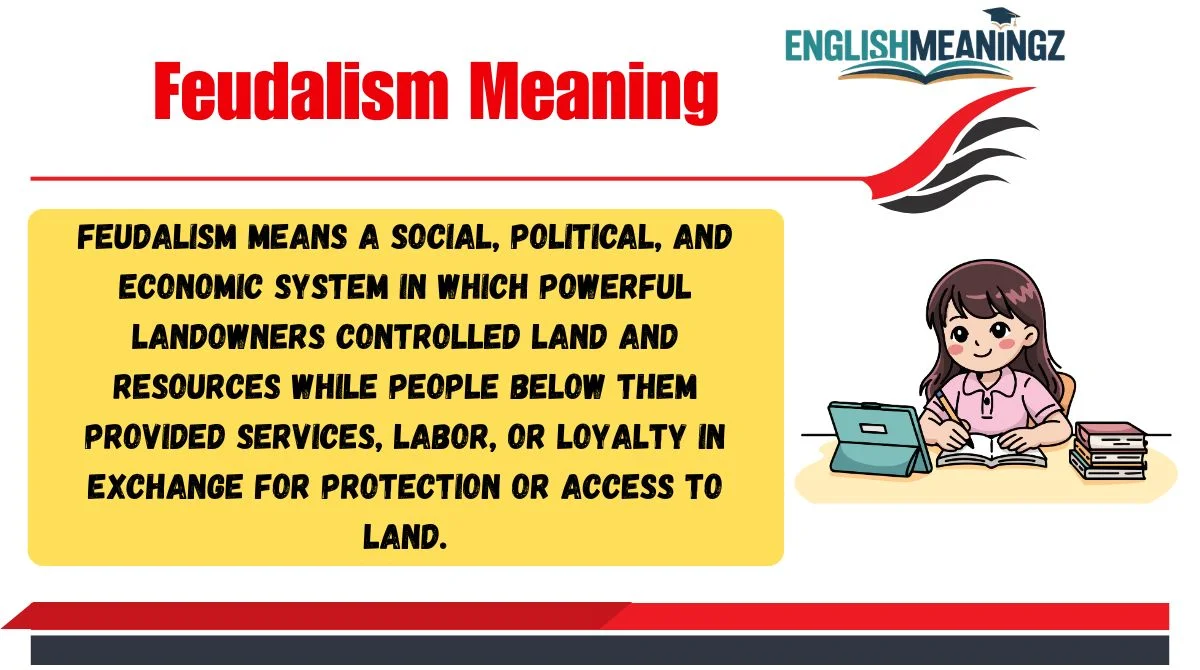
Feudalism means a social, political, and economic system in which powerful landowners controlled land and resources while people below them provided services, labor, or loyalty in exchange for protection or access to land.
In modern text conversations, the word may also refer to:
- A historical system from the Middle Ages
- A strict hierarchy where power is concentrated at the top
- An unfair workplace or organization
- A metaphor for unequal relationships or authority
The Most Common Meanings of “Feudalism”
1. Historical Meaning
This is the most common and traditional definition.
Feudalism was a system used in many parts of medieval Europe. Kings granted land to nobles, nobles managed that land, and peasants worked on it. In return, people received protection and access to resources.
Example:
“Today we learned about feudalism in history class.”
In this sentence, the word refers to the historical system.
2. A System of Unequal Power
People sometimes use feudalism to describe situations where a few individuals hold most of the power while others have limited control.
Example:
“The company feels like feudalism because only senior leaders make decisions.”
Here, the speaker is not talking about medieval history. They are comparing the organization to a highly unequal structure.
3. Political or Economic Criticism
Writers, journalists, and social media users may use the term when discussing wealth inequality, land ownership, or power concentration.
Example:
“Some critics say the housing market is creating a form of modern feudalism.”
The word is being used as a comparison rather than a literal description.
4. Gaming and Fantasy Context
Many strategy games, role-playing games, and fantasy stories include feudal societies.
Example:
“The kingdom in this game is based on feudalism.”
The term describes the political structure within the fictional world.
5. Internet Humor and Memes
Online users sometimes exaggerate situations by calling them “feudalism.”
Example:
“My landlord raised rent again. We’re back to feudalism.”
The statement is usually humorous or sarcastic.
How “Feudalism” Is Used in Real Conversations
Friends & Casual Texting
Among friends, feudalism is often used jokingly to describe unfair situations or strict authority.
Examples:
- “My older brother acts like a feudal lord.”
- “This group project is basically feudalism.”
- “The manager runs this place like feudalism.”
The speaker is usually making a comparison rather than discussing actual history.
Instagram & Snapchat
On social media platforms, users often use the term in discussions about politics, economics, housing, or workplace culture.
Examples:
- “Modern feudalism is becoming a real problem.”
- “This system benefits only a few people.”
- “Feels like feudalism with extra steps.”
Posts using the term often express frustration about inequality or power imbalances.
Dating Apps
The word appears less often in dating conversations but may be used humorously.
Examples:
- “I’m looking for a relationship, not feudalism.”
- “I don’t want one person making all the rules.”
In these cases, the term suggests an unhealthy power imbalance.
Gaming & Online Communities
Gamers frequently encounter feudalism in strategy games, historical games, and fantasy settings.
Examples:
- “The game uses a feudal system.”
- “Your kingdom is based on feudalism.”
- “The nobles control most of the land.”
Here, the word is usually used in its traditional historical sense.
Work or Professional Chat
In workplace discussions, feudalism may appear as criticism of management structures.
Examples:
- “The company has a feudal hierarchy.”
- “Decision-making is too centralized.”
- “Departments operate like separate kingdoms.”
Professional conversations often use the term metaphorically rather than literally.
Is “Feudalism” Rude, Flirty, or Offensive?
The answer depends on context.
Is It Rude?
Not usually.
Feudalism is generally an academic or descriptive term. However, it can sound critical when used to describe a person, company, government, or organization.
Example:
“This office runs on feudalism.”
Some people may view that statement as criticism.
Is It Flirty?
No.
The term has no natural romantic or flirtatious meaning.
If someone uses it during a dating conversation, they are usually discussing power dynamics rather than flirting.
Is It Offensive?
Normally, no.
However, people may become defensive if the term is used to criticize their beliefs, workplace, leadership style, or organization.
Positive vs Negative Usage
Positive Contexts
- Educational discussions
- Historical analysis
- Academic research
- Gaming conversations
Negative Contexts
- Political criticism
- Workplace complaints
- Discussions about inequality
- Social media arguments
The emotional tone usually comes from the speaker’s intention rather than the word itself.
How to Respond When Someone Says “Feudalism”
Casual Replies
- “What makes you say that?”
- “That sounds pretty extreme.”
- “Can you explain what you mean?”
Funny Replies
- “Do I at least get a castle?”
- “Where’s my horse and armor?”
- “Should I start calling you my lord?”
Neutral Replies
- “Interesting comparison.”
- “I understand your point.”
- “That’s one way to describe it.”
Professional Replies
- “Could you clarify your concern?”
- “What specific issues are you referring to?”
- “Can you provide examples of the hierarchy you mentioned?”
Professional responses help keep the discussion focused and respectful.
Common Misunderstandings About “Feudalism”
Assuming It Only Refers to History
Many people think feudalism can only describe medieval Europe.
In reality, the word is often used metaphorically in modern discussions.
Thinking It Means Slavery
Feudalism and slavery are different systems.
While both involve unequal power relationships, they are not the same thing and should not be treated as interchangeable terms.
Assuming Every Hierarchy Is Feudalism
Not every structured organization is feudal.
Schools, businesses, and governments often have leadership systems without fitting the definition of feudalism.
Confusing It with Capitalism
Some people use the terms interchangeably, but they represent different economic and social concepts.
A person may compare certain modern conditions to feudalism, but that does not mean the systems are identical.
Misreading the Tone
Someone may use the word seriously, academically, sarcastically, or humorously.
Understanding the surrounding conversation is important before responding.
Similar Slang Terms You Should Know
Although feudalism is not traditional internet slang, these related terms often appear in similar discussions:
- Hierarchy – A system with different levels of authority.
- Power structure – The way power is organized within a group.
- Elite – A small group with significant influence or resources.
- Gatekeeping – Controlling access to opportunities or information.
- Authority – The right to make decisions or enforce rules.
- Oligarchy – Rule by a small, powerful group.
- Monarchy – Government led by a king or queen.
- Bureaucracy – A system governed by rules and administrative procedures.
- Class system – Social divisions based on status or wealth.
- Nepotism – Favoring relatives in jobs or opportunities.
- Landlordism – Economic control through property ownership.
- Power imbalance – A relationship where one side holds significantly more control.
These terms frequently appear alongside discussions of feudalism.
When You Should Avoid Using “Feudalism”
Professional Settings
Using the word carelessly in meetings or workplace discussions may sound overly dramatic.
Instead of saying:
“This company is feudalism.”
Consider:
“This organization has a highly centralized decision-making structure.”
Cross-Cultural Chats
Not everyone understands the historical meaning of feudalism.
People from different educational backgrounds may interpret the term differently.
Sensitive Situations
Discussions involving politics, economics, social inequality, or government policies can become emotional.
Using feudalism as a label may escalate disagreement rather than encourage understanding.
Academic Discussions Without Accuracy
The word has a specific historical meaning.
Using it incorrectly can create confusion and weaken your argument.
Social Media Debates
Online conversations often simplify complex topics.
Calling something “feudalism” without explanation may lead to misunderstandings or unnecessary arguments.
Final Thoughts
The feudalism meaning is simpler than many people think. At its core, feudalism refers to a system in which power, land, and resources are controlled by higher-ranking individuals while others provide labor, service, or loyalty in return.
Today, the word appears far beyond history books. People use it in political discussions, workplace conversations, gaming communities, social media posts, and everyday jokes. Sometimes it describes a real historical system. Other times it serves as a metaphor for unequal power structures.
The key to understanding the term is context. When you know why a person is using the word, its intended meaning usually becomes much clearer.
FAQs
What is the simple meaning of feudalism?
Feudalism is a system where powerful landowners control land and resources while others provide labor or service in exchange for protection or access to land.
Is feudalism still used today?
Traditional feudalism largely disappeared centuries ago, but people sometimes use the term to describe modern power imbalances.
Why do people compare modern society to feudalism?
Some people believe certain systems concentrate power and wealth among a small group, which reminds them of historical feudal structures.
Is feudalism a political system or an economic system?
It is generally considered a social, political, and economic system because it influenced all three areas.
Can feudalism be used as slang?
Yes. Online users sometimes use the word humorously or metaphorically to describe unfair hierarchies or authority structures.
Is feudalism always negative?
In modern conversations, it is often used negatively. In academic history discussions, it is usually a neutral descriptive term.
What is the difference between feudalism and monarchy?
A monarchy is rule by a king or queen, while feudalism is a broader system involving land ownership, obligations, and hierarchical relationships.
Conclusion
Understanding the feudalism meaning helps you recognize both its historical importance and its modern usage. Traditionally, it described a system built around land ownership, loyalty, and social hierarchy.
Today, people often use the term as a comparison for situations involving unequal power, strict control, or concentrated authority.
Whether you encounter it in a classroom, online debate, workplace discussion, or social media post, paying attention to context will help you understand exactly what the speaker means and respond more effectively.