Divestment is one of those words that people often see in news articles, business reports, school discussions, and social media debates but still find confusing. You might read that a company is planning a divestment, a university is considering divestment, or investors are calling for divestment from a certain industry. Then you wonder: what does that actually mean?
That confusion is exactly why so many people search for the term online. The word sounds formal, but the idea behind it is much simpler than most people think.
In everyday language, divestment usually means getting rid of something valuable that you own. In business, it often means selling assets, investments, or parts of a company.
In social and political discussions, it can mean withdrawing money from organizations or industries that people no longer want to support.
This guide explains the divestment meaning in plain English. You will learn the most common definitions, how the term is used in different situations, examples from real life, common misunderstandings, and related terms that are useful to know.
What Does “Divestment Meaning” Mean in Text?
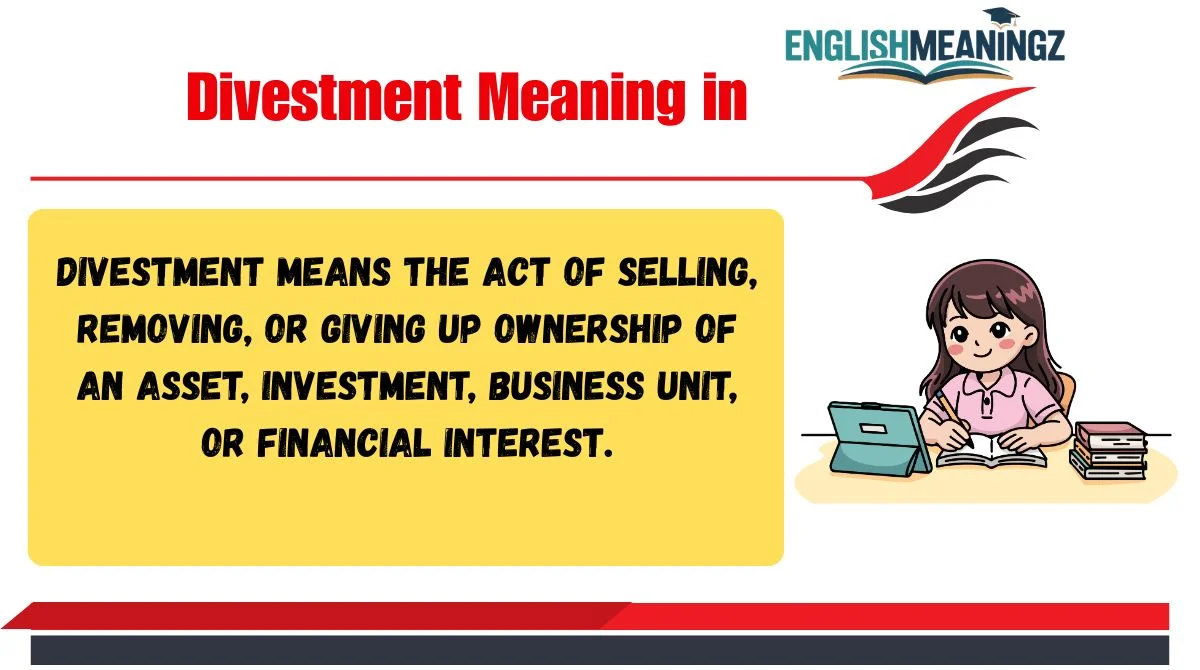
Divestment means the act of selling, removing, or giving up ownership of an asset, investment, business unit, or financial interest. It is commonly used in business, finance, investing, education, and social activism.
Common interpretations include:
- Selling investments or stocks
- Selling part of a company
- Removing financial support from an industry
- Giving up ownership of assets
The exact meaning depends on the context in which the word is used.
The Most Common Meanings of “Divestment Meaning”
Selling Investments
This is the most common meaning.
An investor may choose to sell stocks, bonds, or other assets they own.
Example:
“Many investors announced divestment from the company after the controversy.”
In this case, divestment means selling their investment and ending ownership.
Selling Part of a Business
Companies sometimes sell a division, branch, or product line that no longer fits their goals.
Example:
“The corporation completed the divestment of its retail division.”
Here, the company sold one part of its business.
Ethical or Social Divestment
Organizations may stop investing in industries they believe conflict with their values.
Example:
“The university approved divestment from fossil fuel companies.”
This means the institution removed investments from those businesses.
Government or Public Sector Divestment
Governments may sell ownership in state-controlled companies.
Example:
“The government announced divestment of its stake in the airline.”
This means public ownership was reduced through a sale.
Strategic Financial Restructuring
Businesses sometimes divest assets to improve focus and profitability.
Example:
“The company used divestment to focus on its core products.”
The goal is often better efficiency and growth.
How “Divestment Meaning” Is Used in Real Conversations
Friends & Casual Texting
The word is not common in casual texting, but people may use it when discussing money, business, or news.
Example:
“I heard they’re planning divestment from that project.”
Meaning:
“They’re getting rid of their investment in it.”
Instagram & Snapchat
On social media, divestment often appears in discussions about social issues, environmental concerns, and investing.
Example:
“Support divestment from harmful industries.”
The message encourages people or organizations to remove financial support.
Dating Apps
Divestment rarely appears on dating apps, but it may be used jokingly or metaphorically.
Example:
“I’m practicing emotional divestment from bad relationships.”
Here, the word is being used creatively to describe letting go emotionally.
Gaming & Online Communities
Gamers sometimes use the term when discussing virtual economies or gaming companies.
Example:
“The studio announced divestment of several game properties.”
This means they sold ownership rights or business assets.
Work or Professional Chat
This is one of the most common places where the term appears.
Example:
“We’re reviewing divestment opportunities next quarter.”
Meaning:
The company is considering assets or divisions it may sell.
Is “Divestment” Rude, Flirty, or Offensive?
Divestment is generally none of these things.
It is a neutral and professional term.
Positive Contexts
The word can feel positive when it is associated with:
- Better business decisions
- Ethical investing
- Financial improvement
- Strategic growth
Example:
“The divestment helped the company become more profitable.”
Negative Contexts
Some people view divestment negatively when it leads to:
- Job losses
- Reduced services
- Financial uncertainty
Example:
“The divestment resulted in major organizational changes.”
Emotional Reactions
The word itself is neutral, but opinions about the action can vary greatly depending on who is affected.
An investor may see divestment as smart.
An employee may see it as worrying.
A social activist may see it as necessary.
The emotional tone comes from the situation, not the word.
How to Respond When Someone Says “Divestment”
Casual Replies
- “Why are they selling it?”
- “That sounds like a big move.”
- “What assets are they giving up?”
- “Interesting. What’s the reason?”
Funny Replies
- “Looks like somebody is cleaning house.”
- “That’s one expensive yard sale.”
- “Guess they’re traveling light now.”
- “Time to declutter the balance sheet.”
Neutral Replies
- “I understand.”
- “Thanks for explaining.”
- “That makes sense.”
- “I’ll read more about it.”
Professional Replies
- “What strategic objective does the divestment support?”
- “How will this affect future operations?”
- “Has the transaction been finalized?”
- “What impact is expected on revenue?”
Common Misunderstandings About “Divestment”
Thinking It Means Bankruptcy
Many people assume divestment means a company is failing.
That is not always true.
Successful companies often divest assets to become stronger and more focused.
Assuming It Is Always Political
Divestment is often discussed in political and social campaigns, but the word itself is not political.
Businesses use divestment for purely financial reasons every day.
Confusing It With Downsizing
Downsizing usually refers to reducing staff or operations.
Divestment specifically refers to selling or removing ownership of assets or investments.
Believing It Means Complete Closure
A company can divest one division while continuing to operate successfully.
Selling one part does not mean the entire business is shutting down.
Assuming Divestment Is Always Negative
Some divestments increase profits, improve efficiency, and strengthen organizations.
The outcome depends on the situation.
Confusing Divestment With Investment
These words are opposites.
Investment: Putting money into something.
Divestment: Taking money out or ending ownership.
Similar Slang Terms You Should Know
Although divestment is not slang, these related terms often appear in the same discussions.
Investment
Putting money into an asset with the hope of earning a return.
Asset Sale
Selling a valuable business asset.
Liquidation
Converting assets into cash.
Portfolio Management
Managing a collection of investments.
Restructuring
Changing a company’s organization or operations.
Acquisition
Buying another company or asset.
Merger
Combining two companies into one.
Spin-Off
Creating a separate company from an existing business unit.
Exit Strategy
A planned way to leave an investment.
Stake Sale
Selling ownership shares in a business.
Capital Reallocation
Moving money from one investment to another.
Disinvestment
A term often used as a synonym for divestment.
When You Should Avoid Using “Divestment”
Professional Settings With Non-Experts
Some audiences may not understand the term.
Instead of saying:
“We are considering divestment.”
You could say:
“We are considering selling these assets.”
The message becomes clearer.
Cross-Cultural Chats
Business terminology may not translate well across different languages and cultures.
Using simpler language can reduce confusion.
Sensitive Situations
If employees or community members are affected by a sale, overly technical language may sound cold or detached.
Clear and direct communication is often better.
Educational Discussions With Beginners
Students who are new to finance may understand explanations more easily when plain language is used first.
Customer Communication
Customers usually care about outcomes rather than technical business terms.
Simple explanations work best.
Final Thoughts
Divestment is a straightforward concept once you break it down. At its core, the word means selling, removing, or giving up ownership of something valuable. In business, it often involves selling assets, investments, or company divisions. In social and ethical discussions, it can mean withdrawing financial support from industries or organizations.
The reason the term appears so often in news headlines and financial discussions is that divestment can have major effects on companies, investors, governments, and communities. Yet the basic idea remains simple: someone decides they no longer want to own or support a particular asset or investment.
Understanding the context is the key to understanding the meaning. Once you know who is divesting and what is being sold or removed, the term becomes much easier to follow.
FAQs
What is the simple meaning of divestment?
Divestment means selling, giving up, or removing ownership of an asset, investment, or business interest.
Is divestment the opposite of investment?
Yes. Investment means buying or putting money into something, while divestment means selling it or withdrawing ownership.
Why do companies use divestment?
Companies use divestment to improve focus, raise cash, reduce risk, or concentrate on their most important operations.
Is divestment good or bad?
It depends on the situation. Divestment can improve business performance, but it may also create challenges for employees or stakeholders.
What is ethical divestment?
Ethical divestment occurs when people or organizations remove investments from industries or companies that conflict with their values.
Does divestment mean a company is failing?
No. Many successful companies divest assets as part of long-term growth and strategic planning.
What is the difference between divestment and liquidation?
Divestment usually involves selling specific assets or investments. Liquidation often means selling assets to close a business or pay debts.
Conclusion
The divestment meaning is simply the act of selling, removing, or giving up ownership of an investment, asset, or business interest.
Whether it appears in financial news, corporate strategy discussions, government policy, or ethical investment campaigns, the core idea stays the same.
Understanding this term helps you follow business trends, investment decisions, and public debates with greater confidence.
The next time you see the word divestment, you’ll know exactly what it means, why it is happening, and how it can affect the people and organizations involved.