Words shape perception. The difference between dull writing and compelling communication often lies in vocabulary precision—especially when expressing emotions.
Understanding antonyms is not just about knowing “opposites”; it’s about controlling tone, clarity, and impact.
When you replace a negative emotional word with its opposite, you shift the entire mood of a sentence. This is essential in academic writing, professional emails, storytelling, and even everyday conversation.
A single well-chosen antonym can make your message sound confident, optimistic, and engaging instead of cold or withdrawn.
In academic and professional communication, emotional nuance matters. Whether you are writing essays, reports, or content for SEO, using the right antonym enhances readability, improves audience connection, and signals linguistic mastery.
This guide will help you fully understand the word sullen and provide 25 carefully selected antonyms you can use effectively.
What Does “Sullen” Mean?
Definition:
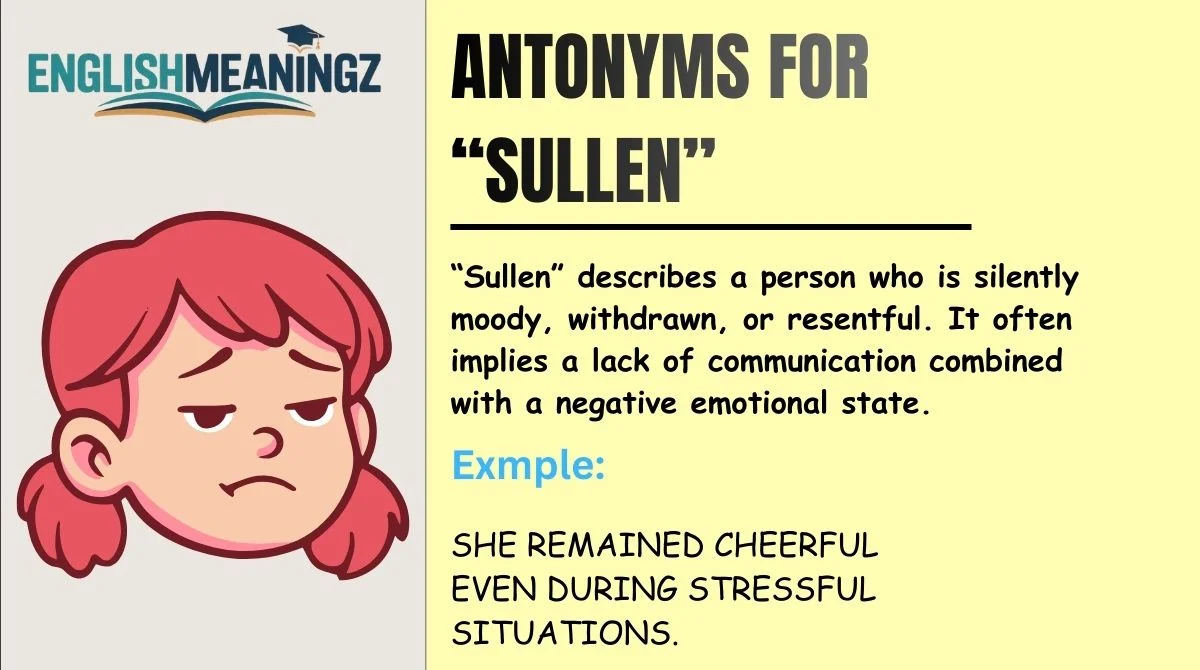
“Sullen” describes a person who is silently moody, withdrawn, or resentful. It often implies a lack of communication combined with a negative emotional state.
Tone Explanation:
The tone of “sullen” is negative and emotionally closed-off. It suggests quiet displeasure rather than loud anger.
Emotional Intensity:
Sullen sits in the middle of the emotional intensity scale:
- Not as aggressive as “furious”
- Stronger than “sad”
It reflects internalized negativity—a person who is unhappy but not expressing it openly.
25 Best Antonyms for “Sullen”
Cheerful
Meaning: Full of happiness and positive energy
Tone: Emotional
Example: She remained cheerful even during stressful situations.
Why Opposite: Cheerfulness expresses visible positivity, the direct contrast of silent negativity.
Joyful
Meaning: Experiencing great pleasure and delight
Tone: Emotional
Example: The children were joyful at the festival.
Why Opposite: Joy replaces the gloom associated with sullen behavior.
Lively
Meaning: Energetic and full of life
Tone: Informal
Example: He brought a lively spirit to the meeting.
Why Opposite: Liveliness contrasts with the dull, withdrawn nature of sullen.
Friendly
Meaning: Kind and pleasant toward others
Tone: Neutral
Example: The receptionist was friendly and welcoming.
Why Opposite: Sullen people avoid interaction; friendly people seek it.
Outgoing
Meaning: Social and open in communication
Tone: Informal
Example: She is outgoing and enjoys meeting new people.
Why Opposite: Outgoing behavior replaces emotional withdrawal.
Optimistic
Meaning: Hopeful about the future
Tone: Academic
Example: He remained optimistic despite setbacks.
Why Opposite: Optimism reflects positivity rather than silent resentment.
Bright
Meaning: Happy and full of light energy
Tone: Informal
Example: Her bright smile changed the atmosphere.
Why Opposite: Brightness symbolizes emotional openness.
Animated
Meaning: Full of expression and movement
Tone: Informal
Example: He became animated while telling the story.
Why Opposite: Animation replaces emotional stillness.
Enthusiastic
Meaning: Showing eager interest
Tone: Formal
Example: She was enthusiastic about the new project.
Why Opposite: Enthusiasm contradicts emotional dullness.
Warm
Meaning: Kind and affectionate
Tone: Emotional
Example: They gave him a warm welcome.
Why Opposite: Warmth replaces emotional coldness.
Pleasant
Meaning: Agreeable and enjoyable
Tone: Neutral
Example: It was a pleasant conversation.
Why Opposite: Pleasantness eliminates negativity.
Radiant
Meaning: Glowing with happiness
Tone: Emotional
Example: She looked radiant on her wedding day.
Why Opposite: Radiance contrasts with dull emotional expression.
Sociable
Meaning: Enjoying interaction with others
Tone: Neutral
Example: He is naturally sociable at events.
Why Opposite: Sociability replaces isolation.
Happy
Meaning: Feeling or showing pleasure
Tone: Emotional
Example: She felt happy after achieving her goal.
Why Opposite: Happiness directly counters gloom.
Playful
Meaning: Light-hearted and fun
Tone: Informal
Example: The puppy was playful all day.
Why Opposite: Playfulness removes seriousness and moodiness.
Carefree
Meaning: Free from worries
Tone: Emotional
Example: They spent a carefree afternoon at the beach.
Why Opposite: Carefree eliminates the heaviness of sullen emotions.
Expressive
Meaning: Open in showing feelings
Tone: Academic
Example: He is expressive about his ideas.
Why Opposite: Expression replaces silent withdrawal.
Jolly
Meaning: Full of good humor
Tone: Informal
Example: The host was jolly and entertaining.
Why Opposite: Jolliness opposes seriousness and gloom.
Upbeat
Meaning: Positive and optimistic
Tone: Informal
Example: She maintained an upbeat attitude.
Why Opposite: Upbeat tone replaces negativity.
Energetic
Meaning: Active and lively
Tone: Neutral
Example: The team was energetic during practice.
Why Opposite: Energy contrasts with emotional stillness.
Engaging
Meaning: Attractive and interesting
Tone: Formal
Example: The speaker was engaging and confident.
Why Opposite: Engagement replaces detachment.
Lighthearted
Meaning: Cheerfully relaxed
Tone: Emotional
Example: He made a lighthearted joke.
Why Opposite: Lightness opposes emotional heaviness.
Smiling
Meaning: Showing happiness through expression
Tone: Neutral
Example: She greeted everyone with a smiling face.
Why Opposite: A smile contradicts sullen silence.
Vivacious
Meaning: Attractively lively
Tone: Formal
Example: Her vivacious personality impressed everyone.
Why Opposite: Vivacity replaces dullness.
Content
Meaning: Peacefully satisfied
Tone: Academic
Example: He felt content with his progress.
Why Opposite: Contentment removes inner resentment.
Strong vs Mild Opposites
Not all antonyms carry equal intensity. Understanding this helps you choose the most precise word.
Mild Opposites:
- Pleasant
- Content
- Calm
These suggest a neutral emotional shift rather than strong positivity.
Moderate Opposites:
- Friendly
- Sociable
- Warm
These indicate active emotional openness.
Strong Opposites:
- Joyful
- Radiant
- Enthusiastic
These convey powerful emotional contrast to sullen.
Tip:
Use mild antonyms in academic writing and strong ones in storytelling or persuasive content.
Context-Based Opposites
Antonyms depend heavily on context.
Social Context:
- Sullen → Outgoing
- Sullen → Sociable
Emotional Context:
- Sullen → Joyful
- Sullen → Cheerful
Professional Context:
- Sullen → Engaging
- Sullen → Enthusiastic
Behavioral Context:
- Sullen → Animated
- Sullen → Expressive
Choosing the right antonym depends on what aspect of “sullen” you want to reverse—emotion, behavior, or communication.
Common Mistakes When Using Opposites
1. Using weak contrasts
Incorrect: He was sullen, but later calm.
Better: He was sullen, but later cheerful.
2. Ignoring tone mismatch
Incorrect: The academic paper used “jolly.”
Better: Use “optimistic” or “positive.”
3. Overusing basic words
Incorrect: Always using “happy”
Better: Rotate with “radiant,” “upbeat,” “joyful”
4. Context confusion
Incorrect: A sullen meeting became playful (may not fit formal context)
Better: A sullen meeting became productive or engaging
5. Misjudging intensity
Incorrect: Replacing sullen with “content” in emotional writing
Better: Use “joyful” or “lively”
Sentence Transformation Examples
1. Original: He sat in a sullen silence.
Rewritten: He sat in a cheerful and relaxed mood.
2. Original: The team appeared sullen after the loss.
Rewritten: The team remained upbeat despite the loss.
3. Original: She gave a sullen response.
Rewritten: She gave a warm and friendly response.
4. Original: His sullen attitude affected others.
Rewritten: His enthusiastic attitude inspired others.
5. Original: The room felt sullen and tense.
Rewritten: The room felt lively and welcoming.
FAQs
What is the simplest antonym for “sullen”?
The simplest antonym is happy, as it directly contrasts negative mood with positive emotion.
Is “cheerful” a stronger antonym than “pleasant”?
Yes, cheerful expresses stronger emotional positivity than pleasant.
Can “calm” be an antonym of sullen?
Not always. Calm lacks negativity but does not imply positivity, so it is a weak antonym.
Which antonym is best for professional writing?
Optimistic, engaging, and positive work best in formal contexts.
Are all antonyms emotional?
No. Some focus on behavior (outgoing, expressive) rather than feelings.
Can “friendly” replace “sullen” in all cases?
No. It works best in social contexts, not internal emotional descriptions.
How do I choose the right antonym?
Identify whether the context is emotional, social, or professional, then match intensity and tone accordingly.
Conclusion
Mastering antonyms like those for “sullen” is more than a vocabulary exercise—it’s a communication upgrade.
By choosing precise opposites, you control tone, influence perception, and elevate your writing quality across academic, professional, and creative contexts.
Whether you want to sound more engaging, persuasive, or expressive, these 25 antonyms give you the tools to transform dull or negative expressions into vivid, impactful language.
The key is not just knowing these words, but applying them with awareness of tone, intensity, and context.