Strong vocabulary is one of the most important elements of effective writing.
Whether someone is preparing for academic exams, writing professional reports, or creating blog content, word variety significantly improves clarity and impact.
When writers rely on the same word repeatedly, their text begins to feel repetitive and less engaging. Using appropriate synonyms allows writers to express the same idea with subtle differences in tone and meaning.
Students preparing for exams such as IELTS, TOEFL, or university assessments often receive higher writing scores when they demonstrate lexical diversity.
Bloggers and content creators also benefit from varied vocabulary because search engines reward well-structured, natural language writing.
Professionals in academic, business, and research environments use synonyms strategically to maintain precision while avoiding redundancy.
One word that frequently appears in descriptive writing is cacophony. It is commonly used when describing unpleasant or chaotic sounds.
However, there are many alternative words that convey similar meanings in different contexts.
This guide explains the meaning of cacophony and presents 13 carefully explained synonyms, organized by usage context.
Each synonym includes a definition, explanation, and example sentence so readers can understand exactly when and how to use it correctly.
Definition and Core Meaning of “Cacophony”

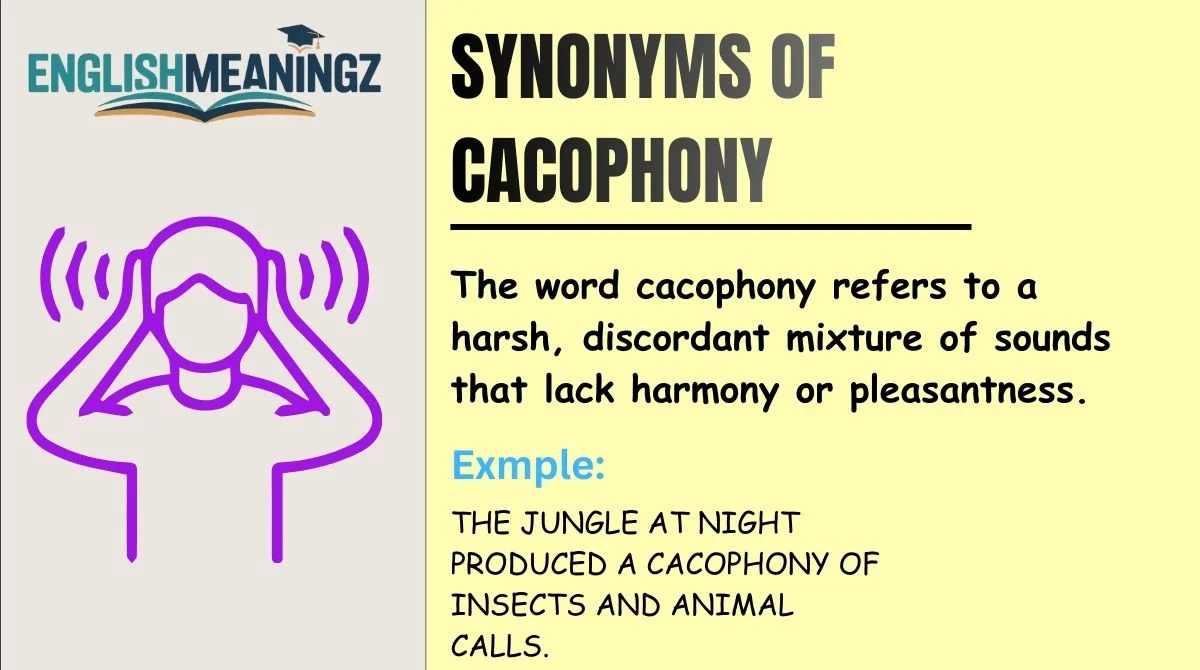
The word cacophony refers to a harsh, discordant mixture of sounds that lack harmony or pleasantness. It is commonly used when describing environments filled with chaotic noise.
The term originates from Greek roots:
- kakos – meaning bad or unpleasant
- phone – meaning sound or voice
When combined, the word literally means “bad sound.”
In everyday language, cacophony often describes situations where multiple sounds occur simultaneously in a disorganized and unpleasant way. These sounds might come from traffic, machinery, crowds, or animals.
Examples of Cacophony in Context
- The city street erupted into a cacophony of car horns, engines, and shouting pedestrians.
- Inside the factory, the cacophony of metal machines made conversation impossible.
- The jungle at night produced a cacophony of insects and animal calls.
In literature, authors frequently use the word to create vivid sensory descriptions. In academic writing, it can also be used metaphorically to describe confusion or competing voices in debate.
Understanding synonyms of cacophony allows writers to choose words that better match the exact tone and intensity of the situation being described.
13 Synonyms Grouped by Context
General Use Synonyms
These words can replace cacophony in many everyday writing situations.
Noise
Meaning:
A general term for sound, especially when it is loud, disruptive, or unwanted.
Context Explanation:
Unlike cacophony, which implies harshness and disorder, noise is broader and more neutral. It can refer to any type of sound.
Example Sentence:
The construction site produced constant noise throughout the afternoon.
Clamor
Meaning:
A loud and persistent mixture of voices or sounds, often associated with shouting or demands.
Context Explanation:
Clamor is frequently used when people are loudly expressing opinions or requests.
Example Sentence:
The clamor of the crowd grew louder as the concert began.
Din
Meaning:
A loud, unpleasant, and prolonged noise.
Context Explanation:
Din emphasizes continuous sound that becomes overwhelming.
Example Sentence:
The classroom erupted into a din of laughter and conversation.
Racket
Meaning:
A loud and disturbing noise created by people, animals, or machines.
Context Explanation:
This word is commonly used in informal speech.
Example Sentence:
The children created a terrible racket while playing in the hallway.
Formal and Academic Writing Synonyms
These alternatives work well in essays, research papers, and formal descriptions.
Discord
Meaning:
A lack of harmony between sounds or musical notes.
Context Explanation:
In academic or musical contexts, discord refers specifically to sounds that clash rather than blend smoothly.
Example Sentence:
The orchestra rehearsal ended abruptly when the conductor noticed a sharp discord among the instruments.
Dissonance
Meaning:
A harsh combination of musical tones that lack harmony.
Context Explanation:
Often used in music theory or metaphorically in academic writing to describe conflicting ideas.
Example Sentence:
The composer intentionally used dissonance to create tension in the symphony.
Uproar
Meaning:
A loud and chaotic disturbance created by many people.
Context Explanation:
This word often describes sudden loud reactions from groups.
Example Sentence:
The announcement caused an immediate uproar among the audience.
Informal Usage Synonyms
These words appear more frequently in casual conversation and storytelling.
Hubbub
Meaning:
A noisy confusion created by many people talking or moving at once.
Context Explanation:
Often used to describe lively or chaotic social environments.
Example Sentence:
The marketplace buzzed with hubbub as vendors called out to customers.
Commotion
Meaning:
A sudden noisy disturbance or confusion.
Context Explanation:
Usually refers to an unexpected burst of activity or sound.
Example Sentence:
A loud commotion erupted outside the building late at night.
Clatter
Meaning:
A series of loud, sharp sounds produced when hard objects strike each other.
Context Explanation:
Often associated with metal objects or dishes.
Example Sentence:
The clatter of pots and pans echoed through the kitchen.
Technical or Subject-Specific Synonyms
These alternatives may appear in literary, musical, or descriptive writing.
Babble
Meaning:
A mixture of many voices speaking at the same time.
Context Explanation:
This word focuses specifically on overlapping speech.
Example Sentence:
The conference hall filled with the babble of conversations during the break.
Roar
Meaning:
A deep, continuous, and powerful sound.
Context Explanation:
Often used for crowds, oceans, engines, or animals.
Example Sentence:
The roar of the stadium crowd could be heard across the city.
Turmoil
Meaning:
A state of chaos and disturbance that may include noise, confusion, or emotional intensity.
Context Explanation:
Although it often refers to emotional or social disorder, it can also describe chaotic sound environments.
Example Sentence:
The political debate created a public turmoil of conflicting opinions.
Word Intensity and Tone Comparison Table
| Word | Formal Level | Emotional Strength | Typical Context |
|---|---|---|---|
| Noise | Neutral | Low | General sound |
| Din | Neutral | Medium | Continuous loud noise |
| Clamor | Semi-formal | Medium | Crowds demanding attention |
| Racket | Informal | Medium | Disturbing loud sounds |
| Discord | Formal | Medium | Music or conflicting tones |
| Dissonance | Academic | High | Musical or conceptual conflict |
| Uproar | Semi-formal | High | Public reaction |
| Hubbub | Informal | Medium | Busy social settings |
| Commotion | Neutral | Medium | Sudden disturbance |
| Roar | Neutral | High | Powerful continuous sound |
This comparison helps writers select a synonym that matches both the tone and intensity of the situation being described.
Common Mistakes When Using These Synonyms
Even though these words share similar meanings, they cannot always replace cacophony directly. Writers sometimes misuse them when they ignore differences in tone or context.
Mistake 1: Using “noise” in highly descriptive writing
Incorrect:
The forest erupted in a noise of animals and insects.
Correction:
The forest erupted in a cacophony of animals and insects.
Explanation:
Cacophony conveys chaotic mixture, while noise is too general.
Mistake 2: Confusing “dissonance” with general noise
Incorrect:
The construction site produced loud dissonance all day.
Correction:
The construction site produced a loud din all day.
Explanation:
Dissonance usually refers to musical or conceptual conflict.
Mistake 3: Using informal words in academic writing
Incorrect:
The laboratory was filled with a racket of machines.
Correction:
The laboratory was filled with a cacophony of machines.
Explanation:
Racket sounds too casual for formal writing.
Synonyms in Academic Writing
Example Paragraph 1
Urban environments are often characterized by intense acoustic activity. The constant din of traffic, construction equipment, and public transportation creates an environment that many residents find stressful. This persistent noise pollution contributes to reduced concentration and increased fatigue among city populations.
Example Paragraph 2
Modern music composition sometimes embraces dissonance to challenge traditional expectations of harmony. By deliberately introducing conflicting tones, composers create emotional tension and complexity. This artistic approach demonstrates how sounds that might resemble cacophony in ordinary contexts can serve powerful expressive purposes in musical design.
IELTS and Exam Writing Tips
1. Avoid Repetition
Repeatedly using the same word weakens writing quality. Instead of repeating cacophony, alternate with appropriate synonyms such as din, clamor, or commotion when the context allows.
Example:
Weak writing:
The city produced a cacophony of sounds. This cacophony made it difficult to focus.
Improved writing:
The city produced a cacophony of sounds. This constant din made concentration difficult.
2. Match the Context Carefully
Not every synonym works in every sentence. Academic essays often prefer neutral or formal vocabulary such as:
- cacophony
- discord
- dissonance
- clamor
Informal words like racket or hubbub are better suited for narratives or blogs.
3. Avoid Forced Synonym Replacement
Sometimes the original word is the most precise choice. Replacing it unnecessarily may reduce clarity.
Example:
Correct:
The orchestra intentionally created dissonance.
Incorrect:
The orchestra intentionally created racket.
Similar Words vs True Synonyms
Although many words resemble cacophony, they may express slightly different ideas.
Noise vs Cacophony
- Noise: any sound, pleasant or unpleasant
- Cacophony: specifically harsh, chaotic sound
Clamor vs Hubbub
- Clamor: loud demands or shouting
- Hubbub: busy, excited background noise
Dissonance vs Discord
- Dissonance: technical musical term
- Discord: general lack of harmony
Recognizing these subtle distinctions helps writers select the most accurate word.
Practice Sentences
Choose the best synonym to complete each sentence.
- The kitchen echoed with the ______ of falling dishes.
- Protesters created a loud ______ outside the government building.
- The orchestra experimented with musical ______ to create tension.
- The classroom became a ______ of voices after the bell rang.
- The market square buzzed with lively ______ during the festival.
Suggested answers:
- clatter
- clamor
- dissonance
- din
- hubbub
FAQs
What is the closest synonym of cacophony?
Words like din, clamor, and discord are among the closest synonyms because they also describe harsh or unpleasant sounds.
Is cacophony always negative?
Yes, the term usually carries a negative tone because it refers to unpleasant or chaotic sound combinations.
Can cacophony be used metaphorically?
Yes. Writers often use it to describe confusion in discussions or arguments, such as “a cacophony of political opinions.”
Which synonym is best for academic writing?
Formal alternatives such as discord, dissonance, and clamor are generally more appropriate for academic contexts.
Is “noise” a true synonym of cacophony?
Not exactly. Noise is broader and can refer to any sound, while cacophony specifically means a harsh mixture of sounds.
Conclusion
Expanding vocabulary is one of the most effective ways to improve writing quality. Words like cacophony add vivid sensory detail, but relying on a single word repeatedly can limit expression.
Learning related terms such as din, clamor, discord, and dissonance allows writers to adjust tone, intensity, and formality depending on the context.
Students preparing for exams, bloggers developing engaging content, and professionals writing reports all benefit from strategic synonym usage.
By understanding subtle differences between these words, writers can describe sound environments with greater accuracy and sophistication.
Developing strong vocabulary takes consistent practice. Exploring synonyms, studying examples, and applying them in real writing tasks will gradually strengthen both clarity and style.