Have you ever received a message that simply said “PMA” and wondered what it meant?
You are not alone. Internet slang changes fast, and new abbreviations appear every day across texting apps, social media platforms, gaming communities, and workplace chats. A short term like PMA can have several meanings depending on the conversation, making it easy to feel confused when you first see it.
Many people search for “PMA meaning” because they encounter it in text messages, Instagram comments, Snapchat stories, Discord servers, gaming chats, or even professional discussions.
Without context, it can be difficult to know whether the sender is talking about mindset, attitude, business, or something entirely different.
The good news is that PMA is usually easy to understand once you know the most common interpretations. In this guide, you’ll learn exactly what PMA means, where it is commonly used, how to respond when someone says it, and the situations where using it may or may not be appropriate.
By the end, you’ll have complete clarity on the meaning of PMA in modern online communication.
What Does “PMA” Mean in Text?
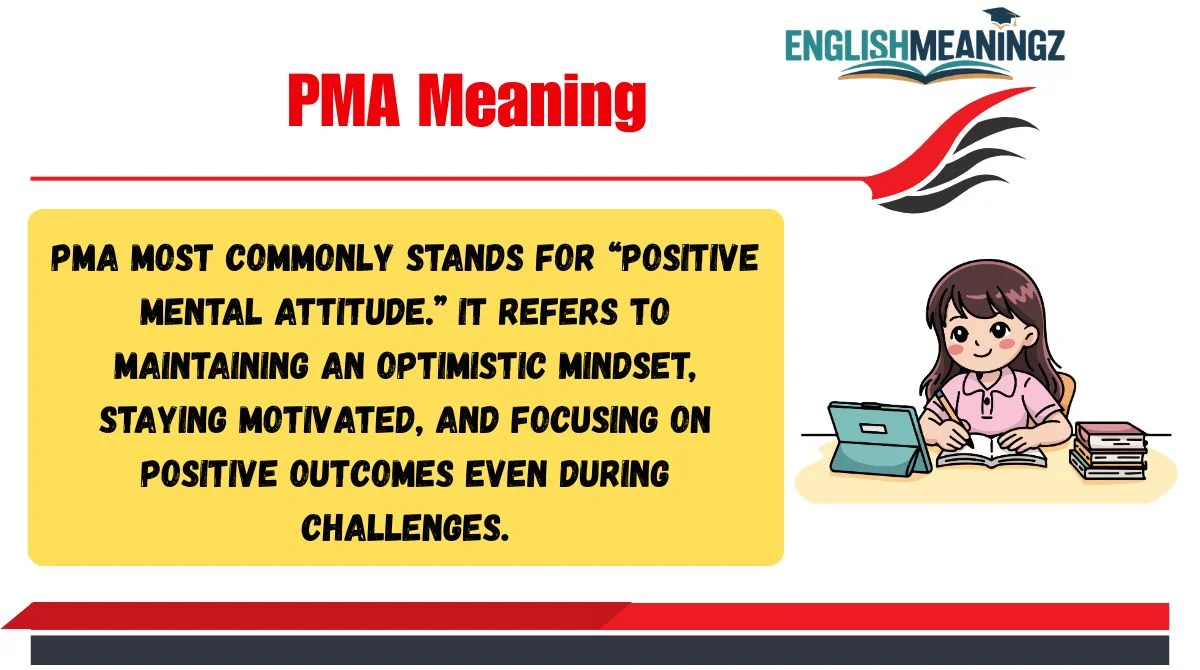
PMA most commonly stands for “Positive Mental Attitude.” It refers to maintaining an optimistic mindset, staying motivated, and focusing on positive outcomes even during challenges.
Depending on the context, PMA can also mean:
- Positive Mental Attitude
- Please Make Available
- Private Military Advisor
- Promotional Marketing Agreement
In texting and social media conversations, the first meaning—Positive Mental Attitude—is by far the most common.
The Most Common Meanings of “PMA”
Positive Mental Attitude
This is the meaning most people intend when using PMA online.
It describes a positive outlook on life, confidence during difficult situations, and a mindset focused on growth rather than negativity.
Example:
- “The project is tough, but PMA!”
- “Keep your PMA and you’ll get through it.”
In these situations, PMA acts as encouragement.
Please Make Available
In business and workplace communication, PMA may stand for “Please Make Available.”
This usage appears in emails, project management systems, and internal company discussions.
Example:
- “PMA the updated files before noon.”
- “Can you PMA the report for the team?”
Here, PMA is a request rather than a motivational phrase.
Private Military Advisor
Some military, security, or political discussions use PMA to mean Private Military Advisor.
This meaning is much less common in everyday conversations.
Example:
- “The company hired a PMA for training.”
Most casual internet users rarely encounter this version.
Promotional Marketing Agreement
In marketing and business industries, PMA can also refer to a Promotional Marketing Agreement.
This definition appears in contracts and business documents.
Example:
- “The brands signed a PMA before the campaign launch.”
Again, this meaning is usually limited to professional environments.
How “PMA” Is Used in Real Conversations
Friends & Casual Texting
Among friends, PMA almost always means Positive Mental Attitude.
People use it when encouraging someone who feels stressed, nervous, or disappointed.
Examples:
- “Exam tomorrow. Trying to keep PMA.”
- “Don’t worry about it. PMA!”
- “You’ll do great. Stay PMA.”
The tone is supportive and friendly.
Instagram & Snapchat
On social media, PMA often appears in captions, comments, and story posts.
Users share it to promote positivity and self-improvement.
Examples:
- “New week, PMA only.”
- “Working on myself and keeping PMA.”
- “Good vibes and PMA.”
It is often associated with motivational content.
Dating Apps
On dating platforms, PMA can signal optimism and confidence.
Someone may mention PMA in their profile to show they prefer positive people.
Examples:
- “Looking for someone with PMA.”
- “Life is better with PMA.”
This usage is generally attractive because it suggests emotional maturity.
Gaming & Online Communities
Gamers frequently use PMA to encourage teammates during difficult matches.
Instead of arguing after mistakes, players remind others to maintain PMA.
Examples:
- “Relax everyone. PMA.”
- “Bad round. Keep PMA.”
- “We can still win. PMA.”
In gaming culture, PMA often helps reduce negativity and improve teamwork.
Work or Professional Chat
Professional teams sometimes use PMA informally to encourage coworkers.
Examples:
- “Big deadline ahead. PMA everyone.”
- “Let’s keep a PMA approach.”
While acceptable in some workplaces, it may not be understood by everyone.
Is “PMA” Rude, Flirty, or Offensive?
In most situations, PMA is neither rude nor offensive.
The phrase usually carries a positive message and is intended to motivate or encourage others.
When PMA Feels Positive
PMA feels supportive when someone is facing a challenge.
Examples include:
- Exam stress
- Work pressure
- Sports competitions
- Personal goals
- Difficult life situations
In these cases, PMA communicates encouragement.
When PMA Can Feel Annoying
Although PMA is generally positive, context matters.
If someone is discussing a serious problem, repeatedly telling them to “just have PMA” may sound dismissive.
For example:
- A person sharing grief
- Someone discussing mental health struggles
- A major personal loss
In these moments, empathy is more important than motivational slogans.
Is PMA Flirty?
Not usually.
PMA is mainly associated with optimism and mindset.
However, if someone says they like your PMA on a dating app, it can be a compliment because they appreciate your positive attitude.
Is PMA Offensive?
No.
There is nothing inherently offensive about the term.
Most people interpret it as a harmless expression of encouragement.
How to Respond When Someone Says “PMA”
The best response depends on the conversation.
Casual Replies
- “Trying my best.”
- “Absolutely.”
- “That’s the plan.”
- “Staying positive.”
These responses fit everyday conversations.
Funny Replies
- “Running on PMA and coffee.”
- “PMA level: loading…”
- “Trying to unlock maximum PMA.”
- “My PMA battery is at 50%.”
Humorous responses keep the mood light.
Neutral Replies
- “Thanks for the reminder.”
- “I’ll keep that in mind.”
- “Good point.”
- “Appreciate it.”
These work when you want to stay polite.
Professional Replies
- “Thank you for the encouragement.”
- “We’ll maintain a positive approach.”
- “I appreciate the support.”
- “Looking forward to a successful outcome.”
These replies sound appropriate in workplace settings.
Common Misunderstandings About “PMA”
Assuming It Has Only One Meaning
Many people believe PMA always means Positive Mental Attitude.
While that is the most common interpretation, professional industries may use entirely different definitions.
Always consider the context.
Confusing It With Other Acronyms
PMA is sometimes mistaken for:
- PM
- AMA
- PMI
- PMP
Each abbreviation has a different meaning.
A small difference in letters can completely change the message.
Misreading the Tone
Some people think PMA is always cheerful.
However, tone depends on how it is delivered.
A genuine PMA message feels supportive.
An insincere PMA message may sound dismissive or sarcastic.
Thinking It Is Gen Z Slang Only
Although younger users often use PMA online, the phrase has been popular across different age groups for years.
Professionals, athletes, gamers, and self-improvement communities all use it.
Assuming Everyone Knows It
Not everyone understands internet abbreviations.
Using PMA with unfamiliar audiences may create confusion instead of clarity.
Similar Slang Terms You Should Know
Here are related expressions often used alongside PMA:
- Good Vibes — Positive energy and optimism.
- Stay Strong — Encouragement during challenges.
- Keep Going — Motivation to continue.
- Mindset Matters — Success starts with thinking positively.
- No Negativity — Avoiding toxic attitudes.
- Trust the Process — Believe in long-term progress.
- You Got This — Confidence-building encouragement.
- Positive Energy — Optimistic emotional outlook.
- Stay Focused — Maintain attention on goals.
- Growth Mindset — Belief that skills improve through effort.
- Keep Pushing — Continue despite obstacles.
- Chin Up — Remain hopeful during difficult times.
These phrases serve similar motivational purposes online.
When You Should Avoid Using “PMA”
Professional Settings
Not every workplace understands internet abbreviations.
In formal reports, contracts, or executive communications, writing the full phrase is usually better.
Cross-Cultural Chats
Internet slang varies by country and culture.
Someone from another region may not recognize PMA.
Clear language often works better.
Sensitive Situations
Avoid using PMA as a quick solution to serious emotional issues.
People facing grief, trauma, or major stress may need understanding rather than motivational shortcuts.
Formal Academic Writing
Academic papers and research documents should generally avoid casual slang abbreviations.
Use precise language instead.
Conversations With New Audiences
When speaking with people who may not know online slang, PMA can create unnecessary confusion.
Consider using “positive attitude” instead.
Final Thoughts
PMA is one of the internet’s most positive abbreviations. In most online conversations, it stands for Positive Mental Attitude, encouraging people to stay optimistic, motivated, and focused during challenges.
Whether you see PMA in text messages, gaming communities, Instagram captions, dating profiles, or workplace chats, the meaning usually centers around positivity and resilience. Still, context matters because PMA can also have professional or industry-specific meanings.
Understanding how and where PMA is used helps you communicate more effectively, avoid misunderstandings, and respond confidently when the term appears in conversation.
The next time someone says “PMA,” you’ll know exactly what they mean and how to reply naturally.
FAQs
What does PMA mean in texting?
PMA most commonly means Positive Mental Attitude, referring to staying optimistic and motivated.
What does PMA mean on Instagram?
On Instagram, PMA usually promotes positivity, self-improvement, and a healthy mindset.
Is PMA a positive term?
Yes. PMA is generally viewed as an encouraging and supportive expression.
What does PMA mean in gaming?
Gamers use PMA to remind teammates to stay positive and avoid toxic behavior during matches.
Can PMA have different meanings?
Yes. Depending on the context, PMA can also mean Please Make Available, Private Military Advisor, or Promotional Marketing Agreement.
Is PMA considered Gen Z slang?
It is commonly used online by younger audiences, but people of many age groups use it as well.
Should I use PMA in professional emails?
Only if your audience understands the abbreviation. In formal communication, writing “positive mental attitude” is often clearer.
Conclusion
The meaning of PMA is simple once you understand the context. In most modern texts, social media posts, gaming chats, and online conversations, PMA stands for Positive Mental Attitude. It is a quick way to encourage optimism, resilience, and confidence.
While PMA can occasionally represent other professional or industry-specific terms, the positive mindset definition remains the most widely recognized.
Knowing how PMA is used, when to respond to it, and when to avoid it can help you navigate digital communication with greater confidence and clarity in 2026 and beyond.