Understanding opposites is one of the fastest ways to sharpen your vocabulary and elevate your writing. Antonyms don’t just provide contrast—they clarify meaning, improve precision, and help you communicate ideas more effectively.
When you know both a word and its opposite, you gain control over tone, nuance, and intent.
In academic and professional communication, this skill becomes even more valuable. Whether you’re writing essays, reports, or persuasive content, choosing the right opposite can transform vague statements into clear, impactful expressions.
This guide explores the best antonyms for artifact, helping you understand not just what the word means—but how to use its opposites intelligently.
What Does “Artifact” Mean?
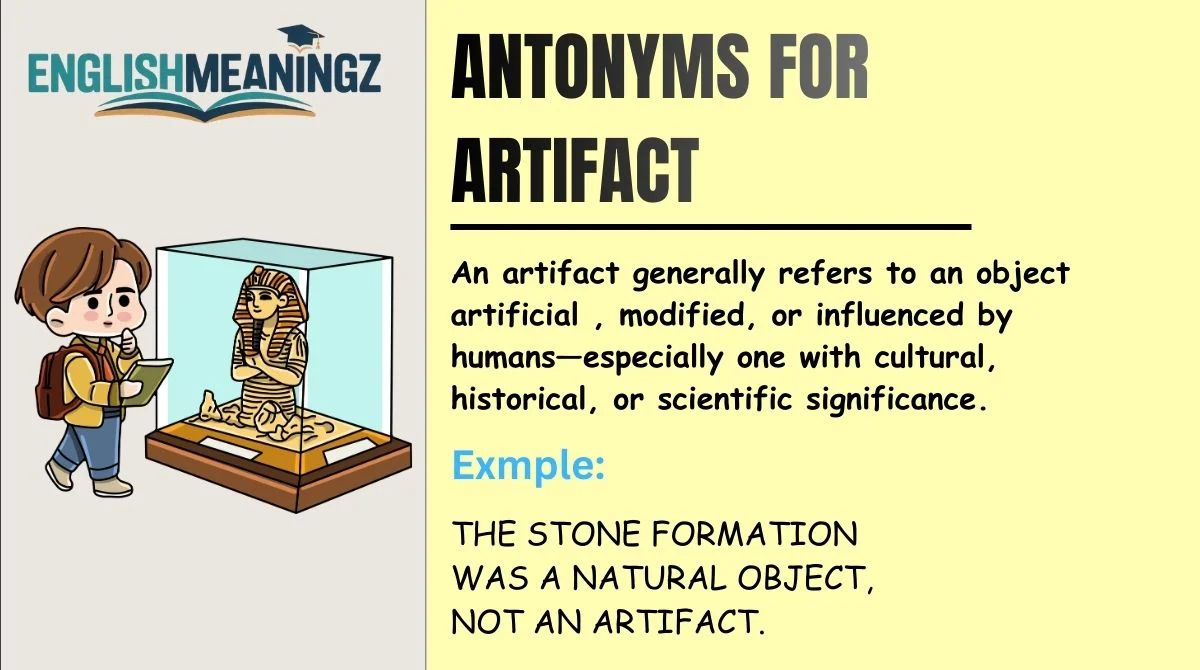
An artifact generally refers to an object artificial , modified, or influenced by humans—especially one with cultural, historical, or scientific significance. It often appears in contexts like archaeology, research, and digital analysis.
Tone Explanation:
The word carries a formal and academic tone. It is commonly used in scholarly writing, museum descriptions, and technical discussions.
Emotional or Action Intensity:
Neutral to slightly formal. It does not express emotion but emphasizes human involvement or artificial creation.
25 Best Antonyms for “Artifact”
Natural Object
Meaning: Something that exists in nature without human intervention
Tone: Academic
Example: The stone formation was a natural object, not an artifact.
Why Opposite: Artifacts are human-artificial; natural objects are not.
Nature
Meaning: The physical world and everything not created by humans
Tone: Formal
Example: The beauty of nature requires no artificial enhancement.
Why Opposite: Nature contrasts with man-artificial creations.
Organic Form
Meaning: Something that develops naturally without artificial influence
Tone: Academic
Example: The sculpture mimicked an organic form found in forests.
Why Opposite: Organic forms arise naturally, unlike artifacts.
Raw Material
Meaning: Unprocessed substance from nature
Tone: Technical
Example: The wood remained raw material before crafting.
Why Opposite: Artifacts are processed; raw materials are untouched.
Untouched Object
Meaning: Something not altered by humans
Tone: Neutral
Example: The cave preserved untouched objects for centuries.
Why Opposite: Artifacts involve modification; untouched objects do not.
Natural Phenomenon
Meaning: Events or occurrences in nature
Tone: Academic
Example: The rainbow is a natural phenomenon.
Why Opposite: Artifacts are created; phenomena occur naturally.
Wilderness
Meaning: Land in its natural state
Tone: Descriptive
Example: The wilderness remained free of human artifacts.
Why Opposite: Wilderness lacks human-artificial elements.
Early State
Meaning: Original, unaltered condition
Tone: Academic
Example: The land existed in a early state.
Why Opposite: Artifacts imply change; early state implies none.
Natural Formation
Meaning: Structure formed by natural processes
Tone: Formal
Example: The cave is a natural formation.
Why Opposite: No human involvement in formation.
Pure Substance
Meaning: Uncontaminated or unaltered material
Tone: Scientific
Example: The sample was a pure substance.
Why Opposite: Artifacts may introduce alteration or contamination.
Original State
Meaning: The initial condition before modification
Tone: Academic
Example: The painting was restored to its original state.
Why Opposite: Artifacts are results of change.
Natural Element
Meaning: A component found in nature
Tone: Scientific
Example: Water is a natural element essential for life.
Why Opposite: Not human-created.
Unprocessed Item
Meaning: Something not altered or refined
Tone: Neutral
Example: The mineral remained an unprocessed item.
Why Opposite: Opposes crafted objects.
Authentic Nature
Meaning: True, unmodified condition
Tone: Formal
Example: The forest retained its authentic nature.
Why Opposite: Artifacts may distort authenticity.
Wild Growth
Meaning: Naturally growing plants or structures
Tone: Informal
Example: The area was covered in wild growth.
Why Opposite: No human shaping involved.
Natural Origin
Meaning: Coming directly from nature
Tone: Academic
Example: The crystal had a natural origin.
Why Opposite: Artifacts originate from human activity.
Unaltered Form
Meaning: Shape or state without change
Tone: Formal
Example: The fossil remained in unaltered form.
Why Opposite: Artifacts imply modification.
Nature-Artificial Object
Meaning: Created by natural processes
Tone: Neutral
Example: The shell is a nature-artificial object.
Why Opposite: Contrasts with human-artificial items.
Raw State
Meaning: Condition before processing
Tone: Informal
Example: The ore existed in its raw state.
Why Opposite: Artifacts are refined.
Untouched Nature
Meaning: Environment free from human interference
Tone: Descriptive
Example: The island is known for untouched nature.
Why Opposite: Opposes human influence.
Natural Condition
Meaning: State as found in nature
Tone: Academic
Example: The experiment observed elements in natural condition.
Why Opposite: No artificial alteration.
Inherent Form
Meaning: Built-in or natural structure
Tone: Formal
Example: The design followed the inherent form of the material.
Why Opposite: Not externally created.
Pure Nature
Meaning: Completely natural state
Tone: Emotional
Example: The region represents pure nature.
Why Opposite: No artificial elements.
Unrefined Material
Meaning: Not processed or improved
Tone: Technical
Example: The metal was unrefined material.
Why Opposite: Artifacts are refined outputs.
Natural Structure
Meaning: Formation created by natural forces
Tone: Academic
Example: The arch is a natural structure.
Why Opposite: Not constructed by humans.
Strong vs Mild Opposites
Not all antonyms carry the same intensity. Some are strong opposites, completely reversing the meaning, while others are mild contrasts.
- Strong Opposites: Nature, natural object, untouched nature
These directly negate human involvement. - Mild Opposites: Raw material, unprocessed item
These imply lack of transformation but not necessarily full opposition.
Understanding this scale helps you choose the most accurate word depending on context.
Context-Based Opposites
Antonyms change depending on usage context:
- Archaeology: Artifact vs natural formation
- Digital Imaging: Artifact vs original signal
- General Writing: Artifact vs nature
Always consider the field or subject before selecting an opposite.
Common Mistakes When Using Opposites
Mistake 1: Using unrelated words
Incorrect: Artifact vs machine
Correct: Artifact vs natural object
Mistake 2: Ignoring context
Incorrect: Artifact vs emotion
Correct: Artifact vs natural phenomenon
Mistake 3: Overgeneralizing
Incorrect: Artifact vs everything natural
Correct: Choose a precise opposite like raw material
Sentence Transformation Examples
- The museum displayed ancient artifacts.
→ The landscape showcased natural formations. - The image distortion was an artifact.
→ The signal remained in its original state. - The sculpture is a beautiful artifact.
→ The cave is a stunning natural structure. - Scientists removed artifacts from the data.
→ Scientists preserved the data in its pure form. - The object was clearly an artifact.
→ The object appeared to be a natural object.
FAQs
What is the simplest antonym for artifact?
The simplest antonym is “natural object.”
Can artifact have different meanings?
Yes, it can refer to physical objects or technical distortions.
Is “nature” always an antonym?
In most contexts, yes, especially when contrasting human-artificial items.
Are all antonyms exact opposites?
No, some are partial or context-dependent.
What is a strong antonym for artifact?
“Untouched nature” or “natural formation.”
Can artifact be used metaphorically?
Yes, especially in data and digital contexts.
Why is context important for antonyms?
Because meaning changes depending on usage field.
Conclusion
Mastering antonyms for artifact gives you more than vocabulary—it gives you precision. By understanding the contrast between human-artificial and natural elements, you can write with clarity, depth, and authority.
Whether you’re working in academic writing, SEO content, or everyday communication, choosing the right opposite strengthens your message and improves readability.