Strong writing depends heavily on vocabulary variety. Repeating the same words throughout an essay, article, or report can weaken the clarity and sophistication of your writing.
One effective way to strengthen written communication is by learning appropriate synonyms that convey similar meanings while adding nuance and precision.
For students preparing essays, academic assignments, or standardized tests such as IELTS, vocabulary diversity can significantly improve writing scores.
Examiners often evaluate lexical resource, meaning the ability to use varied and accurate vocabulary.
Similarly, bloggers and content writers benefit from using different expressions to keep readers engaged and improve search engine optimization.
Professionals who write reports, research papers, or presentations also rely on synonym variation to maintain clarity and avoid repetition.
In topics involving geography, agriculture, sociology, or environmental studies, the word “rural” appears frequently. Understanding its alternatives allows writers to present ideas more effectively.
This guide explores 12 useful synonyms for “rural”, explains their meanings and contexts, and demonstrates how to use them correctly in academic and professional writing.
Definition and Core Meaning of “Rural”
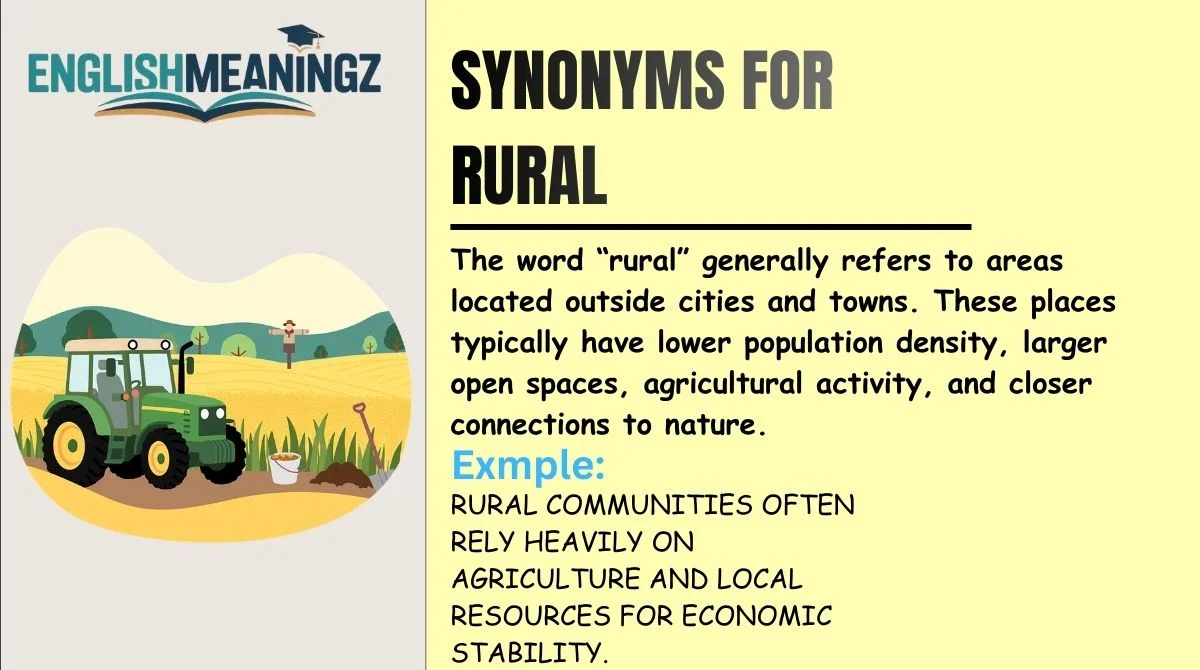
The word “rural” generally refers to areas located outside cities and towns. These places typically have lower population density, larger open spaces, agricultural activity, and closer connections to nature.
In geographic and sociological contexts, rural areas are characterized by:
- Small communities or villages
- Agricultural land and farmland
- Limited industrial development
- Natural landscapes such as forests, fields, and mountains
- Slower-paced lifestyles compared to urban environments
For example:
Rural communities often rely heavily on agriculture and local resources for economic stability.
In academic discussions, “rural” frequently appears in fields such as:
- Geography
- Sociology
- Environmental studies
- Development economics
- Public policy
Because the word is commonly used in these fields, writers often benefit from alternative terms that provide variety and precision.
12 Synonyms Grouped by Context
Different synonyms for rural are appropriate in different contexts. Some are more formal and suitable for academic writing, while others are informal or descriptive.
General Use
These synonyms are widely used and easy to understand in most contexts.
Countryside
Meaning:
Refers to land outside cities, typically including farms, villages, and natural landscapes.
Context Explanation:
This term emphasizes natural scenery and agricultural land rather than population or development levels.
Example Sentence:
Many people prefer living in the countryside because of its peaceful environment and fresh air.
Agricultural
Meaning:
Related to farming, crop production, and livestock raising.
Context Explanation:
Used when discussing economic activities common in rural areas.
Example Sentence:
Agricultural regions play a crucial role in supplying food to urban populations.
Pastoral
Meaning:
Associated with farming life, grazing animals, and peaceful rural landscapes.
Context Explanation:
Often used in literature, geography, and environmental discussions.
Example Sentence:
The region is known for its pastoral scenery and rolling green hills.
Rustic
Meaning:
Characteristic of simple country life or traditional rural settings.
Context Explanation:
Frequently used in lifestyle writing, tourism, and cultural descriptions.
Example Sentence:
The hotel offers a rustic atmosphere that reflects traditional village architecture.
Formal & Academic Writing
These synonyms appear frequently in academic research and professional reports.
Provincial
Meaning:
Related to regions outside major cities or central urban areas.
Context Explanation:
Often used in political, social, and economic discussions about regional development.
Example Sentence:
Provincial communities sometimes experience slower economic growth than metropolitan areas.
Agrarian
Meaning:
Connected with land ownership, farming systems, or agricultural economies.
Context Explanation:
Common in historical, economic, and political analysis.
Example Sentence:
The country historically relied on an agrarian economy before industrialization began.
Nonurban
Meaning:
Describes areas that are not part of cities or urban environments.
Context Explanation:
Used in research studies comparing urban and nonurban populations.
Example Sentence:
Healthcare access remains limited in many nonurban communities.
Remote
Meaning:
Located far from major population centers.
Context Explanation:
Highlights geographic isolation rather than agricultural activity.
Example Sentence:
Remote villages often struggle with transportation and communication infrastructure.
Informal Usage
These words are more conversational and commonly used in everyday language.
Country
Meaning:
A casual term referring to rural areas or farmland outside cities.
Context Explanation:
Used mainly in everyday conversation and storytelling.
Example Sentence:
She grew up in the country surrounded by farms and forests.
Backwoods
Meaning:
A remote and undeveloped rural area.
Context Explanation:
Often used informally and sometimes carries a slightly negative tone.
Example Sentence:
The cabin was located deep in the backwoods far from any towns.
Technical or Subject-Specific Use
These synonyms appear mainly in academic or policy discussions.
Hinterland
Meaning:
A region located beyond coastal or urban areas that supports a city economically.
Context Explanation:
Common in geography, economics, and transportation studies.
Example Sentence:
The port city relies heavily on its agricultural hinterland for exports.
Peripheral
Meaning:
Situated on the outer edges of a region or system.
Context Explanation:
Often used in economic geography and regional planning.
Example Sentence:
Peripheral communities sometimes receive less government investment.
Word Intensity & Tone Comparison Table
| Synonym | Formal Level | Tone | Typical Context |
|---|---|---|---|
| Countryside | Neutral | Descriptive | Travel, lifestyle |
| Agricultural | Formal | Technical | Farming discussions |
| Pastoral | Medium | Positive | Literature, geography |
| Rustic | Informal | Nostalgic | Tourism, lifestyle |
| Provincial | Formal | Neutral | Politics, sociology |
| Agrarian | Highly formal | Analytical | Economics, history |
| Nonurban | Academic | Neutral | Research studies |
| Remote | Neutral | Slightly negative | Geography |
| Hinterland | Academic | Analytical | Economics, geography |
| Peripheral | Academic | Neutral | Regional planning |
This comparison helps writers choose synonyms based on tone, context, and level of formality.
Common Mistakes When Using These Synonyms
Even though synonyms share similar meanings, they are not always interchangeable. Using the wrong word can change the meaning of a sentence.
Mistake 1: Confusing “Agrarian” with “Agricultural”
Incorrect:
The agrarian crops were harvested early this year.
Correct:
The agricultural crops were harvested early this year.
Explanation:
“Agrarian” refers to systems or policies related to farming, while “agricultural” refers directly to farming activities.
Mistake 2: Using “Rustic” in Formal Research
Incorrect:
Rustic populations often face healthcare challenges.
Correct:
Rural populations often face healthcare challenges.
Explanation:
“Rustic” is descriptive and informal, making it unsuitable for academic research.
Mistake 3: Misusing “Remote”
Incorrect:
Remote farms produce most of the nation’s food.
Correct:
Agricultural farms produce most of the nation’s food.
Explanation:
“Remote” refers to isolation, not necessarily farming.
Synonyms in Academic Writing
Example Paragraph 1
Agrarian communities play a significant role in national food security. In many developing countries, agrarian economies rely heavily on small-scale farmers who cultivate crops using traditional methods. These communities often face challenges such as limited infrastructure, low access to education, and reduced healthcare services.
Example Paragraph 2
Nonurban populations frequently experience disparities in economic development compared to urban residents. Limited employment opportunities and transportation infrastructure can restrict economic growth in peripheral regions. As a result, governments often implement development programs aimed at supporting rural industries and improving connectivity.
IELTS & Exam Writing Tips
Vocabulary diversity is an important factor in achieving higher scores in exams such as IELTS or TOEFL.
1. Avoid Repetition
Instead of repeating the same word, vary your vocabulary.
Example:
Poor Writing:
Rural areas face many problems. Rural areas also lack healthcare.
Improved Writing:
Rural areas face many problems. Remote communities also lack healthcare facilities.
2. Maintain Context Accuracy
Not all synonyms are appropriate in every situation.
For example:
“Pastoral scenery” works well when describing landscapes but may not fit economic discussions.
3. Use Synonyms Sparingly
Replacing every occurrence of a word can make writing sound unnatural.
Strategic variation improves clarity without confusing readers.
4. Prioritize Meaning Over Variety
Always ensure that the chosen synonym conveys the exact meaning required by the sentence.
Similar Words vs True Synonyms
Some words are often confused with synonyms for “rural,” but they actually have slightly different meanings.
Urban vs Rural
Urban refers to cities and highly populated areas.
Suburban
Suburban areas are residential zones located near cities, not fully rural.
Regional
Regional refers to a broader geographic area and may include both urban and rural locations.
Understanding these differences helps writers avoid inaccurate vocabulary choices.
Practice Sentences
Choose the most suitable synonym for rural.
- Many tourists enjoy the peaceful atmosphere of the ______ countryside villages.
- The nation’s ______ economy depends heavily on farming.
- Healthcare access remains limited in many ______ communities far from cities.
- The port city receives agricultural goods from its surrounding ______.
- Researchers compared urban and ______ populations in the study.
Possible answers: agrarian, remote, countryside, hinterland, nonurban.
FAQs
What are the best synonyms for rural?
Some common synonyms include countryside, agrarian, agricultural, provincial, pastoral, remote, and nonurban.
Which synonym for rural is most formal?
“Agrarian” and “nonurban” are among the most formal alternatives used in academic and research writing.
Can countryside replace rural in academic essays?
Yes, but it is slightly more descriptive and often used in general writing rather than technical research.
What is the difference between rural and remote?
Rural refers to countryside areas outside cities, while remote emphasizes distance and isolation.
Why should writers learn synonyms for rural?
Learning synonyms helps avoid repetition, improves vocabulary diversity, and strengthens writing quality in essays and professional documents.
Conclusion
Expanding vocabulary is one of the most effective ways to improve writing quality.
The word “rural” appears frequently in academic essays, research papers, and professional reports, especially in topics related to geography, agriculture, and social development.
By learning synonyms such as countryside, agrarian, provincial, pastoral, nonurban, and hinterland, writers can add variety and precision to their work.
However, choosing the correct synonym requires understanding context, tone, and level of formality.
Students preparing for exams, bloggers creating engaging content, and professionals writing reports all benefit from strategic vocabulary variation.
Consistent practice, reading, and careful word selection will gradually strengthen writing skills and enhance overall communication effectiveness.