Strong writing is not just about knowing the right words—it’s about understanding contrasts. When you master opposites, your ability to express nuance, tone, and intent improves dramatically. This is where antonyms become essential.
Using precise opposites enhances clarity. It allows writers to emphasize differences, highlight consequences, and build persuasive arguments. Whether you’re crafting academic essays, business reports, or digital content, antonyms help you sharpen your message.
In academic and professional communication, vocabulary precision directly impacts credibility. Misusing a word—or its opposite—can distort meaning. That’s why understanding antonyms of action-based verbs like “salvage” is especially important.
These words often carry emotional and situational weight, making their opposites equally powerful.
This article will give you a complete, structured understanding of “salvage antonyms,” including 24 carefully selected opposites, usage insights, and practical examples.
What Does “Salvage” Mean?
Definition:
“Salvage” means to rescue, save, or recover something from loss, damage, or destruction.
Tone Explanation:
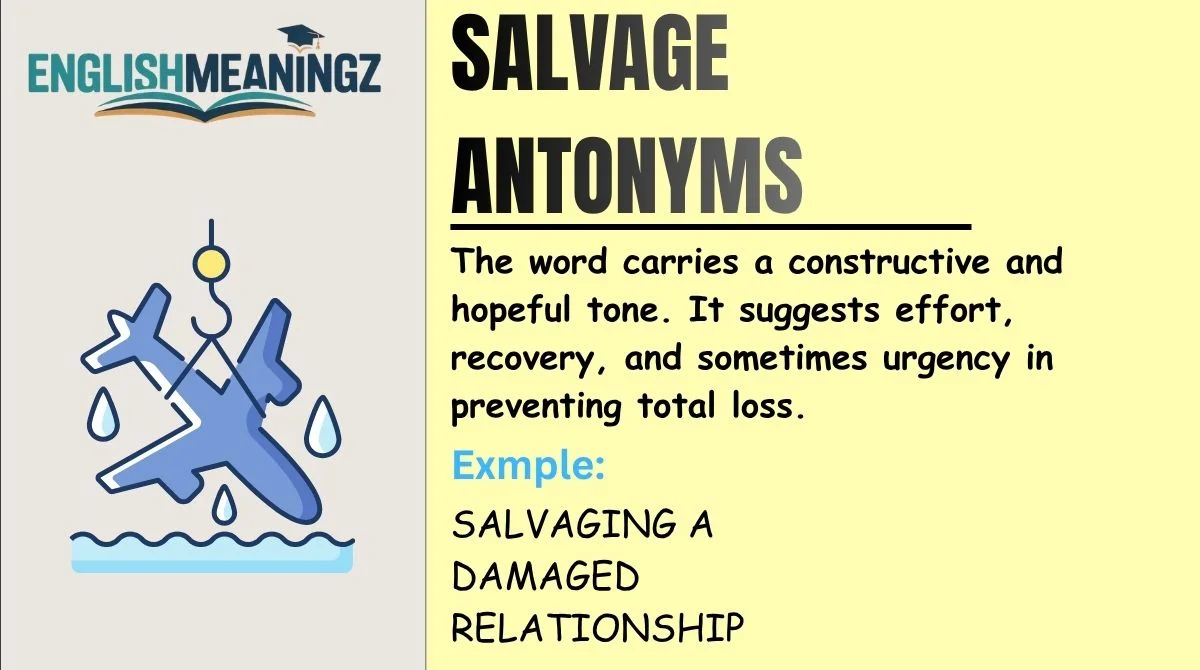
The word carries a constructive and hopeful tone. It suggests effort, recovery, and sometimes urgency in preventing total loss.
Emotional or Action Intensity:
“Salvage” often implies:
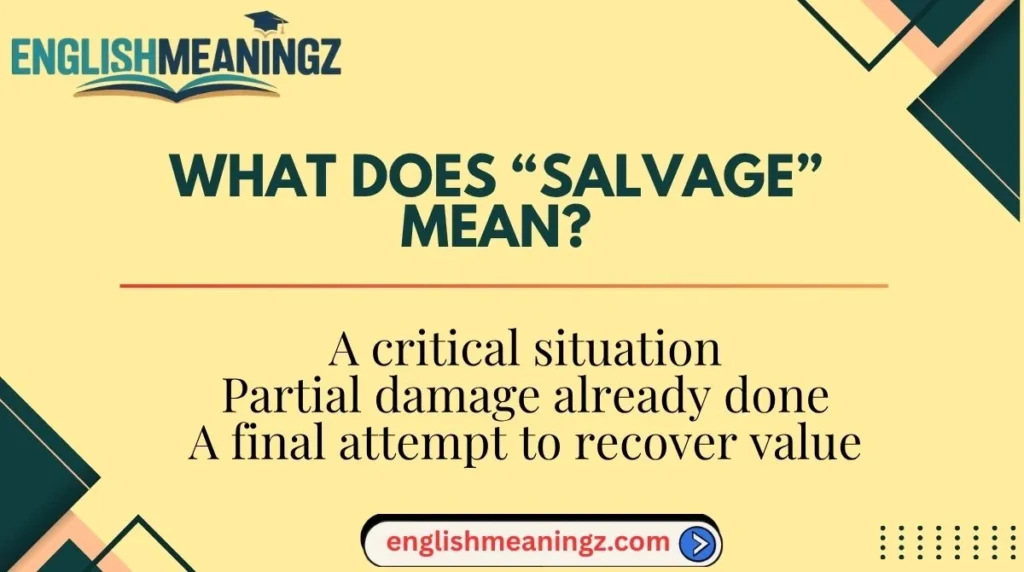
- A critical situation
- Partial damage already done
- A final attempt to recover value
For example:
- Salvaging a failing project
- Salvaging a damaged relationship
It’s not just about saving—it’s about saving what remains.
24 Best Antonyms for “Salvage”
Destroy
Meaning: To completely ruin or demolish
Tone: Formal
Example: The storm destroyed the entire village.
Why Opposite: Instead of saving something, it eliminates it entirely.
Ruin
Meaning: To severely damage beyond repair
Tone: Emotional
Example: His careless actions ruined the opportunity.
Why Opposite: “Salvage” recovers; “ruin” ensures loss.
Waste
Meaning: To use carelessly or inefficiently
Tone: Informal
Example: Don’t waste your time on trivial matters.
Why Opposite: Salvage preserves value; waste discards it.
Abandon
Meaning: To leave something behind completely
Tone: Formal
Example: They abandoned the project midway.
Why Opposite: Salvage involves effort; abandon involves withdrawal.
Neglect
Meaning: To fail to care for properly
Tone: Academic
Example: The building decayed due to years of neglect.
Why Opposite: Salvage is active care; neglect is passive disregard.
Discard
Meaning: To throw away as useless
Tone: Neutral
Example: He discarded the broken device.
Why Opposite: Salvage recovers usefulness; discard rejects it.
Demolish
Meaning: To tear down completely
Tone: Formal
Example: The old structure was demolished for safety.
Why Opposite: Demolish eliminates; salvage preserves.
Squander
Meaning: To waste recklessly
Tone: Emotional
Example: She squandered her savings on luxury items.
Why Opposite: Salvage conserves; squander wastes.
Ignore
Meaning: To pay no attention to
Tone: Neutral
Example: He ignored the warning signs.
Why Opposite: Salvage requires attention; ignore avoids it.
Reject
Meaning: To refuse or dismiss
Tone: Formal
Example: The proposal was rejected outright.
Why Opposite: Salvage attempts recovery; reject denies value.
Lose
Meaning: To fail to keep or maintain
Tone: Neutral
Example: They lost their chance to win.
Why Opposite: Salvage prevents loss; lose accepts it.
Forfeit
Meaning: To give up something as a penalty
Tone: Formal
Example: The team forfeited the match.
Why Opposite: Salvage fights to retain; forfeit surrenders.
Destruct
Meaning: To self-destroy or collapse
Tone: Technical
Example: The system destructed due to overload.
Why Opposite: Destruct eliminates; salvage repairs.
Damage
Meaning: To harm or impair
Tone: Neutral
Example: The fire damaged the building.
Why Opposite: Salvage fixes damage; damage causes it.
Throw Away
Meaning: To dispose of carelessly
Tone: Informal
Example: He threw away valuable documents.
Why Opposite: Salvage recovers; throwing away eliminates.
Scrap
Meaning: To discard something as unusable
Tone: Informal
Example: The plan was scrapped due to issues.
Why Opposite: Scrap ends value; salvage restores it.
Destroy Completely
Meaning: Total elimination
Tone: Formal
Example: The evidence was destroyed completely.
Why Opposite: Absolute contrast to recovery.
Give Up
Meaning: To stop trying
Tone: Informal
Example: Don’t give up so easily.
Why Opposite: Salvage requires persistence; giving up stops effort.
Collapse
Meaning: To fall apart suddenly
Tone: Neutral
Example: The structure collapsed overnight.
Why Opposite: Salvage stabilizes; collapse destabilizes.
Deteriorate
Meaning: To worsen over time
Tone: Academic
Example: Conditions deteriorated rapidly.
Why Opposite: Salvage improves; deteriorate declines.
Destroy Value
Meaning: To eliminate usefulness
Tone: Formal
Example: Poor management destroyed the company’s value.
Why Opposite: Salvage retains value.
Overlook
Meaning: To fail to notice
Tone: Neutral
Example: He overlooked a critical detail.
Why Opposite: Salvage involves awareness; overlook ignores it.
Waste Away
Meaning: To gradually decline
Tone: Emotional
Example: The opportunity wasted away.
Why Opposite: Salvage prevents decline.
Break Down
Meaning: To stop functioning
Tone: Informal
Example: The machine broke down suddenly.
Why Opposite: Salvage restores function; breakdown removes it.
Strong vs Mild Opposites
Not all antonyms carry equal intensity. Understanding this difference helps you choose the most precise word.
Strong Opposites (High Intensity):
- Destroy
- Demolish
- Ruin
- Destruct
These imply complete and irreversible loss.
Moderate Opposites:
- Damage
- Discard
- Reject
- Scrap
These suggest partial loss or conscious removal.
Mild Opposites:
- Ignore
- Neglect
- Overlook
These reflect passive failure rather than active destruction.
Insight:
Use strong antonyms in dramatic or critical contexts. Use mild ones for subtle or professional writing.
Context-Based Opposites
The correct antonym depends heavily on context.
In Business:
- Salvage → “Rescue a failing deal”
- Opposite → “Abandon” or “Scrap”
In Relationships:
- Salvage → “Repair emotional damage”
- Opposite → “Give up” or “Ignore”
In Engineering:
- Salvage → “Recover usable parts”
- Opposite → “Demolish” or “Discard”
In Personal Growth:
- Salvage → “Recover from failure”
- Opposite → “Deteriorate” or “Waste potential”
Key Insight:
There is no single universal antonym. The best choice depends on intent, tone, and situation.
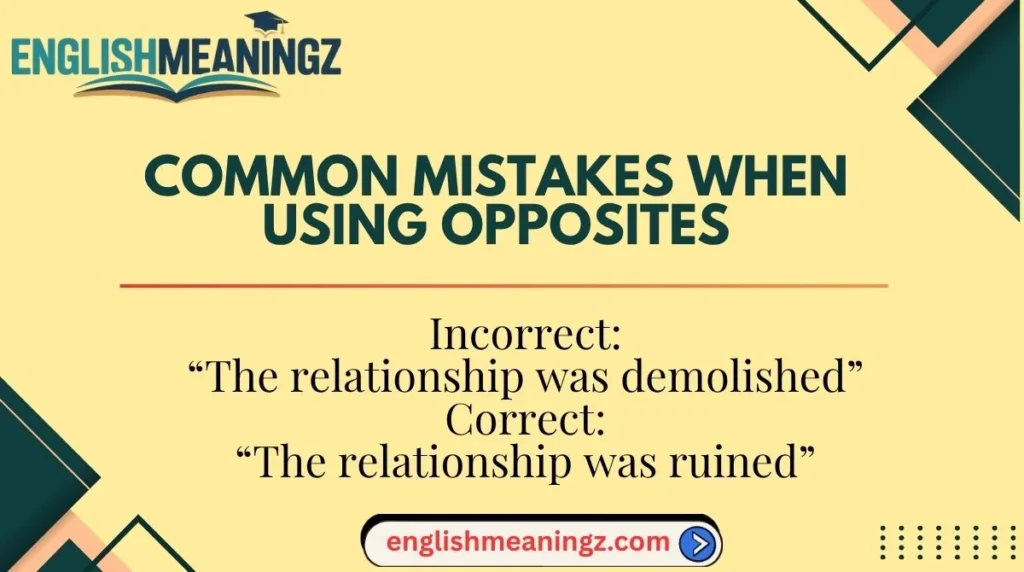
Common Mistakes When Using Opposites
Mistake 1: Using Weak Opposites
Incorrect:
“He destroyed the opportunity” (when only minor damage occurred)
Correct:
“He neglected the opportunity”
Mistake 2: Confusing Tone
Incorrect:
“The company ignored the project” (sounds unprofessional)
Correct:
“The company abandoned the project”
Mistake 3: Literal vs Figurative Confusion
Incorrect:
“The relationship was demolished”
Correct:
“The relationship was ruined”
Mistake 4: Overusing “Destroy”
Using “destroy” for every context reduces precision.
Better alternatives:
- Ruin (emotional)
- Scrap (practical)
- Waste (casual)
Sentence Transformation Examples
Original → With Antonym
- He salvaged the situation quickly.
→ He ruined the situation quickly. - They managed to salvage the project.
→ They decided to abandon the project. - She tried to salvage their friendship.
→ She chose to give up on their friendship. - The team salvaged valuable data.
→ The team discarded valuable data. - He salvaged his reputation after the mistake.
→ He damaged his reputation further.
FAQs
What is the exact opposite of salvage?
There is no single exact opposite. Common choices include destroy, abandon, and discard, depending on context.
Is “destroy” always the best antonym?
No. It is the strongest antonym but may be too intense for many situations.
Can “ignore” be an antonym of salvage?
Yes, in contexts where lack of action leads to loss.
What is a formal antonym for salvage?
“Abandon,” “reject,” and “demolish” are suitable in formal writing.
What is a mild opposite of salvage?
“Neglect” and “overlook” are mild opposites.
Why are there multiple antonyms?
Because “salvage” applies to different contexts—emotional, physical, and abstract.
How do I choose the right antonym?
Focus on:
- Intensity
- Context
- Tone
Conclusion
Understanding antonyms of “salvage” goes beyond memorizing words—it’s about mastering contrast. Each opposite carries a different level of intensity, tone, and implication.
By learning how to distinguish between “destroy,” “abandon,” “neglect,” and others, you gain precise control over your language.
This precision improves clarity, strengthens arguments, and enhances communication across academic, professional, and everyday contexts. Instead of relying on generic opposites, you can now select the exact word that matches your intent.
The real power lies not just in knowing words—but in knowing when and how to use them.