Understanding opposites is one of the fastest ways to sharpen your writing. When you know not just what a word means—but what it doesn’t mean—you gain control over tone, clarity, and precision.
This is especially true for abstract terms like rationale, which appear frequently in academic, business, and analytical writing.
Writers who master antonyms can express contrast more effectively, avoid ambiguity, and communicate arguments with greater impact.
Whether you’re writing essays, reports, or persuasive content, knowing the right opposite word can transform your message.
In academic and professional communication, precision is everything. Using the wrong contrast can weaken arguments, while the right antonym strengthens logic and clarity.
That’s why understanding rationale antonyms is not just a vocabulary exercise—it’s a strategic writing skill.
What Does “Rationale” Mean?
Definition:
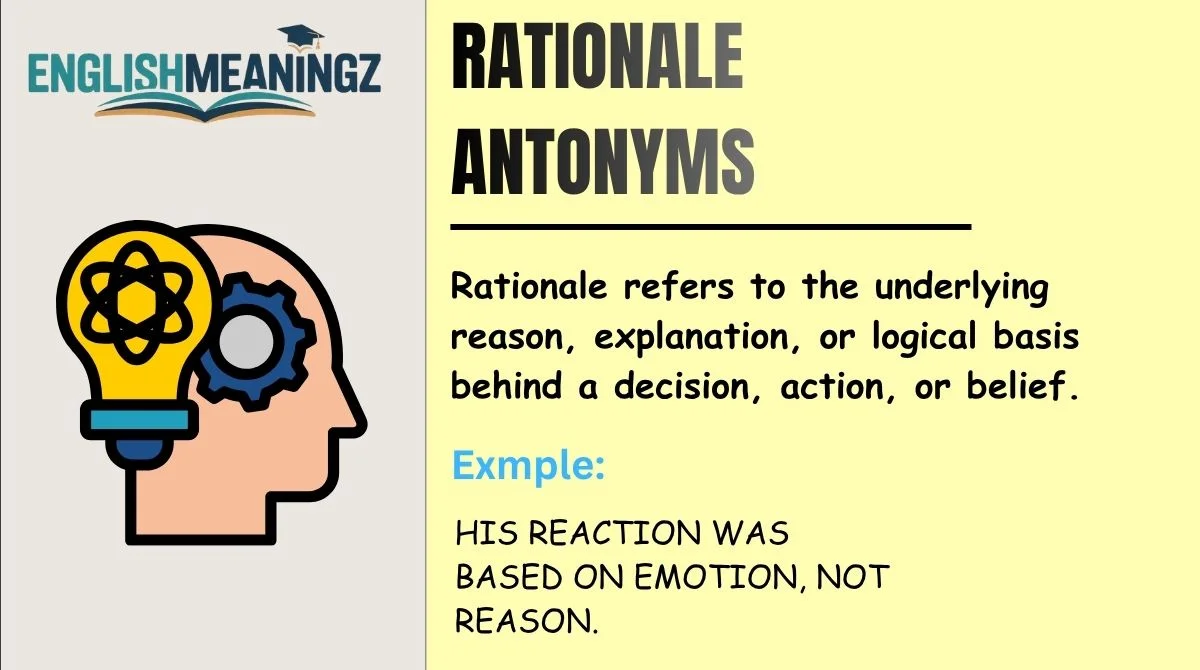
Rationale refers to the underlying reason, explanation, or logical basis behind a decision, action, or belief.
Tone Explanation:
The word carries a formal and intellectual tone, often used in academic, corporate, or analytical contexts.
Emotional / Action Intensity:
It implies logical reasoning, deliberation, and justification, with low emotional influence and high cognitive intent.
16 Best Antonyms for “Rationale”
1. Irrationality
Meaning: Lack of logical thinking
Tone: Academic
Example: His decision was driven by irrationality rather than careful thought.
Why Opposite: It directly contrasts with the logical foundation that rationale represents.
2. Impulse
Meaning: Sudden, unplanned action
Tone: Informal
Example: She bought the car on impulse without considering the cost.
Why Opposite: Rationale involves thought; impulse ignores it.
3. Emotion
Meaning: Feeling-based response
Tone: Emotional
Example: His reaction was based on emotion, not reason.
Why Opposite: Rationale is logic-driven, while emotion is feeling-driven.
4. Illogic
Meaning: Absence of logical structure
Tone: Formal
Example: The argument collapsed due to its illogic.
Why Opposite: It negates structured reasoning.
5. Absurdity
Meaning: Something completely unreasonable
Tone: Academic
Example: The proposal was dismissed as absurdity.
Why Opposite: Rationale implies reason; absurdity rejects it.
6. Chaos
Meaning: Complete disorder
Tone: Neutral
Example: The meeting turned into chaos without a clear plan.
Why Opposite: Rationale creates order; chaos destroys it.
7. Guesswork
Meaning: Decisions based on guessing
Tone: Informal
Example: The solution was pure guesswork.
Why Opposite: Rationale relies on evidence, not guesses.
8. Whim
Meaning: Sudden change of mind
Tone: Informal
Example: He quit his job on a whim.
Why Opposite: Rationale involves consistency and reasoning.
9. Nonsense
Meaning: Meaningless or illogical statements
Tone: Informal
Example: That explanation is complete nonsense.
Why Opposite: It lacks the logical basis inherent in rationale.
10. Confusion
Meaning: Lack of clarity or understanding
Tone: Neutral
Example: The instructions caused confusion.
Why Opposite: Rationale clarifies; confusion obscures.
11. Madness
Meaning: Extreme irrational behavior
Tone: Emotional
Example: His actions bordered on madness.
Why Opposite: It represents the extreme absence of reason.
12. Folly
Meaning: Foolishness
Tone: Formal
Example: Ignoring advice proved to be a folly.
Why Opposite: Rationale reflects wisdom; folly reflects poor judgment.
13. Blindness
Meaning: Lack of awareness or insight
Tone: Formal
Example: His blindness to the facts caused failure.
Why Opposite: Rationale requires awareness and understanding.
14. Disorder
Meaning: Lack of organization
Tone: Neutral
Example: The system failed due to disorder.
Why Opposite: Rationale brings structure and clarity.
15. Carelessness
Meaning: Lack of attention or thought
Tone: Neutral
Example: The error was due to carelessness.
Why Opposite: Rationale demands careful thinking.
16. Instinct
Meaning: Natural reaction without reasoning
Tone: Neutral
Example: He acted on instinct rather than analysis.
Why Opposite: Instinct bypasses logical reasoning.
Strong vs Mild Opposites
Not all antonyms carry the same intensity. Some are extreme opposites, while others are softer contrasts.
Strong Opposites:
Words like madness, absurdity, and irrationality represent a complete absence of logic. They create dramatic contrast and are useful in persuasive or critical writing.
Mild Opposites:
Words such as impulse, instinct, and guesswork suggest partial absence of reasoning. They are more subtle and suitable for balanced or descriptive writing.
Intensity Scale Example:
Rationale → Instinct → Impulse → Irrationality → Madness
Choosing the right level depends on how strongly you want to emphasize contrast.
Context-Based Opposites
Antonyms are not always fixed—they depend on context.
- In academic writing, irrationality or illogic works best
- In casual conversation, impulse or whim sounds natural
- In emotional storytelling, madness or emotion fits better
- In business writing, guesswork or carelessness is more appropriate
Example:
- “The decision lacked rationale” → guesswork (business context)
- “His actions lacked rationale” → madness (dramatic context)
Understanding context ensures accuracy and tone alignment.
Common Mistakes When Using Opposites
1. Confusing Emotion with Irrationality
Incorrect: His emotional speech lacked all rationale.
Correct: His speech relied more on emotion than rationale.
2. Using Weak Opposites in Strong Contexts
Incorrect: The plan was impulsive and disastrous.
Better: The plan was irrational and disastrous.
3. Overusing Dramatic Antonyms
Words like madness should not be used in formal reports.
4. Ignoring Tone
Whim is informal and may not suit academic writing.
5. Misplacing Context
Using chaos instead of illogic in logical arguments can confuse meaning.
Sentence Transformation Examples
1. Original: The decision was based on clear rationale.
Rewritten: The decision was driven by impulse rather than careful reasoning.
2. Original: Her argument had strong rationale.
Rewritten: Her argument was weakened by illogic and confusion.
3. Original: The strategy followed a solid rationale.
Rewritten: The strategy relied on guesswork instead of structured thinking.
4. Original: His actions showed sound rationale.
Rewritten: His actions reflected madness rather than reason.
5. Original: The policy was built on clear rationale.
Rewritten: The policy emerged from carelessness and poor judgment.
FAQs
What is the simplest antonym for rationale?
The simplest antonym is impulse, as it represents action without thought.
Is emotion always the opposite of rationale?
Not always. Emotion can coexist with reasoning, but pure emotional decisions lack rationale.
Which antonym is best for academic writing?
Irrationality and illogic are the most suitable choices.
Can instinct be a positive opposite?
Yes. In some contexts, instinct is valuable, even if it lacks formal reasoning.
What is the strongest opposite of rationale?
Madness or absurdity represent the most extreme contrast.
Are all antonyms interchangeable?
No. Context, tone, and intensity determine the correct choice.
Why is understanding antonyms important?
It improves clarity, strengthens arguments, and enhances communication precision.
Conclusion
Mastering rationale antonyms is a powerful way to elevate your writing. It allows you to express contrast with precision, adapt tone to different contexts, and communicate ideas more effectively.
Whether you’re writing academically, professionally, or creatively, choosing the right opposite word can transform your message from basic to impactful.
The key is not just knowing antonyms—but understanding their intensity, tone, and context. With the 16 antonyms covered here, you now have a strong toolkit to replace vague contrasts with clear, purposeful language.