Language becomes powerful when you can control contrast. One of the most effective ways to sharpen writing is by mastering opposites—especially for emotionally charged words like perilous.
When you understand antonyms, you don’t just replace words—you reshape tone, intention, and impact.
In academic and professional communication, precision matters. Choosing the right opposite of a word like perilous can shift a sentence from alarming to reassuring, from dramatic to composed.
This ability improves clarity, enhances persuasion, and makes your writing more versatile across different contexts.
What Does “Perilous” Mean?
The word perilous refers to something that involves serious risk, danger, or potential harm. It often describes situations, actions, or conditions that could lead to negative or even life-threatening outcomes.
Tone Explanation:
Perilous carries a strong, dramatic tone. It suggests urgency and seriousness, often used in formal, literary, or descriptive writing.
Emotional/Intensity Level:
High intensity. The word implies significant danger rather than mild risk. It often evokes fear, caution, or alertness.
17 Best Antonyms for “Perilous”
1. Safe
Meaning: Free from danger or harm
Tone: Neutral / Academic
Example: The neighborhood is considered safe for families.
Why It’s Opposite: It directly contrasts danger by emphasizing protection and security.
2. Secure
Meaning: Protected against threats or risks
Tone: Formal
Example: The data is stored in a secure system.
Why It’s Opposite: While perilous suggests vulnerability, secure implies stability and defense.
3. Harmless
Meaning: Not capable of causing damage
Tone: Informal / Neutral
Example: The insect looks scary but is completely harmless.
Why It’s Opposite: Removes any possibility of danger entirely.
4. Risk-free
Meaning: Involving no chance of loss or harm
Tone: Professional / Business
Example: This investment offers a risk-free return.
Why It’s Opposite: Eliminates the uncertainty and threat inherent in perilous.
5. Protected
Meaning: Kept safe from harm or injury
Tone: Formal
Example: The wildlife is protected by law.
Why It’s Opposite: Focuses on prevention of danger rather than exposure to it.
6. Stable
Meaning: Not likely to change or fail
Tone: Academic
Example: The economy is currently stable.
Why It’s Opposite: A perilous situation is unstable; stability removes unpredictability.
7. Calm
Meaning: Free from agitation or disturbance
Tone: Emotional
Example: The sea remained calm throughout the journey.
Why It’s Opposite: Contrasts the chaos or danger often associated with peril.
8. Peaceful
Meaning: Free from conflict or disturbance
Tone: Emotional / Descriptive
Example: They lived in a peaceful village.
Why It’s Opposite: Opposes the tension and threat implied by perilous.
9. Assured
Meaning: Confidently certain or guaranteed
Tone: Formal
Example: Success is assured with consistent effort.
Why It’s Opposite: Removes uncertainty and fear of negative outcomes.
10. Benign
Meaning: Gentle and not harmful
Tone: Academic
Example: The tumor was found to be benign.
Why It’s Opposite: Suggests absence of threat, especially in serious contexts.
11. Comfortable
Meaning: Providing ease and relaxation
Tone: Informal
Example: The environment felt comfortable and welcoming.
Why It’s Opposite: Shifts from danger to ease and relaxation.
12. Favorable
Meaning: Advantageous or beneficial
Tone: Professional
Example: The conditions are favorable for growth.
Why It’s Opposite: Moves from risk to opportunity.
13. Reliable
Meaning: Dependable and trustworthy
Tone: Formal
Example: He is a reliable source of information.
Why It’s Opposite: Opposes uncertainty and risk with consistency.
14. Sound
Meaning: Strong and in good condition
Tone: Academic
Example: The structure is sound and secure.
Why It’s Opposite: A perilous structure is weak; a sound one is safe.
15. Mild
Meaning: Not severe or intense
Tone: Neutral
Example: The symptoms were mild and manageable.
Why It’s Opposite: Reduces the intensity of danger.
16. Tranquil
Meaning: Calm and peaceful
Tone: Literary / Emotional
Example: The lake looked tranquil at sunset.
Why It’s Opposite: Replaces tension and threat with serenity.
17. Nonhazardous
Meaning: Not dangerous
Tone: Technical / Academic
Example: The materials are classified as nonhazardous.
Why It’s Opposite: Directly negates hazard and risk.
Strong vs Mild Opposites
Not all antonyms carry equal weight. Some completely reverse the meaning of perilous, while others only soften it.
Strong Opposites:
Safe, Secure, Risk-free, Nonhazardous
These eliminate danger entirely and provide a full contrast.
Moderate Opposites:
Stable, Reliable, Protected
These reduce risk but still acknowledge potential vulnerability.
Mild Opposites:
Calm, Mild, Comfortable
These shift tone rather than completely reversing danger.
Understanding this scale allows you to choose words based on the exact level of contrast needed.
Context-Based Opposites
Antonyms are not always fixed—they depend on context.
- In finance, perilous investment → secure investment
- In health, perilous condition → stable condition
- In travel, perilous journey → safe journey
- In emotions, perilous situation → calm situation
Choosing the right antonym depends on what kind of danger is being described—physical, emotional, financial, or situational.
Common Mistakes When Using Opposites
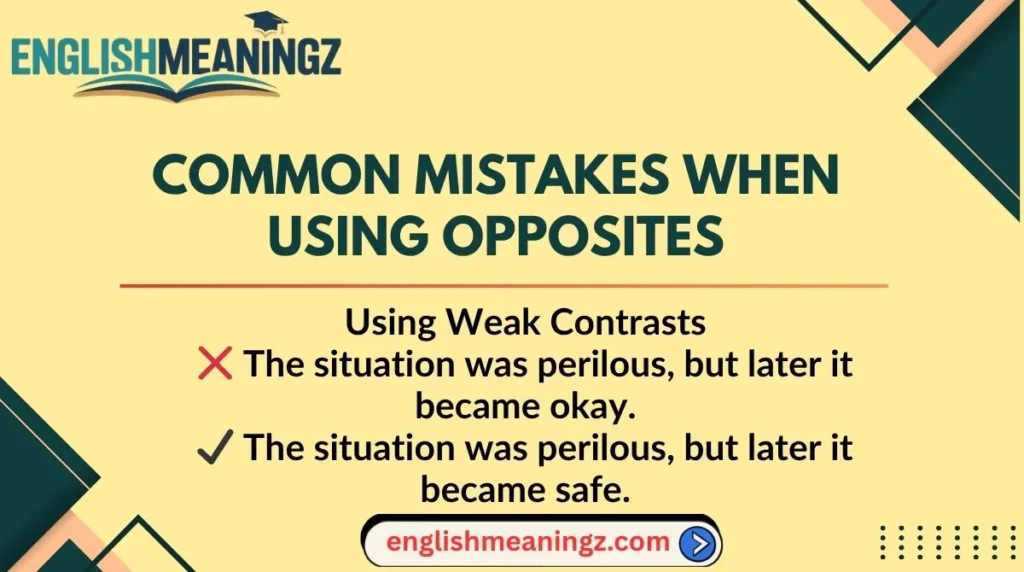
1. Using Weak Contrasts
❌ The situation was perilous, but later it became okay.
✔ The situation was perilous, but later it became safe.
2. Ignoring Context
❌ A perilous disease became comfortable.
✔ A perilous disease became stable.
3. Mixing Tone Levels
❌ The perilous scenario turned into a chill environment.
✔ The perilous scenario turned into a peaceful environment.
4. Overusing Simple Words
❌ Perilous → good
✔ Perilous → secure / risk-free / stable
Precision improves credibility.
Sentence Transformation Examples
Original 1
The hikers faced a perilous path.
Rewritten: The hikers followed a safe path.
Original 2
The company made a perilous decision.
Rewritten: The company made a secure decision.
Original 3
He was in a perilous condition after the accident.
Rewritten: He was in a stable condition after the accident.
Original 4
They sailed through perilous waters.
Rewritten: They sailed through calm waters.
Original 5
The mission seemed perilous at first.
Rewritten: The mission seemed risk-free at first.
FAQs
What is the exact opposite of “perilous”?
The most direct opposite is safe, as it completely removes the idea of danger.
Are all antonyms interchangeable?
No. The correct antonym depends on context, tone, and intensity.
Is “calm” a true antonym of “perilous”?
It is a mild antonym. It changes emotional tone rather than eliminating danger completely.
Which antonym is best for academic writing?
Words like stable, secure, benign, and nonhazardous are ideal for formal contexts.
Can “perilous” have multiple opposites?
Yes. Language is flexible, and antonyms vary depending on usage.
Why is it important to learn antonyms?
They improve clarity, expand vocabulary, and enhance writing precision.
How can I remember these antonyms easily?
Group them by intensity: strong (safe), moderate (stable), and mild (calm).
Conclusion
Mastering antonyms of perilous is more than a vocabulary exercise—it’s a strategic skill. By understanding how different opposites function across tone, context, and intensity, you gain control over how your message is perceived.
Whether you’re writing academically, professionally, or creatively, choosing the right antonym can transform uncertainty into clarity and danger into reassurance.