Understanding opposites is one of the fastest ways to sharpen your language skills. When you learn antonyms, you don’t just memorize new words—you develop a deeper sense of contrast, tone, and precision.
This ability is essential for anyone aiming to write with clarity and impact.
In both academic and professional communication, choosing the right word can completely change how your message is received.
A strong vocabulary allows you to express subtle differences in meaning, especially when discussing abstract ideas like growth, limitation, or transformation.
That’s where learning antonyms of advanced words like transcend becomes valuable—it equips you to communicate both elevation and restriction with equal mastery.
What Does “Transcend” Mean?
Definition:
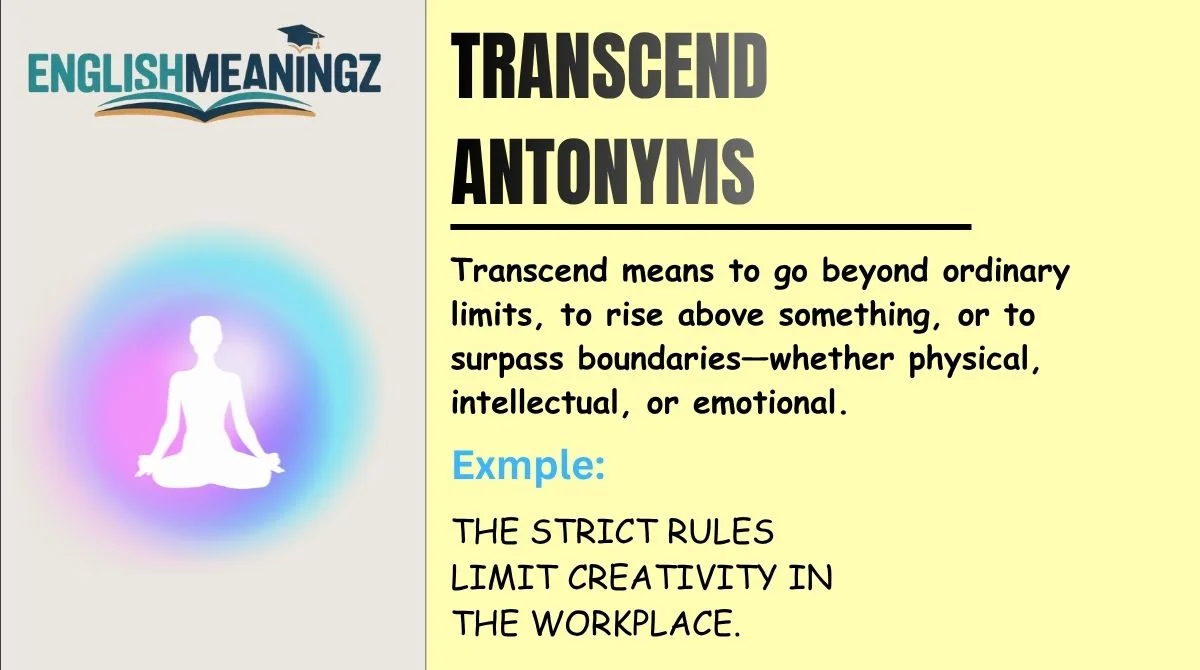
Transcend means to go beyond ordinary limits, to rise above something, or to surpass boundaries—whether physical, intellectual, or emotional.
Tone Explanation:
This word carries a formal and elevated tone, often used in academic, philosophical, or inspirational contexts.
Emotional / Action Intensity:
It expresses high intensity—a sense of breakthrough, progress, or superiority. It implies movement upward or beyond constraints, often associated with growth, excellence, or enlightenment.
17 Best Antonyms for “Transcend”
1. Limit
Meaning: To restrict within boundaries
Tone: Formal
Example: The strict rules limit creativity in the workplace.
Why Opposite: While transcend means going beyond limits, limit enforces them.
2. Confine
Meaning: To keep within fixed boundaries
Tone: Formal / Academic
Example: The patient was confined to the hospital for observation.
Why Opposite: Transcend breaks boundaries; confine enforces containment.
3. Restrict
Meaning: To control or reduce freedom
Tone: Formal
Example: New policies restrict employee flexibility.
Why Opposite: Restriction prevents expansion, unlike transcendence.
4. Suppress
Meaning: To hold back or inhibit
Tone: Emotional / Formal
Example: He suppressed his emotions during the meeting.
Why Opposite: Transcend expresses release; suppress implies control and blockage.
5. Contain
Meaning: To hold within limits
Tone: Neutral
Example: The damage was contained quickly.
Why Opposite: Containment stops expansion, opposing transcendence.
6. Hinder
Meaning: To create obstacles
Tone: Formal
Example: Lack of funding hindered the project.
Why Opposite: Hindrance blocks progress, while transcendence enables it.
7. Impede
Meaning: To slow down or obstruct
Tone: Academic
Example: Traffic congestion impedes emergency services.
Why Opposite: Impeding prevents movement beyond limits.
8. Stagnate
Meaning: To stop developing or progressing
Tone: Academic
Example: Without innovation, businesses stagnate.
Why Opposite: Transcend implies growth; stagnation implies no movement.
9. Remain
Meaning: To stay the same
Tone: Neutral
Example: He remained in the same position for years.
Why Opposite: Remaining is static; transcendence is dynamic.
10. Submit
Meaning: To yield or surrender
Tone: Formal
Example: They submitted to authority without resistance.
Why Opposite: Transcend rises above; submit lowers oneself.
11. Yield
Meaning: To give way
Tone: Formal
Example: The company yielded to market pressure.
Why Opposite: Yielding implies giving in rather than rising above.
12. Obey
Meaning: To follow orders
Tone: Neutral
Example: Students must obey school rules.
Why Opposite: Obedience accepts limits; transcendence challenges them.
13. Comply
Meaning: To act according to rules
Tone: Formal
Example: All employees must comply with regulations.
Why Opposite: Compliance stays within limits instead of surpassing them.
14. Settle
Meaning: To accept less or remain in place
Tone: Informal
Example: Don’t settle for mediocrity.
Why Opposite: Transcend pushes higher; settling accepts less.
15. Fall Short
Meaning: To fail to reach a level
Tone: Informal
Example: The results fell short of expectations.
Why Opposite: Falling short contrasts with exceeding limits.
16. Deteriorate
Meaning: To become worse
Tone: Formal
Example: His health deteriorated over time.
Why Opposite: Transcend improves; deterioration declines.
17. Descend
Meaning: To move downward
Tone: Formal
Example: The plane began to descend slowly.
Why Opposite: Transcend implies rising; descend implies lowering.
Strong vs Mild Opposites
Not all antonyms carry the same intensity. Understanding this difference helps you choose the most accurate word.
Strong Opposites:
Words like confine, suppress, impede, and descend create a clear and forceful contrast. They directly oppose the idea of rising above limitations.
Mild Opposites:
Words like remain, comply, and settle show a softer contrast. They don’t actively block progress but imply a lack of movement or ambition.
Key Insight:
- Use strong antonyms in persuasive or emotional writing.
- Use mild antonyms in neutral or descriptive contexts.
Context-Based Opposites
Antonyms are not always fixed—they depend on context.
- In emotional context:
Transcend → Suppress - In physical movement:
Transcend → Descend - In professional growth:
Transcend → Stagnate - In rules and authority:
Transcend → Comply
Choosing the right opposite depends on what aspect of transcend you are addressing—movement, growth, or freedom.
Common Mistakes When Using Opposites
1. Using unrelated words
Incorrect: Transcend → Ignore
Reason: Ignoring is not the opposite of surpassing.
2. Choosing weak contrasts
Incorrect: Transcend → Stay
Better: Transcend → Stagnate
3. Confusing tone levels
Using informal antonyms in formal writing can weaken impact.
4. Misunderstanding context
Example:
Wrong: He transcended the rules → He descended the rules
Correct: He transcended the rules → He complied with the rules
Sentence Transformation Examples
1. Original: She transcended all expectations.
Rewritten: She fell short of expectations.
2. Original: He transcended his limitations.
Rewritten: He remained within his limitations.
3. Original: The artist transcended traditional styles.
Rewritten: The artist complied with traditional styles.
4. Original: They transcended barriers to succeed.
Rewritten: They were hindered by barriers.
5. Original: Her ideas transcend conventional thinking.
Rewritten: Her ideas remain within conventional thinking.
FAQs
What is the simplest antonym of transcend?
The simplest antonym is limit, as it directly opposes the idea of going beyond boundaries.
Is “descend” always an antonym of transcend?
Not always. It works best in physical or metaphorical “up vs down” contexts.
Can “comply” be an antonym of transcend?
Yes, especially when transcend means breaking rules, and comply means following them.
Which antonym is best for academic writing?
Words like restrict, impede, and stagnate are ideal for formal contexts.
Are all antonyms exact opposites?
No. Some are contextual or partial opposites depending on usage.
What is a strong emotional opposite of transcend?
Suppress works well when referring to emotions or inner growth.
Why should I learn antonyms like these?
They improve precision, clarity, and expressive power in both writing and speaking.
Conclusion
Mastering antonyms of advanced words like transcend gives you a powerful edge in communication. It allows you to express both progress and limitation with clarity and nuance.
Whether you’re writing academically, professionally, or creatively, understanding these contrasts helps you choose words that truly match your intent.
By learning these 17 antonyms—ranging from strong restrictions like confine to subtle contrasts like remain—you gain control over tone, meaning, and impact.
The more precisely you can express opposites, the more persuasive and polished your language becomes.