Understanding opposites is one of the fastest ways to sharpen your vocabulary and elevate your writing. Antonyms do more than just provide contrast—they help clarify meaning, refine tone, and create precision in communication.
Whether you’re writing essays, crafting professional emails, or optimizing content for search engines, knowing the right opposite word can dramatically improve clarity and impact.
In academic and professional communication, word choice reflects intelligence, credibility, and intent. Using accurate antonyms allows you to avoid ambiguity and express ideas more effectively.
For instance, replacing a vague contrast with a precise antonym strengthens arguments, enhances readability, and improves SEO performance by expanding semantic range.
This guide explores 24 powerful antonyms for “text”, along with practical usage, tone distinctions, and real-world examples to help you master them confidently.
What Does “Text” Mean?
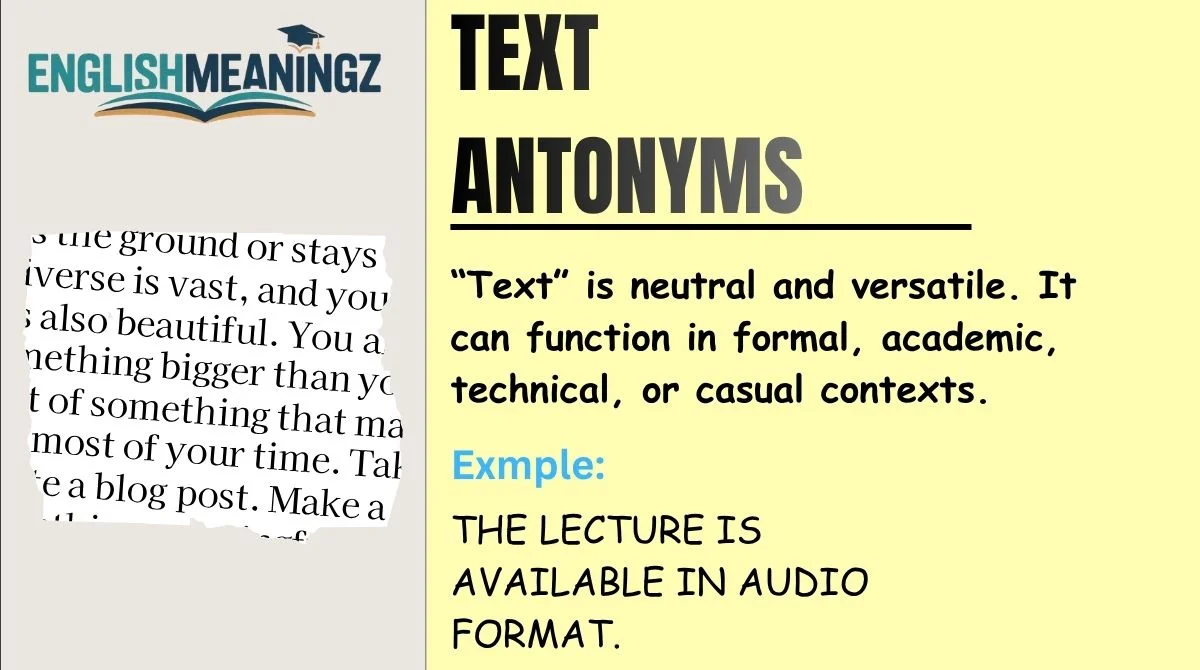
The word “text” primarily refers to written or printed words used to convey information, ideas, or messages. It can appear in books, articles, messages, or digital formats.
Tone Explanation:
“Text” is neutral and versatile. It can function in formal, academic, technical, or casual contexts.
Emotional or Action Intensity:
The word itself carries low emotional intensity. However, its meaning can shift depending on context—ranging from informative (academic text) to conversational (text message).
24 Best Antonyms for “Text”
1. Silence
Meaning: Absence of sound or communication
Tone: Emotional / Neutral
Example: The room fell into complete silence after the announcement.
Why Opposite: Text conveys information; silence represents no communication.
2. Speech
Meaning: Spoken words
Tone: Formal / Informal
Example: Her speech was more impactful than any written text.
Why Opposite: Text is written; speech is verbal.
3. Audio
Meaning: Sound-based communication
Tone: Technical
Example: The lecture is available in audio format.
Why Opposite: Audio relies on sound, not written words.
4. Conversation
Meaning: Interactive spoken exchange
Tone: Informal
Example: A conversation can reveal more than static text.
Why Opposite: Text is static; conversation is dynamic and spoken.
5. Image
Meaning: Visual representation
Tone: Neutral
Example: The image conveyed emotions that text could not.
Why Opposite: Images communicate visually, not through words.
6. Video
Meaning: Moving visual content
Tone: Informal / Technical
Example: The video explained the concept better than text.
Why Opposite: Video combines visuals and motion instead of written language.
7. Gesture
Meaning: Body movement expressing meaning
Tone: Informal
Example: His gesture replaced the need for text.
Why Opposite: Gesture is non-verbal communication.
8. Expression
Meaning: Conveying emotion without words
Tone: Emotional
Example: Her facial expression said more than text ever could.
Why Opposite: Expression often excludes written language.
9. Action
Meaning: Doing rather than describing
Tone: Neutral
Example: Actions speak louder than text.
Why Opposite: Text explains; action demonstrates.
10. Noise
Meaning: Unstructured sound
Tone: Informal
Example: The noise drowned out any meaningful text.
Why Opposite: Noise lacks structured meaning unlike text.
11. Verbalization
Meaning: Speaking thoughts aloud
Tone: Formal
Example: Verbalization is often quicker than writing text.
Why Opposite: Focuses on spoken, not written communication.
12. Illustration
Meaning: Visual explanation
Tone: Academic
Example: The illustration clarified what text could not.
Why Opposite: Illustration replaces written explanation.
13. Demonstration
Meaning: Showing how something works
Tone: Formal
Example: A demonstration is more effective than reading text.
Why Opposite: Demonstration is action-based, not text-based.
14. Signal
Meaning: Non-verbal sign or cue
Tone: Technical
Example: The signal conveyed the message without text.
Why Opposite: Signals replace written communication.
15. Symbol
Meaning: Representation without words
Tone: Academic
Example: Symbols often replace lengthy text.
Why Opposite: Symbols compress meaning without writing.
16. Sound
Meaning: Audible communication
Tone: Neutral
Example: Sound can express tone better than text.
Why Opposite: Text is visual; sound is auditory.
17. Performance
Meaning: Acting or presenting
Tone: Formal
Example: The performance communicated the story without text.
Why Opposite: Performance uses action instead of writing.
18. Movement
Meaning: Physical motion conveying meaning
Tone: Neutral
Example: Dance uses movement instead of text.
Why Opposite: Movement is expressive without words.
19. Interaction
Meaning: Two-way communication
Tone: Informal
Example: Interaction is more engaging than plain text.
Why Opposite: Text is often one-directional.
20. Experience
Meaning: Direct involvement
Tone: Emotional
Example: Experience teaches better than text.
Why Opposite: Experience replaces theoretical written content.
21. Reality
Meaning: Actual events
Tone: Neutral
Example: Reality differs from what text describes.
Why Opposite: Text represents; reality exists.
22. Practice
Meaning: Doing repeatedly
Tone: Academic
Example: Practice is more effective than reading text.
Why Opposite: Practice is action, not written instruction.
23. Observation
Meaning: Watching and learning
Tone: Formal
Example: Observation often replaces the need for text.
Why Opposite: Observation is visual, not written.
24. Demonstrative Action
Meaning: Showing instead of telling
Tone: Formal
Example: Demonstrative action eliminates the need for text.
Why Opposite: Emphasizes action over written explanation.
Strong vs Mild Opposites
Not all antonyms carry the same intensity. Some completely contrast with “text,” while others only partially oppose it.
Strong Opposites:
- Silence
- Action
- Gesture
- Reality
These eliminate written communication entirely.
Mild Opposites:
- Speech
- Audio
- Illustration
- Conversation
These still communicate but through different mediums.
Understanding this scale helps you choose the most accurate antonym based on context and tone.
Context-Based Opposites
Antonyms for “text” vary depending on usage:
- Academic context: Illustration, demonstration
- Digital context: Video, audio
- Emotional context: Silence, expression
- Professional context: Verbalization, presentation
For example, in a classroom, “demonstration” may be the best opposite, while in social media, “video” works better.
Common Mistakes When Using Opposites
1. Confusing medium with meaning
Incorrect: Speech is always the opposite of text
Correct: It depends on context
2. Using weak contrasts
Incorrect: Message as an opposite of text
Correct: Silence or gesture
3. Ignoring tone
Formal writing requires precise antonyms like “verbalization” instead of “talk”
4. Overgeneralizing
Not every non-written form is a perfect opposite
Sentence Transformation Examples
1. Original: The text explains the process clearly.
Rewritten: The demonstration shows the process clearly.
2. Original: I prefer reading text to understand concepts.
Rewritten: I prefer observation to understand concepts.
3. Original: The text message was informative.
Rewritten: The audio message was informative.
4. Original: The text describes the situation.
Rewritten: The reality reveals the situation.
5. Original: The text lacked emotion.
Rewritten: The performance conveyed deep emotion.
FAQs
What is the exact opposite of “text”?
There is no single exact opposite. “Silence” and “speech” are the closest depending on context.
Are antonyms always direct opposites?
No, some are contextual rather than absolute opposites.
Can “speech” always replace “text”?
Not always. It depends on whether the contrast is written vs spoken.
Why are antonyms important in writing?
They improve clarity, contrast, and engagement.
Are visual elements antonyms of text?
Yes, in many contexts, visuals like images or videos act as opposites.
How do I choose the right antonym?
Consider context, tone, and communication method.
Do antonyms improve SEO?
Yes, they expand keyword diversity and semantic relevance.
Conclusion
Mastering antonyms for “text” is more than a vocabulary exercise—it’s a strategic advantage in communication.
By understanding the differences between written, spoken, visual, and action-based expressions, you gain the ability to choose words with precision and purpose.
Whether you’re writing academically, professionally, or creatively, these 24 antonyms help you communicate more effectively, avoid repetition, and enhance clarity.
The key is context. Always match the antonym to the situation, tone, and intent of your message. When used correctly, opposites don’t just contrast—they elevate your entire writing style.