Strong vocabulary is one of the most important elements of effective writing. Whether you are preparing an academic essay, publishing a blog post, or writing a professional report, the ability to express ideas with varied language significantly improves clarity and engagement.
One common mistake many writers make is repeating the same descriptive word throughout their text.
Repetition weakens writing quality and often reduces academic scores in exams such as IELTS, TOEFL, and university assessments.
A rich vocabulary allows writers to maintain precision while also keeping the reader interested.
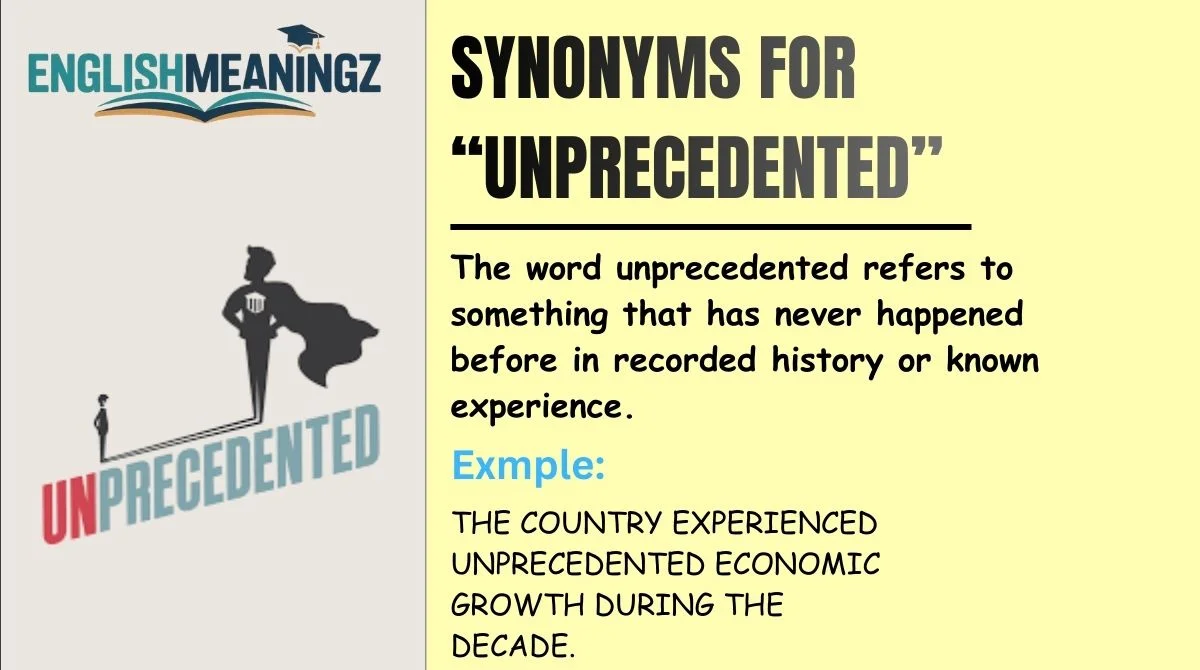
The word “unprecedented” is frequently used to describe events, achievements, or situations that have never happened before.
While it is a powerful word, overusing it can make writing sound repetitive. Learning alternative expressions enables writers to adapt tone, adjust intensity, and communicate more effectively.
This article explores 16 synonyms for “unprecedented”, explains their meanings, and demonstrates how to use them in different contexts.
Students, bloggers, and professionals will benefit from understanding when and how to replace this word with suitable alternatives.
Definition and Core Meaning of “Unprecedented”
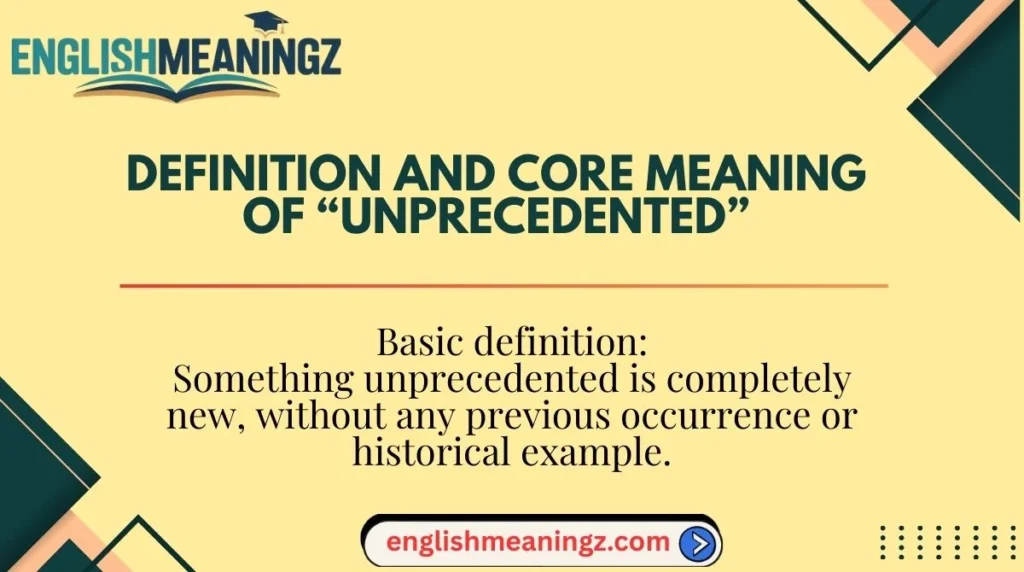
The word unprecedented refers to something that has never happened before in recorded history or known experience. It describes events or circumstances that lack prior examples, making them exceptional, remarkable, or historically significant.
In academic and professional contexts, the term is often used to emphasize scale, originality, or novelty.
Basic definition:
Something unprecedented is completely new, without any previous occurrence or historical example.
Example Sentences
- The country experienced unprecedented economic growth during the decade.
- Scientists observed unprecedented levels of atmospheric change in recent years.
- The company achieved unprecedented global expansion in less than five years.
Because of its strong meaning, writers often seek synonyms that convey similar ideas but suit different tones and contexts.
16 Synonyms Grouped by Context
General Use
These synonyms can be used in everyday writing or general descriptive contexts.
1. Unparalleled
Meaning: Something that has no equal or comparison.
Context: Often used to describe excellence or extreme uniqueness.
Example:
The athlete demonstrated unparalleled determination throughout the competition.
2. Unmatched
Meaning: Not equaled by anything else.
Context: Frequently used to describe superiority or exceptional quality.
Example:
Her dedication to community service remains unmatched among her peers.
3. Extraordinary
Meaning: Very unusual or remarkable.
Context: Used when something goes beyond ordinary expectations.
Example:
The rescue team showed extraordinary courage during the disaster response.
4. Remarkable
Meaning: Worth noticing due to its unusual nature or achievement.
Context: Common in both academic and journalistic writing.
Example:
The researcher made a remarkable discovery in renewable energy technology.
Formal & Academic Writing
These synonyms are particularly useful in essays, research papers, and professional reports.
5. Historic
Meaning: Important in history or likely to be remembered.
Context: Used when describing events with long-term historical significance.
Example:
The agreement marked a historic moment in international diplomacy.
6. Groundbreaking
Meaning: Introducing new ideas or methods.
Context: Often used in scientific research and innovation.
Example:
The team published a groundbreaking study on climate change adaptation.
7. Revolutionary
Meaning: Causing a dramatic change in thinking, technology, or systems.
Context: Common in technological, social, and scientific discussions.
Example:
The invention of smartphones was revolutionary for global communication.
8. Transformative
Meaning: Capable of producing significant change.
Context: Used in academic discussions about policy, education, and social reform.
Example:
Digital learning platforms have had a transformative impact on modern education.
9. Exceptional
Meaning: Unusually good or outstanding.
Context: Appropriate for formal assessments or academic descriptions.
Example:
The university recognized her exceptional academic performance.
Informal Usage
These synonyms are often used in casual writing, journalism, or conversational contexts.
10. Record-Breaking
Meaning: Surpassing previous records.
Context: Common in sports, weather reports, and news coverage.
Example:
The city experienced record-breaking temperatures during the summer.
11. Incredible
Meaning: Difficult to believe due to its extraordinary nature.
Context: Widely used in informal speech and media.
Example:
The startup achieved incredible growth within its first year.
12. Unbelievable
Meaning: So surprising that it is hard to accept as true.
Context: Used for emphasis in storytelling and informal writing.
Example:
The magician performed unbelievable tricks during the show.
13. Phenomenal
Meaning: Extremely impressive or remarkable.
Context: Popular in journalism and entertainment media.
Example:
The singer received a phenomenal response from the audience.
Technical or Subject-Specific Use
These words are particularly useful in academic, scientific, or analytical contexts.
14. Novel
Meaning: New and not previously known or used.
Context: Frequently used in research, science, and technology discussions.
Example:
Researchers developed a novel method for detecting early-stage diseases.
15. Original
Meaning: Not copied or previously created.
Context: Common in discussions about creativity and innovation.
Example:
The artist is known for her original style of digital illustration.
16. Pioneering
Meaning: Involving new ideas or methods that lead future developments.
Context: Often used to describe influential researchers or inventors.
Example:
She conducted pioneering research in artificial intelligence.
Word Intensity & Tone Comparison Table
| Word | Formal Level | Emotional Strength | Typical Context |
|---|---|---|---|
| Unprecedented | High | Strong | Academic, journalism |
| Unparalleled | High | Strong | Achievements |
| Groundbreaking | High | Strong | Research, innovation |
| Revolutionary | High | Very Strong | Technology, politics |
| Transformative | High | Moderate | Education, policy |
| Exceptional | Medium-High | Moderate | Performance evaluation |
| Remarkable | Medium | Moderate | General description |
| Record-breaking | Medium | Strong | Sports, statistics |
| Incredible | Informal | Strong | Media, storytelling |
| Phenomenal | Informal | Strong | Entertainment |
This comparison helps writers choose words that match the appropriate tone and context.
Common Mistakes When Using These Synonyms
Even though these words are similar, they are not always interchangeable. Misusing them can weaken the clarity of writing.
Mistake 1: Using Informal Words in Academic Writing
Incorrect:
The scientist made an incredible discovery in quantum physics.
Better:
The scientist made a groundbreaking discovery in quantum physics.
Mistake 2: Overusing Strong Words
Writers sometimes exaggerate by repeatedly using very powerful adjectives.
Incorrect:
The company launched a revolutionary product, followed by another revolutionary update.
Better:
The company launched a revolutionary product, followed by a significant update.
Mistake 3: Confusing “Novel” with “Fiction”
Some learners think “novel” only refers to books.
Incorrect:
The study used a novel book method.
Correct:
The study used a novel approach to data analysis.
Mistake 4: Misusing “Historic”
Historic refers to importance in history, not simply something old.
Incorrect:
They visited a historic restaurant last night.
Better:
They visited a historic landmark known for its cultural heritage.
Synonyms in Academic Writing
Example Paragraph 1
The rapid advancement of artificial intelligence represents a transformative shift in modern society. Over the past decade, researchers have introduced groundbreaking innovations that significantly improve healthcare diagnostics and industrial efficiency. These developments illustrate how technological progress can reshape economic systems and redefine professional roles.
Example Paragraph 2
Climate change has created unparalleled environmental challenges across the globe. Rising temperatures, extreme weather patterns, and declining biodiversity highlight the urgent need for pioneering research and sustainable policy initiatives. Governments and international organizations must collaborate to address these complex issues effectively.
IELTS & Exam Writing Tips
1. Avoid Repetition
Repeated vocabulary reduces lexical variety scores in writing exams.
Example:
Instead of repeating unprecedented several times, rotate synonyms:
- unprecedented growth
- remarkable expansion
- extraordinary progress
2. Choose Context-Appropriate Words
Some synonyms are better suited for academic writing.
Best for IELTS essays:
- unprecedented
- remarkable
- exceptional
- transformative
- groundbreaking
3. Do Not Replace Words Blindly
Sometimes the original word is the best choice.
Example:
“Unprecedented crisis” is a commonly accepted phrase. Replacing it with “incredible crisis” may weaken the meaning.
4. Focus on Collocations
Certain words naturally pair with specific nouns.
Examples:
- Groundbreaking research
- Historic agreement
- Record-breaking sales
Learning these combinations improves fluency.
Similar Words vs True Synonyms
Although many words appear similar to unprecedented, subtle differences exist.
Unprecedented vs Extraordinary
- Unprecedented: Never happened before.
- Extraordinary: Very unusual but not necessarily the first time.
Example:
The pandemic created unprecedented global disruption.
Her performance was extraordinary.
Unprecedented vs Revolutionary
- Unprecedented: Something entirely new.
- Revolutionary: Something that causes major change.
Example:
A revolutionary invention may not be unprecedented if similar ideas existed before.
Unprecedented vs Record-Breaking
- Unprecedented: No historical example.
- Record-breaking: Surpasses previous records.
Example:
Record-breaking rainfall may still have happened before.
Understanding these differences allows writers to select the most precise word.
Practice Sentences
Complete the sentences with an appropriate synonym.
- The scientist conducted ______ research that changed modern medicine.
- The country faced ______ economic challenges during the crisis.
- The athlete achieved ______ success by winning five gold medals.
- Researchers introduced a ______ method for improving battery efficiency.
- The city experienced ______ rainfall last year.
Suggested answers: groundbreaking, unprecedented, phenomenal, novel, record-breaking.
FAQs
What is the best synonym for unprecedented?
Some of the best synonyms include unparalleled, groundbreaking, revolutionary, remarkable, and exceptional. The best choice depends on the writing context.
Is “unprecedented” a formal word?
Yes. The word is considered formal and commonly used in academic writing, journalism, and professional communication.
Can “extraordinary” replace “unprecedented”?
Sometimes, but not always. Extraordinary means very unusual, while unprecedented specifically means something that has never occurred before.
Which synonym is best for academic essays?
Words such as groundbreaking, transformative, exceptional, and unparalleled work well in academic writing.
How can students improve vocabulary for writing?
Students can improve vocabulary by reading academic texts, practicing synonyms, learning word collocations, and applying new vocabulary in writing exercises.
Conclusion
Expanding vocabulary is one of the most effective ways to improve writing quality. While the word unprecedented is powerful and widely used, relying on it too often can limit stylistic variety.
Learning synonyms such as unparalleled, groundbreaking, transformative, phenomenal, and pioneering allows writers to express ideas more precisely and adapt tone for different audiences.
This skill is particularly valuable for students preparing for academic exams, bloggers creating engaging content, and professionals producing clear reports.
By understanding context, tone, and subtle meaning differences, writers can select the most appropriate word for each situation.
Continuous vocabulary development not only strengthens writing but also enhances communication skills in academic and professional environments.