Strong writing depends not only on ideas but also on vocabulary variety. Repeating the same word multiple times can make writing sound limited, reduce clarity, and lower overall quality.
This is especially important in academic essays, professional reports, and online content where language precision matters.
Using synonyms effectively helps writers communicate ideas more clearly while keeping the text engaging and sophisticated.
In academic environments, vocabulary range is often directly connected to higher writing scores. Exams such as IELTS, TOEFL, and university-level assignments specifically reward lexical variety.
Students benefit from synonyms by improving essay quality and avoiding repetition. Bloggers and content writers use them to maintain reader interest and improve SEO performance.
Professionals rely on precise vocabulary to sound credible and authoritative in reports, presentations, and research papers.
One commonly used word that appears frequently in writing is “contemporary.” Learning its synonyms allows writers to adapt tone, context, and formality depending on the situation.
This guide explains the meaning of the word contemporary and presents 15 useful synonyms, grouped by context, with clear explanations and examples.
Definition and Core Meaning of “Contemporary”
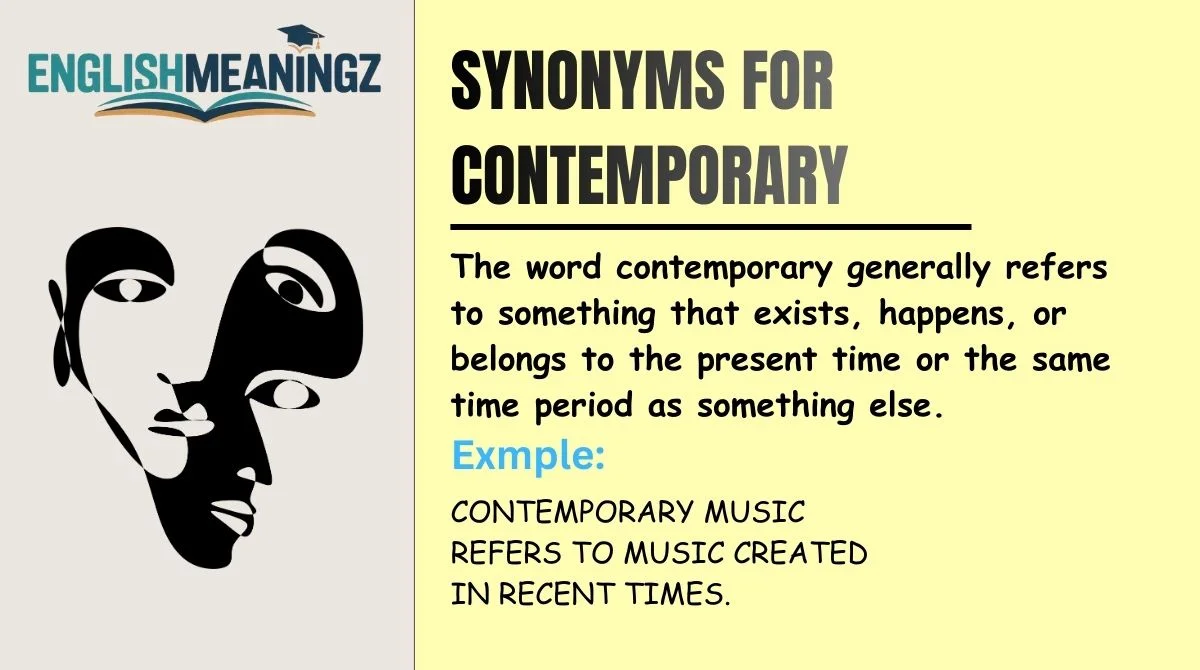
The word contemporary generally refers to something that exists, happens, or belongs to the present time or the same time period as something else.
In everyday language, it often describes modern culture, art, design, literature, or events happening in the current era.
For example:
- Contemporary music refers to music created in recent times.
- Contemporary issues refer to problems affecting society today.
In academic discussions, the term may also describe people or events that existed during the same historical period.
Example:
- Shakespeare and Cervantes were contemporaries.
Therefore, the word has two primary meanings:
- Belonging to the present time
- Existing at the same time as something else
Understanding this dual meaning is essential when selecting the most appropriate synonym.
15 Synonyms Grouped by Context
General Use
These synonyms are commonly used in everyday writing and conversation.
Modern
Meaning: Related to the present era or current styles.
Context Explanation:
“Modern” is one of the closest and most common substitutes for contemporary. It often describes technology, lifestyle, architecture, or ideas associated with recent developments.
Example Sentence:
Modern communication technologies have transformed how people interact globally.
Current
Meaning: Happening or existing now.
Context Explanation:
“Current” is widely used in journalism, academic discussions, and professional reports when referring to present conditions or ongoing situations.
Example Sentence:
Researchers are studying current environmental challenges facing coastal regions.
Present-day
Meaning: Existing in today’s world.
Context Explanation:
This phrase emphasizes comparison between the past and today.
Example Sentence:
Present-day cities must balance economic growth with environmental protection.
Recent
Meaning: Occurring not long ago.
Context Explanation:
Although slightly different from “contemporary,” this word is useful when discussing events close to the present time.
Example Sentence:
Recent technological innovations have improved medical diagnosis.
Formal & Academic Writing
These synonyms are particularly useful in essays, research papers, and professional writing.
Modern-day
Meaning: Relating specifically to the modern period.
Context Explanation:
Common in historical comparisons or academic discussions.
Example Sentence:
Modern-day economies rely heavily on digital infrastructure.
Up-to-date
Meaning: Incorporating the latest knowledge or developments.
Context Explanation:
Often used when referring to information, research, or data that reflects the latest developments.
Example Sentence:
The report provides up-to-date statistics on global energy consumption.
Existing
Meaning: Currently in place or operating.
Context Explanation:
Used frequently in formal writing to describe systems, policies, or structures that are already established.
Example Sentence:
The study evaluates existing healthcare policies across different regions.
Coeval
Meaning: Existing at the same time.
Context Explanation:
A more academic synonym used mainly in historical or literary analysis.
Example Sentence:
The philosopher was coeval with several influential thinkers of his era.
Informal Usage
These words are common in casual communication or conversational writing.
Today’s
Meaning: Belonging to the present day.
Context Explanation:
Often used in blogs, media articles, and everyday speech.
Example Sentence:
Today’s students rely heavily on digital tools for learning.
New-age
Meaning: Reflecting modern ideas or progressive thinking.
Context Explanation:
Frequently used in discussions about lifestyle, spirituality, or innovative practices.
Example Sentence:
New-age wellness trends emphasize mindfulness and mental health.
Fresh
Meaning: New, original, or recently introduced.
Context Explanation:
In informal contexts, this word suggests newness or innovation.
Example Sentence:
The company introduced fresh ideas to improve customer engagement.
Technical or Subject-Specific Use
These synonyms are often used in specialized contexts.
State-of-the-art
Meaning: Using the most advanced technology available.
Context Explanation:
Common in engineering, technology, medicine, and research discussions.
Example Sentence:
The hospital installed state-of-the-art medical equipment.
Cutting-edge
Meaning: Extremely advanced or innovative.
Context Explanation:
Frequently used in science, technology, and business.
Example Sentence:
The university laboratory focuses on cutting-edge artificial intelligence research.
Progressive
Meaning: Supporting modern ideas or reforms.
Context Explanation:
Often used in social sciences and policy discussions.
Example Sentence:
Progressive educational policies emphasize critical thinking.
Avant-garde
Meaning: Highly innovative or experimental.
Context Explanation:
Commonly used in art, design, literature, and culture.
Example Sentence:
The gallery showcases avant-garde contemporary art.
Word Intensity & Tone Comparison Table
| Word | Formal Level | Emotional Tone | Typical Context |
|---|---|---|---|
| Modern | Neutral | Neutral | General writing |
| Current | Formal | Neutral | Academic reports |
| Present-day | Formal | Neutral | Historical comparison |
| Recent | Neutral | Mild | News and updates |
| Up-to-date | Semi-formal | Positive | Information accuracy |
| Cutting-edge | Informal–Professional | Strong | Technology |
| State-of-the-art | Professional | Strong | Engineering/Science |
| Progressive | Academic | Positive | Social policies |
| Avant-garde | Academic | Artistic | Art and culture |
| Fresh | Informal | Positive | Casual writing |
Common Mistakes When Using These Synonyms
Although many synonyms appear similar, incorrect usage can create confusion or alter meaning.
Mistake 1: Using “recent” instead of “contemporary”
Incorrect:
Recent architecture often reflects cultural identity.
Correction:
Contemporary architecture often reflects cultural identity.
Explanation:
“Recent” refers to time, while “contemporary” often describes current styles or ideas.
Mistake 2: Overusing “modern”
Incorrect:
Modern society faces modern challenges that require modern solutions.
Correction:
Contemporary society faces current challenges that require innovative solutions.
Explanation:
Repeating the same synonym reduces vocabulary quality.
Mistake 3: Misusing “avant-garde”
Incorrect:
The company released an avant-garde software update.
Correction:
The company released a cutting-edge software update.
Explanation:
“Avant-garde” is primarily used for art and creative expression.
Synonyms in Academic Writing
Example Paragraph 1
Contemporary societies face complex environmental challenges that require interdisciplinary solutions. Modern research emphasizes the integration of technology, policy, and community engagement to address climate change. Current studies suggest that sustainable development strategies must consider both economic growth and environmental protection.
Example Paragraph 2
Present-day educational systems increasingly incorporate digital technologies to enhance learning experiences. Up-to-date teaching methods encourage collaboration, critical thinking, and problem-solving. These progressive approaches prepare students for rapidly evolving global economies.
IELTS & Exam Writing Tips
Vocabulary variety is a major scoring factor in exams such as IELTS writing tasks.
1. Avoid repetition
Instead of repeating “contemporary,” alternate with suitable synonyms.
Example:
Contemporary societies face new challenges.
Modern economies must adapt quickly.
2. Choose context-appropriate synonyms
Not every synonym works in every situation.
Example:
Correct: cutting-edge technology
Incorrect: avant-garde technology
3. Maintain clarity
Do not replace a word simply to appear sophisticated.
Example:
Clear writing is always more important than complex vocabulary.
4. Use synonyms strategically
Replacing one or two repeated words is often sufficient.
5. Learn collocations
Some synonyms naturally pair with specific nouns:
- cutting-edge technology
- modern architecture
- current research
Similar Words vs True Synonyms
Many words seem similar but are not exact substitutes.
Contemporary vs Modern
“Modern” often refers to developments since the industrial era, while “contemporary” refers specifically to the present time.
Contemporary vs Current
“Current” focuses on time, while “contemporary” may also refer to style or cultural trends.
Contemporary vs Recent
“Recent” means not long ago, but it does not always describe present conditions.
Example:
Recent discoveries vs contemporary research trends.
Contemporary vs Progressive
“Progressive” emphasizes forward-thinking ideas rather than simply belonging to the present.
Practice Sentences
Complete the sentences using appropriate synonyms.
- __________ technology is transforming global communication.
- Researchers rely on __________ data for accurate conclusions.
- The museum displays __________ art from modern artists.
- __________ societies must address climate change.
- The laboratory uses __________ equipment for experiments.
- __________ education focuses on creativity and innovation.
- The architect designed a __________ building with minimalist features.
- Scholars analyze __________ political developments.
Possible answers may include: modern, current, contemporary, cutting-edge, progressive, state-of-the-art, present-day.
FAQs
What is the closest synonym for contemporary?
The closest synonym is modern, especially when referring to present-day styles, technology, or culture.
Can “current” replace “contemporary”?
Yes, but only when referring to present time. It may not work when describing artistic or stylistic movements.
Is “avant-garde” a synonym for contemporary?
It can be related but is more specific. “Avant-garde” refers to highly innovative or experimental art and design.
Which synonym is best for academic writing?
Common academic alternatives include current, present-day, modern, and up-to-date.
How many synonyms should I use in an essay?
Use synonyms naturally to avoid repetition, but prioritize clarity over excessive vocabulary variation.
Conclusion
Expanding vocabulary is one of the most effective ways to improve writing quality. Learning synonyms for commonly used words such as contemporary allows writers to express ideas more precisely while avoiding repetition.
Students benefit from stronger essays and higher exam scores. Bloggers improve readability and SEO performance. Professionals communicate ideas more effectively in reports and presentations.
By understanding context, tone, and subtle differences between synonyms, writers can select the most accurate word for each situation.
Continuous vocabulary development ultimately leads to clearer communication, stronger arguments, and more engaging writing.