Mastering opposites is one of the fastest ways to upgrade your writing from average to exceptional. When you understand not just what a word means—but also what it does not mean—you gain precision, control, and stylistic flexibility.
In academic and professional communication, clarity is everything. Words like semblance often appear in formal contexts, especially when describing appearances, illusions, or partial truths.
But relying on a single term limits expression. Knowing its antonyms allows you to communicate the absence of illusion, the presence of reality, or the complete rejection of appearance.
This article delivers a clean, structured, and fully original breakdown of 16 powerful antonyms for semblance, helping you write with accuracy, nuance, and authority.
What Does “Semblance” Mean?
Definition:
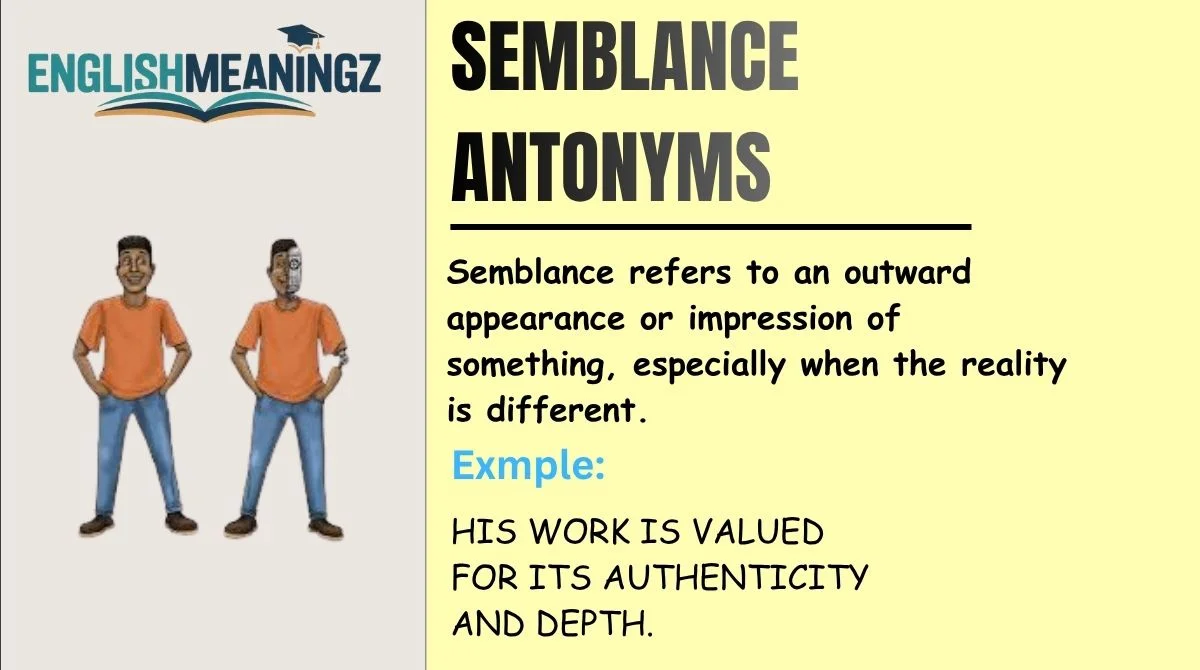
Semblance refers to an outward appearance or impression of something, especially when the reality is different.
Tone Explanation:
The word carries a slightly formal and often skeptical tone. It suggests something that looks real but may not fully be so.
Emotional / Intensity Insight:
Semblance operates in the gray area between truth and illusion. It doesn’t imply complete falsehood—but rather a partial, possibly misleading appearance. For example, “a semblance of order” suggests that things appear organized, even if they are not truly structured underneath.
16 Best Antonyms for “Semblance”
Reality
Meaning: The state of things as they actually exist
Tone: Formal / Academic
Example: The investigation revealed the harsh reality behind the polished presentation.
Why Opposite: Semblance suggests appearance; reality emphasizes truth without illusion.
Truth
Meaning: Something that is accurate and factual
Tone: Formal / Academic
Example: She demanded the truth rather than a comforting illusion.
Why Opposite: Truth removes any layer of deception or surface-level impression.
Authenticity
Meaning: Genuineness and originality
Tone: Formal
Example: His work is valued for its authenticity and depth.
Why Opposite: Semblance may mask reality, while authenticity reveals it fully.
Genuineness
Meaning: The quality of being real or sincere
Tone: Neutral / Formal
Example: There was a warmth in her voice that reflected true genuineness.
Why Opposite: Semblance implies a façade; genuineness eliminates it.
Substance
Meaning: The real physical or meaningful essence
Tone: Academic
Example: The argument lacked substance despite its impressive delivery.
Why Opposite: Semblance is surface-level; substance refers to depth and reality.
Actuality
Meaning: The state of being real or factual
Tone: Formal
Example: In actuality, the project was far from complete.
Why Opposite: Actuality contradicts any misleading appearance implied by semblance.
Certainty
Meaning: Firm conviction without doubt
Tone: Formal
Example: The data provided certainty rather than speculation.
Why Opposite: Semblance suggests ambiguity; certainty removes it.
Clarity
Meaning: The quality of being clear and easy to understand
Tone: Neutral
Example: The revised report brought clarity to the issue.
Why Opposite: Semblance creates ambiguity; clarity eliminates confusion.
Transparency
Meaning: Openness and honesty without concealment
Tone: Professional
Example: The company promotes transparency in all operations.
Why Opposite: Semblance may hide truth; transparency reveals it fully.
Honesty
Meaning: Truthfulness and sincerity
Tone: Emotional / Neutral
Example: His honesty made him a trusted leader.
Why Opposite: Semblance can mislead; honesty ensures accuracy.
Directness
Meaning: Straightforward communication
Tone: Neutral
Example: Her directness eliminated any misunderstanding.
Why Opposite: Semblance is indirect; directness is explicit.
Plainness
Meaning: Lack of decoration or disguise
Tone: Neutral
Example: The plainness of the design highlighted its function.
Why Opposite: Semblance often involves presentation; plainness avoids it.
Explicitness
Meaning: Fully and clearly expressed
Tone: Academic
Example: The instructions were written with explicitness.
Why Opposite: Semblance leaves room for interpretation; explicitness does not.
Openness
Meaning: Willingness to share information freely
Tone: Emotional / Professional
Example: Openness in communication builds trust.
Why Opposite: Semblance may conceal truth; openness exposes it.
Reality Check
Meaning: A moment of facing the truth
Tone: Informal
Example: The results served as a harsh reality check.
Why Opposite: Semblance creates illusion; a reality check destroys it.
Bare Truth
Meaning: The complete and unfiltered truth
Tone: Emotional
Example: He finally revealed the bare truth about the situation.
Why Opposite: Semblance softens or disguises; bare truth exposes everything.
Strong vs Mild Opposites
Not all antonyms carry the same intensity. Understanding this helps you choose the right word for the context.
Mild Opposites:
Words like clarity, directness, and plainness gently contrast semblance. They reduce ambiguity without strongly rejecting illusion.
Moderate Opposites:
Terms such as authenticity, genuineness, and transparency clearly oppose superficial appearances and emphasize realness.
Strong Opposites:
Words like reality, truth, bare truth, and actuality completely eliminate any sense of illusion or façade.
Key Insight:
Use mild antonyms in neutral descriptions and strong antonyms when you want to challenge or expose deception.
Context-Based Opposites
Antonyms for semblance shift depending on context. Choosing the wrong one can weaken your message.
In Academic Writing:
Use actuality, substance, or explicitness to maintain a formal tone.
In Professional Communication:
Prefer transparency, clarity, and honesty for workplace contexts.
In Emotional or Narrative Writing:
Words like bare truth and reality check create stronger emotional impact.
In Critical Analysis:
Use truth and authenticity to contrast misleading appearances.
Common Mistakes When Using Opposites
Mistake 1: Using Weak Contrasts
Incorrect: “The report showed clarity instead of semblance.”
Better: “The report revealed the truth instead of a mere semblance.”
Mistake 2: Ignoring Tone
Using informal antonyms like reality check in academic writing reduces credibility.
Mistake 3: Confusing Similar Words
Words like appearance are not antonyms—they are synonyms.
Mistake 4: Overusing Strong Words
Not every situation requires bare truth. Sometimes clarity is more appropriate.
Sentence Transformation Examples
Original: The plan gave a semblance of organization.
Rewritten: The plan demonstrated genuine organization and clarity.
Original: His apology had only a semblance of sincerity.
Rewritten: His apology lacked honesty and authenticity.
Original: The system maintained a semblance of control.
Rewritten: The system achieved actual control and stability.
Original: There was a semblance of agreement among the team.
Rewritten: There was clear and genuine agreement among the team.
Original: The design created a semblance of simplicity.
Rewritten: The design reflected true simplicity and transparency.
FAQs
What is the simplest antonym of semblance?
The simplest antonym is reality, as it directly contrasts appearance with truth.
Can “truth” always replace semblance?
Not always. Use truth when emphasizing factual correctness, not just removing illusion.
Is “authenticity” a strong antonym?
Yes, it strongly opposes any form of artificial or misleading appearance.
Which antonym is best for professional writing?
Transparency and clarity are ideal in business contexts.
Are informal antonyms acceptable in essays?
Generally no. Stick to formal terms like actuality or substance.
What is the strongest opposite of semblance?
Bare truth is among the strongest because it implies complete exposure.
How do I choose the right antonym?
Focus on context, tone, and intensity. Match the word to your purpose.
Conclusion
Understanding antonyms of semblance unlocks a deeper level of expression. Instead of merely describing appearances, you gain the ability to highlight truth, expose illusion, and communicate with precision.
From subtle contrasts like clarity to powerful opposites like bare truth, each word offers a unique way to sharpen your message. The key is not just knowing these antonyms—but applying them with intention.
When you replace vague appearances with exact language, your writing becomes more persuasive, credible, and impactful.