Strong vocabulary is one of the most powerful tools in effective writing. Whether someone is writing an academic essay, a professional report, or an online blog post, repeating the same word too often can make the text sound monotonous and unsophisticated.
One commonly repeated word in English writing is “revealed.” While it is a useful verb, relying on it excessively may reduce clarity and stylistic variety.
Using synonyms strategically helps writers express ideas more precisely while improving readability.
Academic institutions, including international exams such as IELTS and TOEFL, often reward lexical variety because it demonstrates language proficiency.
Writers who know how to replace repetitive words with appropriate alternatives tend to achieve higher scores and produce more engaging content.
Students benefit from synonym knowledge when writing essays or research papers. Bloggers and content creators rely on vocabulary variation to maintain reader interest and strengthen search engine optimization.
Professionals also use precise synonyms to communicate findings clearly in reports, presentations, and technical documents.
However, not every synonym can replace a word in every context. The meaning, tone, and formality level of each alternative must match the situation.
This guide explores 14 powerful synonyms for “revealed,” explains when to use them, and provides practical examples to help writers apply them correctly.
Definition and Core Meaning of “Revealed”
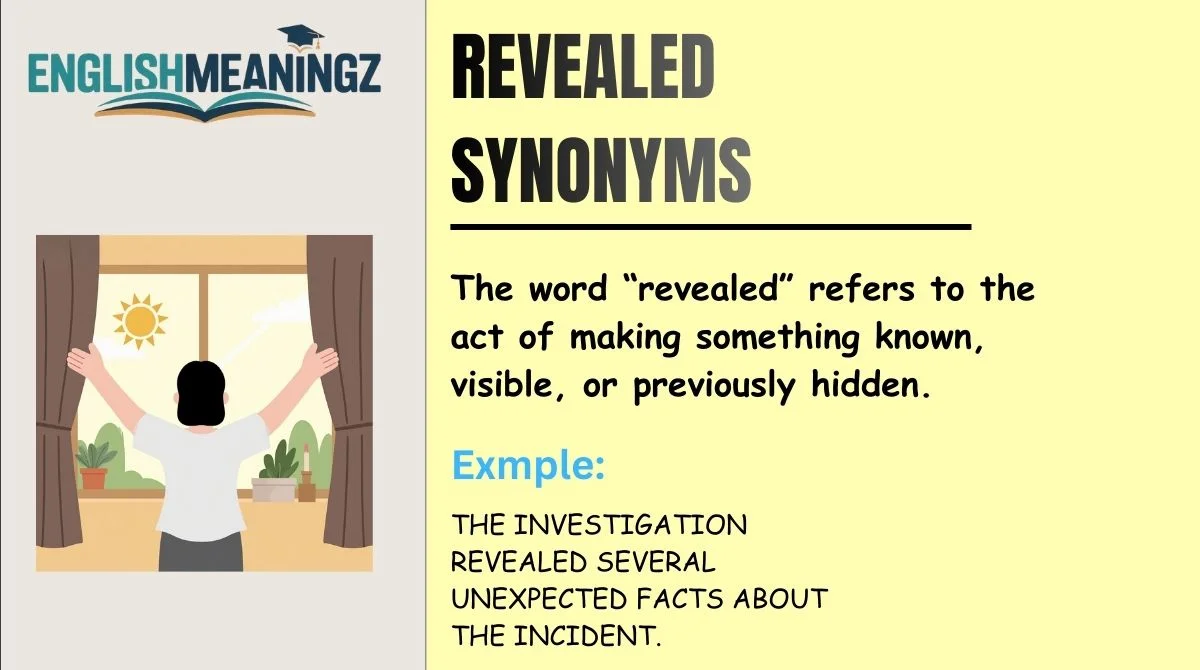
The word “revealed” refers to the act of making something known, visible, or previously hidden. It is commonly used when information, facts, emotions, or secrets become known to others.
In everyday language, “revealed” often describes situations where new information is disclosed.
Example:
The investigation revealed several unexpected facts about the incident.
In academic and research contexts, the word is frequently used to describe findings from experiments, surveys, or studies.
Example:
The results revealed a strong relationship between sleep quality and academic performance.
The core meaning of “revealed” therefore includes several related concepts:
- Making hidden information visible
- Disclosing facts or data
- Showing something clearly
- Bringing truth or knowledge to light
Because of this broad meaning, many different synonyms can replace “revealed,” depending on tone, formality, and context.
14 Synonyms Grouped by Context
To use synonyms effectively, it is helpful to group them based on the type of communication. Some words fit everyday writing, while others are better suited for academic or technical situations.
General Use Synonyms
These synonyms work well in most writing situations and are widely understood.
Showed
Meaning: To make something visible or clear to others.
Context: One of the most common alternatives to “revealed,” especially in simple explanations.
Example:
The report showed that customer satisfaction had increased significantly.
Disclosed
Meaning: To make secret or confidential information known.
Context: Often used in journalism, legal writing, or formal announcements.
Example:
The company disclosed its financial losses in the annual report.
Uncovered
Meaning: To discover something that was hidden or unknown.
Context: Frequently used in investigative journalism, research, or discovery.
Example:
The journalist uncovered evidence of corruption within the organization.
Exposed
Meaning: To make something visible or bring attention to something wrong or hidden.
Context: Often used when revealing wrongdoing or truth.
Example:
The documentary exposed serious environmental violations.
Formal and Academic Writing Synonyms
These words are particularly useful for essays, research papers, and professional writing.
Demonstrated
Meaning: To show evidence or proof clearly.
Context: Common in scientific and academic writing.
Example:
The experiment demonstrated the effectiveness of the new treatment.
Indicated
Meaning: To suggest or point to something as a conclusion.
Context: Used when research results suggest a particular outcome.
Example:
The survey indicated a growing interest in online education.
Illustrated
Meaning: To clarify an idea by providing examples or explanations.
Context: Academic explanations and educational writing.
Example:
The case study illustrated how leadership influences team performance.
Presented
Meaning: To provide information or findings formally.
Context: Common in research papers, reports, and presentations.
Example:
The study presented new data on climate change patterns.
Informal Usage Synonyms
These synonyms are commonly used in conversational writing or storytelling.
Let Out
Meaning: To accidentally or casually reveal information.
Context: Informal conversations or narratives.
Example:
He accidentally let out the secret during dinner.
Spilled
Meaning: To reveal a secret, often unintentionally.
Context: Casual conversations or storytelling.
Example:
She finally spilled the details of the surprise party.
Technical or Subject-Specific Synonyms
These words are often used in scientific, analytical, or investigative contexts.
Detected
Meaning: To discover something through investigation or analysis.
Context: Scientific research, technology, or security.
Example:
The system detected unusual network activity.
Identified
Meaning: To recognize or establish something clearly.
Context: Academic research and problem analysis.
Example:
Researchers identified several factors influencing student motivation.
Confirmed
Meaning: To verify information as accurate or true.
Context: Scientific, medical, and investigative writing.
Example:
The laboratory tests confirmed the presence of the virus.
Brought to Light
Meaning: To reveal something that was previously hidden.
Context: Formal or journalistic writing.
Example:
The investigation brought several important facts to light.
Word Intensity and Tone Comparison
Different synonyms vary in formality and emotional strength. Understanding these differences helps writers choose the best word for their context.
| Word | Formal Level | Emotional Strength | Typical Context |
|---|---|---|---|
| Showed | Neutral | Low | General writing |
| Disclosed | Formal | Medium | Legal or corporate communication |
| Uncovered | Neutral | Medium | Investigative reporting |
| Exposed | Medium | Strong | Revealing wrongdoing |
| Demonstrated | Formal | Neutral | Academic research |
| Indicated | Formal | Low | Statistical findings |
| Illustrated | Formal | Low | Educational writing |
| Detected | Technical | Neutral | Scientific analysis |
| Confirmed | Formal | Medium | Verification processes |
| Brought to Light | Formal | Medium | Journalism or reports |
This comparison highlights that not all synonyms carry the same tone. For example, “exposed” often implies wrongdoing, while “demonstrated” simply indicates evidence.
Common Mistakes When Using These Synonyms
Many writers make mistakes when replacing words with synonyms. The most common issue is using a word in the wrong context.
Mistake 1: Using informal synonyms in academic writing
Incorrect:
The study spilled several interesting findings.
Correct:
The study revealed several interesting findings.
or
The study demonstrated several important findings.
Mistake 2: Using emotionally strong words unnecessarily
Incorrect:
The survey exposed students’ study habits.
Correct:
The survey indicated students’ study habits.
“Exposed” suggests wrongdoing or scandal, which may not match the context.
Mistake 3: Replacing a word when the meaning changes
Incorrect:
The report detected a new economic policy.
Correct:
The report presented a new economic policy.
“Detected” refers to discovery through analysis, not presenting information.
Synonyms in Academic Writing
Example Paragraph 1
Recent research on digital education demonstrated that online learning platforms significantly improve accessibility for students in remote regions. The study also indicated that flexible learning schedules increase student participation. Furthermore, survey responses confirmed that many learners prefer hybrid education models combining traditional and digital instruction.
Example Paragraph 2
A detailed analysis of environmental data revealed alarming changes in air quality over the past decade. Satellite measurements detected rising pollution levels in urban areas, while field studies identified major sources of industrial emissions. These findings illustrated the urgent need for stronger environmental regulations.
IELTS and Exam Writing Tips
Examiners in language proficiency tests evaluate vocabulary range as part of the lexical resource score. Using synonyms effectively can help demonstrate advanced language ability.
Avoid excessive repetition
Instead of writing:
The study revealed many results. The results revealed new patterns.
Try:
The study revealed many results. These findings indicated new patterns.
Choose synonyms carefully
Not every synonym fits every sentence. Replace a word only if the meaning remains accurate.
Do not replace key technical terms
In academic writing, certain words must remain consistent.
Example:
If a research paper frequently uses “revealed” to describe experimental results, replacing it randomly may reduce clarity.
Maintain clarity
Vocabulary variety is useful, but clarity is more important. If a synonym makes a sentence confusing, the original word may be better.
Similar Words vs True Synonyms
Many words appear similar to “revealed,” but they are not exact synonyms. Understanding these differences prevents misuse.
Reveal vs Announce
“Announce” refers to publicly declaring information, often formally.
Example:
The company announced its new CEO.
Reveal vs Discover
“Discover” refers to finding something for the first time, not necessarily sharing it with others.
Example:
Scientists discovered a new species.
Reveal vs Explain
“Explain” means clarifying or describing something in detail.
Example:
The teacher explained the concept clearly.
Reveal vs Prove
“Prove” means demonstrating that something is true through evidence.
Example:
The data proved the hypothesis.
Recognizing these distinctions helps writers avoid confusing word substitutions.
Practice Sentences
Fill in the blanks using appropriate synonyms for “revealed.”
- The investigation ______ several hidden financial transactions.
- The experiment ______ that temperature affects chemical reactions.
- The report ______ new trends in consumer behavior.
- The documentary ______ corruption within the political system.
- The analysis ______ the main causes of the problem.
- Security software ______ unusual login attempts.
- The survey ______ growing public concern about climate change.
- The journalist ______ important details during the interview.
Possible answers include: uncovered, demonstrated, showed, exposed, identified, detected, indicated, and disclosed.
Frequently Asked Questions
What is the best synonym for “revealed”?
The best synonym depends on context. In academic writing, demonstrated, indicated, or identified often work well. In general writing, showed or disclosed may be suitable.
Are “revealed” and “disclosed” the same?
They are similar but not identical. “Disclosed” usually refers to releasing confidential or secret information, while “revealed” has a broader meaning.
Can I use “showed” in academic writing?
Yes, but more formal alternatives like demonstrated or indicated are often preferred in research papers.
What synonym should I use in research papers?
Words such as demonstrated, indicated, confirmed, identified, and illustrated are commonly used in academic research.
Why should writers use synonyms?
Synonyms improve vocabulary variety, prevent repetition, and make writing more engaging and professional.
Conclusion
Developing a strong vocabulary is essential for clear and effective communication. While the word “revealed” is useful, relying on it repeatedly can weaken the impact of writing.
By learning and applying appropriate synonyms, writers can express ideas with greater precision and variety.
Students benefit from improved academic writing, bloggers enhance readability and engagement, and professionals communicate findings more effectively.
However, successful synonym use requires understanding context, tone, and meaning differences.
The fourteen synonyms explored in this guide—from showed and disclosed to demonstrated and identified—provide writers with versatile tools for different situations.
Practicing these alternatives will gradually expand vocabulary and strengthen overall writing quality.
Consistent vocabulary development not only improves writing style but also builds confidence in communication.
Over time, mastering synonyms like these will help writers produce clearer, more persuasive, and more professional content.