Mastering opposites is one of the fastest ways to sharpen your language skills. When you understand not just what a word means—but what it does not mean—you gain precision, clarity, and stylistic control.
This is especially true for abstract terms like “recourse,” which often appear in academic, legal, and professional writing.
Knowing antonyms of “recourse” helps you express situations where no help, remedy, or fallback exists. This ability strengthens arguments, refines tone, and improves readability in essays, reports, and everyday communication.
In academic and professional contexts, vocabulary depth signals credibility. Using the right opposite word at the right moment can transform a vague statement into a sharp, authoritative one. That’s exactly what this guide will help you achieve.
What Does “Recourse” Mean?
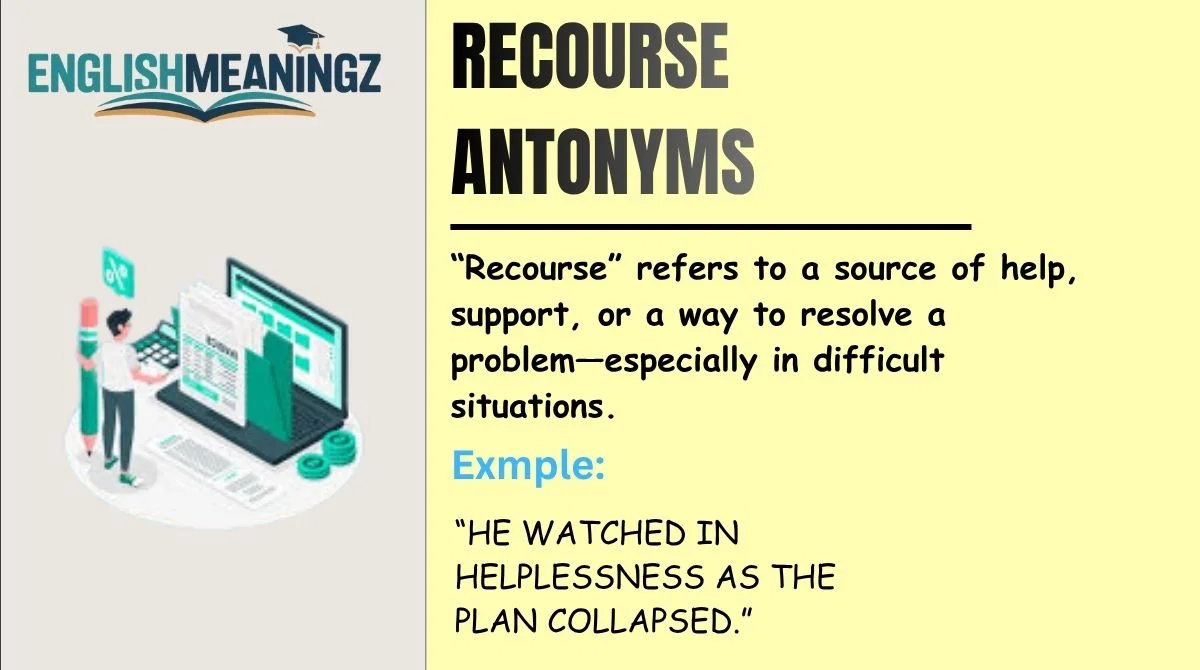
“Recourse” refers to a source of help, support, or a way to resolve a problem—especially in difficult situations. It often implies having a backup option, remedy, or authority to turn to.
Tone: Formal, often used in legal, academic, or professional contexts
Intensity: Moderate to strong—it suggests structured or reliable help rather than casual assistance
Example:
“When negotiations failed, they had no recourse but to file a lawsuit.”
Here, “recourse” emphasizes a final or official option available after other attempts have failed.
16 Best Antonyms for “Recourse”
1. Helplessness
Meaning: Lack of ability to act or improve a situation
Tone: Emotional
Example: “He watched in helplessness as the plan collapsed.”
Why it’s an opposite: Recourse implies options; helplessness means having none.
2. Powerlessness
Meaning: Absence of control or authority
Tone: Formal / Emotional
Example: “The citizens felt powerlessness against the new policy.”
Why it’s an opposite: Recourse provides control; powerlessness removes it.
3. Hopelessness
Meaning: A state without hope for improvement
Tone: Emotional
Example: “A sense of hopelessness filled the room.”
Why it’s an opposite: Recourse offers solutions; hopelessness denies them.
4. Despair
Meaning: Complete loss of hope
Tone: Emotional
Example: “She sank into despair after repeated failures.”
Why it’s an opposite: Recourse suggests action; despair suggests surrender.
5. Dead End
Meaning: A situation with no possible progress
Tone: Informal
Example: “The investigation reached a dead end.”
Why it’s an opposite: Recourse opens paths; a dead end closes them.
6. Impotence
Meaning: Inability to take effective action
Tone: Formal
Example: “He felt political impotence in the system.”
Why it’s an opposite: Recourse empowers; impotence restricts.
7. Inaction
Meaning: Failure to act
Tone: Formal
Example: “Government inaction worsened the crisis.”
Why it’s an opposite: Recourse leads to action; inaction avoids it.
8. Stalemate
Meaning: A situation where no progress can be made
Tone: Academic
Example: “Talks ended in a stalemate.”
Why it’s an opposite: Recourse moves forward; stalemate freezes progress.
9. Futility
Meaning: Pointlessness or lack of effectiveness
Tone: Academic
Example: “They realized the futility of resistance.”
Why it’s an opposite: Recourse implies effectiveness; futility denies it.
10. Abandonment
Meaning: Leaving something without support
Tone: Emotional
Example: “The project suffered from abandonment.”
Why it’s an opposite: Recourse provides support; abandonment removes it.
11. Isolation
Meaning: Being alone without help or connection
Tone: Neutral
Example: “The village lived in complete isolation.”
Why it’s an opposite: Recourse involves reaching out; isolation cuts off help.
12. Defeat
Meaning: Failure to succeed
Tone: Neutral / Emotional
Example: “They accepted defeat after long efforts.”
Why it’s an opposite: Recourse implies continued effort; defeat ends it.
13. Resignation
Meaning: Acceptance of failure or inability to change things
Tone: Formal / Emotional
Example: “He spoke with quiet resignation.”
Why it’s an opposite: Recourse fights back; resignation gives up.
14. Constraint
Meaning: Limitation or restriction
Tone: Academic
Example: “Financial constraints limited their options.”
Why it’s an opposite: Recourse expands options; constraints reduce them.
15. Limitation
Meaning: A restriction on ability or scope
Tone: Neutral
Example: “Time limitations affected the outcome.”
Why it’s an opposite: Recourse provides alternatives; limitations restrict them.
16. No Way Out
Meaning: A situation with no escape or solution
Tone: Informal
Example: “They felt there was no way out of the crisis.”
Why it’s an opposite: Recourse offers a way out; this phrase denies it completely.
Strong vs Mild Opposites
Not all antonyms carry the same intensity. Understanding this helps you choose the most precise word.
Strong opposites:
Despair, hopelessness, no way out, helplessness
→ These completely eliminate the idea of recourse.
Moderate opposites:
Powerlessness, futility, stalemate, defeat
→ These suggest difficulty but not always total absence of options.
Mild opposites:
Limitation, constraint, inaction
→ These imply reduced or unused recourse rather than complete absence.
Key insight:
Use strong antonyms for emotional or dramatic writing, and mild ones for analytical or academic contexts.
Context-Based Opposites
Antonyms of “recourse” can change depending on context:
Legal context:
- Recourse → Remedy
- Opposite → Impotence, no legal option
Emotional context:
- Recourse → Hope or support
- Opposite → Despair, hopelessness
Strategic context:
- Recourse → Backup plan
- Opposite → Dead end, stalemate
Professional context:
- Recourse → Solution or escalation path
- Opposite → Inaction, limitation
Understanding context ensures you select the most accurate opposite—not just a generic one.
Common Mistakes When Using Opposites
1. Using unrelated negatives
Incorrect: “Recourse vs anger”
→ Anger is not an opposite; it’s an emotion.
2. Confusing limitation with absence
Incorrect: “Constraint always equals no recourse”
→ Constraints limit options but don’t eliminate them.
3. Overusing emotional antonyms in formal writing
Incorrect: “The report shows despair in policy structure.”
→ Better: “The report highlights structural limitations.”
4. Misjudging intensity
Incorrect: Using “despair” in a minor inconvenience
→ Choose “limitation” or “constraint” instead.
5. Ignoring tone consistency
Mixing informal antonyms like “no way out” in academic writing reduces credibility.
Sentence Transformation Examples
1. Original:
“They had recourse to legal action.”
Rewritten:
“They were left with no way out of the situation.”
2. Original:
“She sought recourse from management.”
Rewritten:
“She faced the issue with complete powerlessness.”
3. Original:
“The company used financial recourse to recover.”
Rewritten:
“The company struggled under severe financial constraints.”
4. Original:
“He always had recourse in difficult times.”
Rewritten:
“He often faced challenges with helplessness.”
5. Original:
“They relied on recourse for resolution.”
Rewritten:
“They encountered a dead end in resolving the issue.”
FAQs
What is the simplest antonym of “recourse”?
The simplest antonym is “helplessness,” as it clearly expresses lack of options.
Is “despair” always an antonym of recourse?
Not always. It works in emotional contexts but may not fit formal or legal writing.
Can “limitation” be considered an opposite?
Yes, but it is a mild opposite. It suggests reduced options, not complete absence.
Which antonym is best for academic writing?
“Constraint,” “limitation,” and “futility” are ideal due to their formal tone.
What is the strongest antonym of recourse?
“No way out” or “hopelessness” are among the strongest because they imply total absence of solutions.
Are all antonyms emotional?
No. Some are analytical (e.g., stalemate, constraint), while others are emotional (e.g., despair).
How do I choose the right antonym?
Consider three factors: context, tone, and intensity. Match all three for accuracy.
Conclusion
Understanding antonyms of “recourse” is more than a vocabulary exercise—it’s a strategic skill. Whether you’re writing academically, professionally, or creatively, knowing how to express the absence of options gives your language depth and precision.
From strong emotional opposites like “despair” to analytical alternatives like “constraint,” each antonym serves a unique purpose. The key is choosing the right one based on tone, context, and intensity.
Master these 16 antonyms, and you’ll not only improve your writing—you’ll communicate with clarity, authority, and impact in 2026 and beyond.