Understanding opposites is one of the most powerful ways to elevate your vocabulary and refine your communication skills.
When you learn antonyms deeply—not just as surface-level word pairs—you begin to recognize subtle shifts in tone, intention, and meaning.
This allows you to express ideas with greater precision, especially in academic, professional, and persuasive writing.
In both formal and creative contexts, choosing the right opposite word can completely transform the clarity and impact of your message.
Whether you’re writing essays, business reports, or content for SEO, mastering antonyms helps eliminate ambiguity and strengthens your linguistic control.
This article explores high-quality antonyms of the word “quixotic” and shows you how to use them effectively.
What Does “Quixotic” Mean?
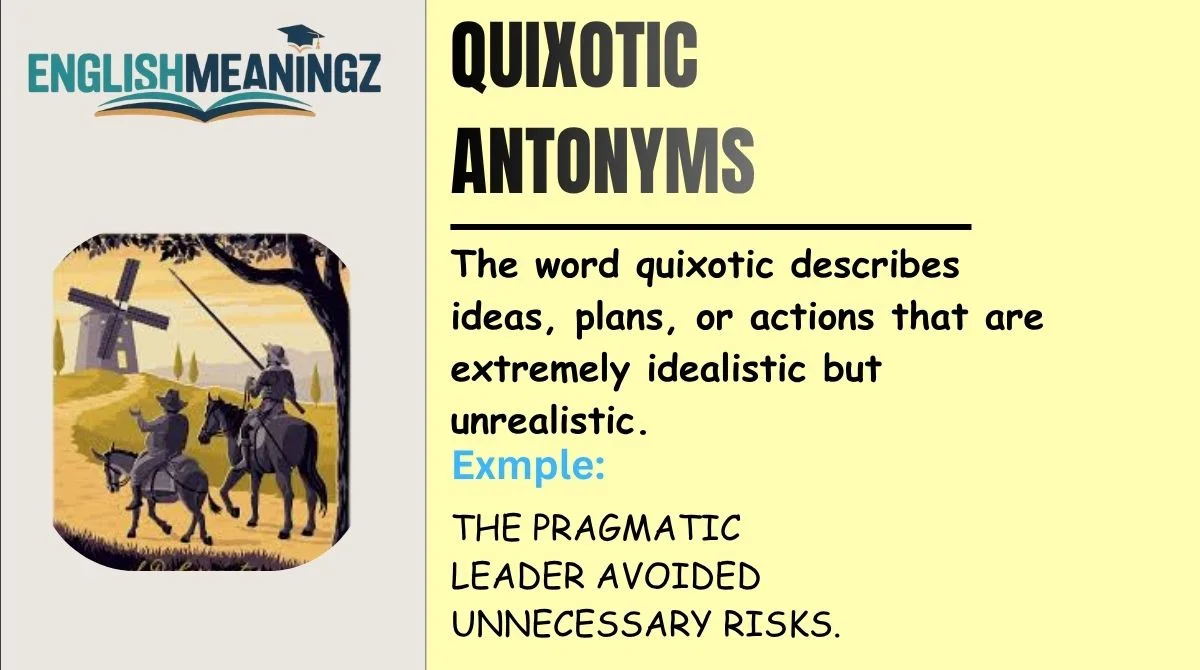
The word quixotic describes ideas, plans, or actions that are extremely idealistic but unrealistic. It often carries a slightly romantic or admirable tone, suggesting noble intentions that are disconnected from practical reality.
Tone Explanation:
Quixotic is typically semi-formal and often used in academic or literary contexts. It can be slightly critical or gently appreciative, depending on context.
Emotional / Action Intensity:
It reflects high imagination and emotional enthusiasm, but low practicality. A quixotic person may pursue dreams without considering real-world limitations.
23 Best Antonyms for “Quixotic”
Realistic
Meaning: Based on practical facts and achievable outcomes
Tone: Academic
Example: Her realistic plan ensured the project was completed on time.
Why opposite: It focuses on practicality rather than idealistic fantasy.
Practical
Meaning: Concerned with actual use or real-world application
Tone: Formal
Example: He offered a practical solution instead of a dreamy proposal.
Why opposite: Rejects unrealistic ideas in favor of workable ones.
Pragmatic
Meaning: Dealing with things sensibly and realistically
Tone: Academic
Example: The pragmatic leader avoided unnecessary risks.
Why opposite: Emphasizes logic over imagination.
Sensible
Meaning: Showing good judgment
Tone: Informal/Formal
Example: Choosing a stable job was a sensible decision.
Why opposite: Avoids impractical or idealistic thinking.
Rational
Meaning: Based on reason and logic
Tone: Academic
Example: His rational approach solved the issue quickly.
Why opposite: Opposes emotional or unrealistic thinking.
Logical
Meaning: Following clear reasoning
Tone: Formal
Example: The logical explanation convinced everyone.
Why opposite: Contrasts with imaginative but impractical ideas.
Down-to-earth
Meaning: Practical and realistic
Tone: Informal
Example: She is too down-to-earth to believe in impossible dreams.
Why opposite: Focuses on reality rather than fantasy.
Real-world
Meaning: Based on actual conditions
Tone: Academic
Example: The strategy works well in real-world situations.
Why opposite: Opposes abstract or idealistic thinking.
Feasible
Meaning: Possible and practical to achieve
Tone: Formal
Example: They chose a feasible plan within their budget.
Why opposite: Rejects unrealistic ambition.
Viable
Meaning: Capable of working successfully
Tone: Academic
Example: The company needed a viable solution.
Why opposite: Focuses on success potential.
Grounded
Meaning: Sensible and realistic
Tone: Informal
Example: His grounded perspective helped avoid failure.
Why opposite: Avoids fanciful thinking.
Balanced
Meaning: Fair and reasonable
Tone: Formal
Example: She maintained a balanced viewpoint.
Why opposite: Opposes extreme idealism.
Level-headed
Meaning: Calm and practical
Tone: Informal
Example: A level-headed approach prevented mistakes.
Why opposite: Avoids impulsive, unrealistic thinking.
Objective
Meaning: Not influenced by emotions
Tone: Academic
Example: The judge remained objective in decision-making.
Why opposite: Contrasts with emotional idealism.
Calculated
Meaning: Carefully planned
Tone: Formal
Example: It was a calculated move for success.
Why opposite: Opposes impulsive idealistic action.
Strategic
Meaning: Planned with long-term goals
Tone: Academic
Example: The strategic decision boosted profits.
Why opposite: Focuses on realistic planning.
Methodical
Meaning: Systematic and organized
Tone: Formal
Example: A methodical approach ensured accuracy.
Why opposite: Rejects spontaneous unrealistic ideas.
Real
Meaning: Genuine and actual
Tone: Informal
Example: He preferred real solutions over fantasies.
Why opposite: Focuses on authenticity.
Concrete
Meaning: Specific and definite
Tone: Academic
Example: She gave concrete examples.
Why opposite: Opposes vague idealism.
Practical-minded
Meaning: Focused on useful outcomes
Tone: Informal
Example: A practical-minded leader ensures success.
Why opposite: Avoids unrealistic thinking.
Hardheaded
Meaning: Tough and practical
Tone: Informal
Example: The hardheaded investor avoided risky ideas.
Why opposite: Rejects romantic idealism.
Realizable
Meaning: Capable of being achieved
Tone: Academic
Example: They worked toward realizable goals.
Why opposite: Focuses on achievable results.
Sensible-minded
Meaning: Guided by reason
Tone: Formal
Example: A sensible-minded person avoids unrealistic risks.
Why opposite: Opposes emotional or fanciful thinking.
Strong vs Mild Opposites
Not all antonyms carry the same intensity. Some directly oppose the unrealistic nature of “quixotic,” while others simply reduce its emotional or imaginative aspect.
Strong opposites:
Words like pragmatic, realistic, rational, and feasible directly challenge the core meaning of quixotic. They emphasize practicality and reject idealism entirely.
Mild opposites:
Words like balanced, grounded, and sensible soften the contrast. They don’t completely reject imagination but prioritize moderation and realism.
Understanding this scale allows writers to choose words based on context. For example, academic writing often prefers strong opposites, while conversational writing benefits from milder alternatives.
Context-Based Opposites
Antonyms are not always fixed; they depend on context.
- In business writing, strategic or viable may be the best opposite of quixotic.
- In casual conversation, down-to-earth or level-headed fits better.
- In academic essays, rational and pragmatic are more appropriate.
For example:
A “quixotic investment plan” is best contrasted with a “viable investment plan,” not necessarily a “sensible” one, because financial context demands precision.
Common Mistakes When Using Opposites
1. Using weak opposites
Incorrect: His quixotic idea was replaced with a different idea.
Correct: His quixotic idea was replaced with a practical solution.
2. Ignoring tone mismatch
Using informal antonyms in formal writing can reduce credibility.
Example mistake: “The plan was kinda down-to-earth” in an academic paper.
3. Confusing realism with negativity
Not all non-quixotic ideas are pessimistic. Words like realistic are neutral, not negative.
4. Overusing the same antonym
Repeating “practical” reduces variety and richness.
5. Misjudging context
Using logical instead of feasible in technical discussions can weaken precision.
Sentence Transformation Examples
Original: His quixotic dream of building a city overnight failed.
Rewritten: His unrealistic dream was replaced with a feasible development plan.
Original: She made a quixotic attempt to change everything instantly.
Rewritten: She adopted a pragmatic approach to gradual improvement.
Original: Their quixotic vision ignored real limitations.
Rewritten: Their realistic strategy addressed existing challenges.
Original: The proposal sounded quixotic and risky.
Rewritten: The proposal was replaced with a viable and calculated plan.
Original: He followed a quixotic path in business.
Rewritten: He chose a strategic and methodical business approach.
FAQs
What is the simplest antonym of quixotic?
The simplest antonym is realistic, as it directly contrasts idealism with practicality.
Is “practical” always the best opposite?
Not always. It depends on context—pragmatic or feasible may be more precise.
Can quixotic ever be positive?
Yes, it can imply noble intentions, though still unrealistic.
What tone does quixotic carry?
It usually has a semi-formal, slightly literary tone.
Are all antonyms of quixotic formal?
No. Some are informal, like down-to-earth and level-headed.
How do I choose the right antonym?
Focus on context, tone, and the level of practicality required.
Why is learning antonyms important?
It enhances clarity, improves vocabulary, and strengthens communication skills.
Conclusion
Mastering antonyms of “quixotic” is more than a vocabulary exercise—it’s a practical tool for improving clarity and precision in communication.
By understanding the spectrum from idealistic to realistic thinking, you gain the ability to adapt your language to different contexts, whether academic, professional, or conversational.
The key is not just knowing these words, but using them intentionally to reflect tone, logic, and purpose. With consistent practice, your writing will become sharper, more credible, and significantly more impactful.