Understanding opposites is one of the fastest ways to upgrade your vocabulary and writing precision. When you learn antonyms deeply—not just as word pairs, but as contextual contrasts—you gain control over tone, clarity, and nuance.
This is especially important in academic and professional communication, where the difference between a hopeful “prospect” and a discouraging “dead end” can shape the entire message.
In writing, antonyms act as contrast tools. They help you emphasize meaning, avoid repetition, and present balanced arguments.
Whether you’re crafting essays, reports, or persuasive content, knowing the right opposite word at the right time strengthens your expression and credibility.
What Does “Prospect” Mean?
Definition:
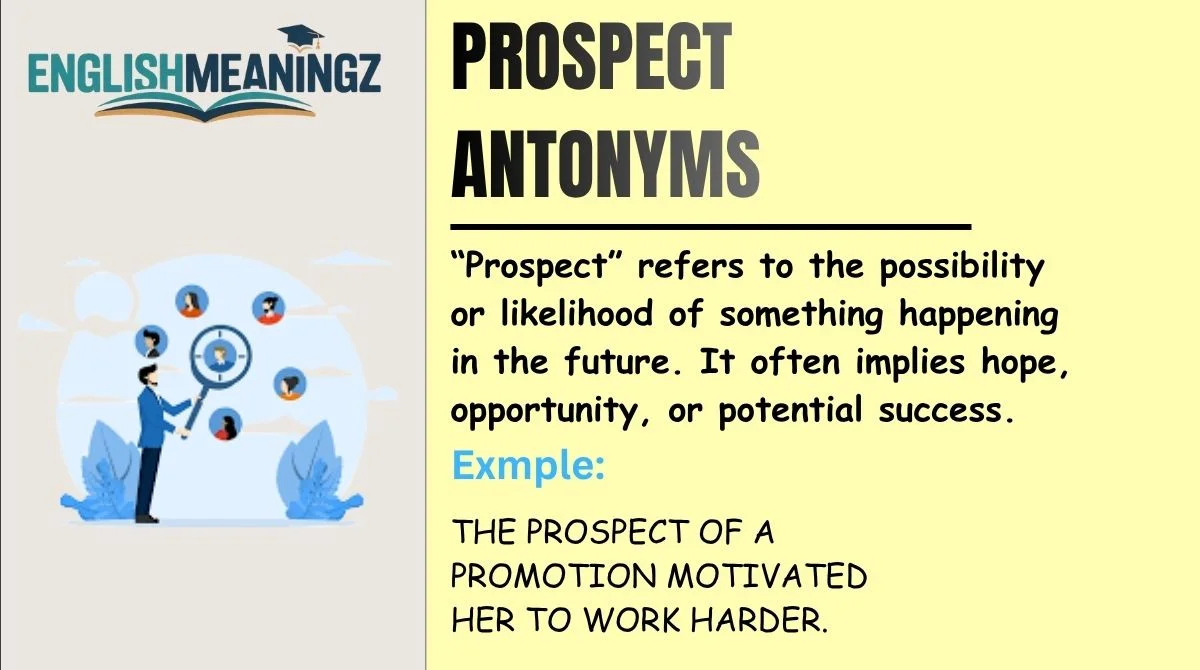
“Prospect” refers to the possibility or likelihood of something happening in the future. It often implies hope, opportunity, or potential success.
Tone Explanation:
The word carries a positive and forward-looking tone. It suggests anticipation, optimism, and expectation.
Emotional / Action Intensity:
- Emotionally: Hopeful, encouraging
- Contextually: Future-oriented, opportunity-driven
- Intensity: Moderate to strong positivity depending on context
Example:
The prospect of a promotion motivated her to work harder.
22 Best Antonyms for “Prospect”
1. Impossibility
Meaning: Something that cannot happen
Tone: Formal / Academic
Example: The plan was dismissed as an impossibility.
Why Opposite: It removes all future potential, directly contradicting “prospect.”
2. Hopelessness
Meaning: Absence of hope
Tone: Emotional
Example: He felt a deep sense of hopelessness after repeated failures.
Why Opposite: “Prospect” implies hope; this eliminates it entirely.
3. Despair
Meaning: Complete loss of hope
Tone: Emotional
Example: The news filled them with despair.
Why Opposite: It represents emotional collapse instead of anticipation.
4. Dead End
Meaning: A situation with no progress
Tone: Informal
Example: His career felt like a dead end.
Why Opposite: No forward movement, unlike a promising prospect.
5. Failure
Meaning: Lack of success
Tone: Neutral / Academic
Example: The project ended in failure.
Why Opposite: Opposes the positive expectation embedded in “prospect.”
6. Futility
Meaning: Pointlessness or uselessness
Tone: Academic
Example: Continuing the effort seemed like futility.
Why Opposite: A prospect has purpose; futility removes it.
7. Rejection
Meaning: Refusal or denial
Tone: Formal
Example: Her proposal faced immediate rejection.
Why Opposite: Denies opportunity rather than offering it.
8. Loss
Meaning: Absence or deprivation
Tone: Neutral
Example: The company suffered a major loss.
Why Opposite: Instead of gaining opportunity, something is taken away.
9. Decline
Meaning: Downward movement
Tone: Formal
Example: The business is in steady decline.
Why Opposite: Opposes growth and future promise.
10. Setback
Meaning: A delay or reversal
Tone: Neutral
Example: The injury was a major setback.
Why Opposite: Interrupts or weakens future prospects.
11. Stagnation
Meaning: Lack of movement or progress
Tone: Academic
Example: Economic stagnation affected growth.
Why Opposite: No progress versus forward-looking opportunity.
12. Doom
Meaning: Certain negative outcome
Tone: Emotional
Example: The decision spelled doom for the project.
Why Opposite: Predicts failure rather than possibility.
13. Uncertainty (Negative Context)
Meaning: Lack of clarity or assurance
Tone: Neutral
Example: The future was filled with uncertainty.
Why Opposite: Weakens the confidence implied by “prospect.”
14. Disappointment
Meaning: Failure to meet expectations
Tone: Emotional
Example: The results led to disappointment.
Why Opposite: Ends hope rather than building it.
15. Blockage
Meaning: Obstruction
Tone: Neutral
Example: A blockage halted progress.
Why Opposite: Stops forward movement entirely.
16. Regression
Meaning: Return to a worse state
Tone: Academic
Example: The system showed signs of regression.
Why Opposite: Moves backward instead of forward.
17. Defeat
Meaning: Loss in competition or struggle
Tone: Emotional / Formal
Example: The team faced defeat.
Why Opposite: Eliminates positive outcome potential.
18. Termination
Meaning: Ending of something
Tone: Formal
Example: His contract faced termination.
Why Opposite: Ends opportunity instead of creating it.
19. Crisis
Meaning: Dangerous or unstable situation
Tone: Formal
Example: The country is in economic crisis.
Why Opposite: Replaces opportunity with risk.
20. Collapse
Meaning: Sudden failure
Tone: Dramatic
Example: The structure faced total collapse.
Why Opposite: Destroys potential entirely.
21. Disadvantage
Meaning: Unfavorable condition
Tone: Neutral
Example: Lack of resources was a disadvantage.
Why Opposite: Limits opportunity rather than enhancing it.
22. Barrier
Meaning: Obstacle preventing progress
Tone: Neutral
Example: Language was a barrier to communication.
Why Opposite: Blocks future possibilities.
Strong vs Mild Opposites
Not all antonyms carry the same intensity. Some completely eliminate the idea of a “prospect,” while others only weaken it.
Strong Opposites:
- Impossibility
- Doom
- Collapse
- Despair
These words completely destroy any sense of future opportunity.
Mild Opposites:
- Setback
- Uncertainty
- Disadvantage
- Decline
These suggest reduced potential but not total elimination.
Understanding this scale helps you choose the right word based on emotional strength and context.
Context-Based Opposites
Antonyms depend heavily on context. “Prospect” can mean different things, and its opposite changes accordingly.
- Career Context:
Prospect → Promotion
Opposite → Dead end - Business Context:
Prospect → Opportunity
Opposite → Loss / Decline - Emotional Context:
Prospect → Hope
Opposite → Despair - Future Planning:
Prospect → Possibility
Opposite → Impossibility
Choosing the correct antonym requires understanding the situation, not just the dictionary definition.
Common Mistakes When Using Opposites
1. Using weak antonyms in strong contexts
Wrong: The project had no prospect, it was uncertain.
Correct: The project had no prospect; it was doomed.
2. Ignoring tone mismatch
Wrong: The academic paper used “dead end”
Correct: Use “stagnation” or “futility” for formal tone
3. Confusing related but not opposite words
Wrong: Prospect vs Challenge
Correct: Prospect vs Barrier
4. Overusing emotional opposites
Using “despair” everywhere weakens impact
5. Not considering context
“Failure” may not always oppose “prospect” directly
Sentence Transformation Examples
- Original: The prospect of success excited her.
Rewritten: The possibility of failure discouraged her. - Original: They saw great prospects in the new market.
Rewritten: They saw serious risks and losses in the new market. - Original: His career has strong prospects.
Rewritten: His career seems like a dead end. - Original: The prospect of growth attracted investors.
Rewritten: The decline in growth scared investors away. - Original: There is a bright prospect ahead.
Rewritten: There is uncertainty and doubt ahead.
FAQs
What is the simplest antonym of “prospect”?
“Impossibility” or “failure” are the simplest direct opposites.
Is “problem” an antonym of prospect?
Not exactly. A problem can exist alongside a prospect; it is not a direct opposite.
Can “uncertainty” be an antonym?
Yes, but it is a mild opposite since it reduces confidence rather than eliminating possibility.
Which antonym is best for academic writing?
“Futility,” “stagnation,” and “decline” work best in formal contexts.
What is the strongest emotional opposite?
“Despair” or “doom” are the most emotionally intense opposites.
Are all antonyms interchangeable?
No. Context and tone determine which antonym fits best.
Why should I learn multiple antonyms?
Because different situations require different levels of intensity and tone.
Conclusion
Mastering antonyms of “prospect” is more than memorizing word pairs—it’s about understanding contrast, tone, and context.
From strong opposites like “doom” and “impossibility” to milder ones like “setback” and “uncertainty,” each word offers a unique way to express limitation or absence of opportunity.
By applying these effectively, you can write with greater clarity, precision, and impact in both academic and professional settings.