Understanding opposites is one of the fastest ways to sharpen your writing and thinking. When you know not only what a word means but also what it does not mean, your vocabulary becomes more precise, flexible, and impactful.
This is especially important in academic, professional, and analytical writing where clarity matters.
In professional communication, choosing the right antonym can completely shift tone and meaning.
For example, replacing a structured term like “procedure” with a more spontaneous or chaotic alternative changes how readers interpret intent, organization, and authority.
Mastering these contrasts helps you sound more deliberate, persuasive, and intelligent.
What Does “Procedure” Mean?
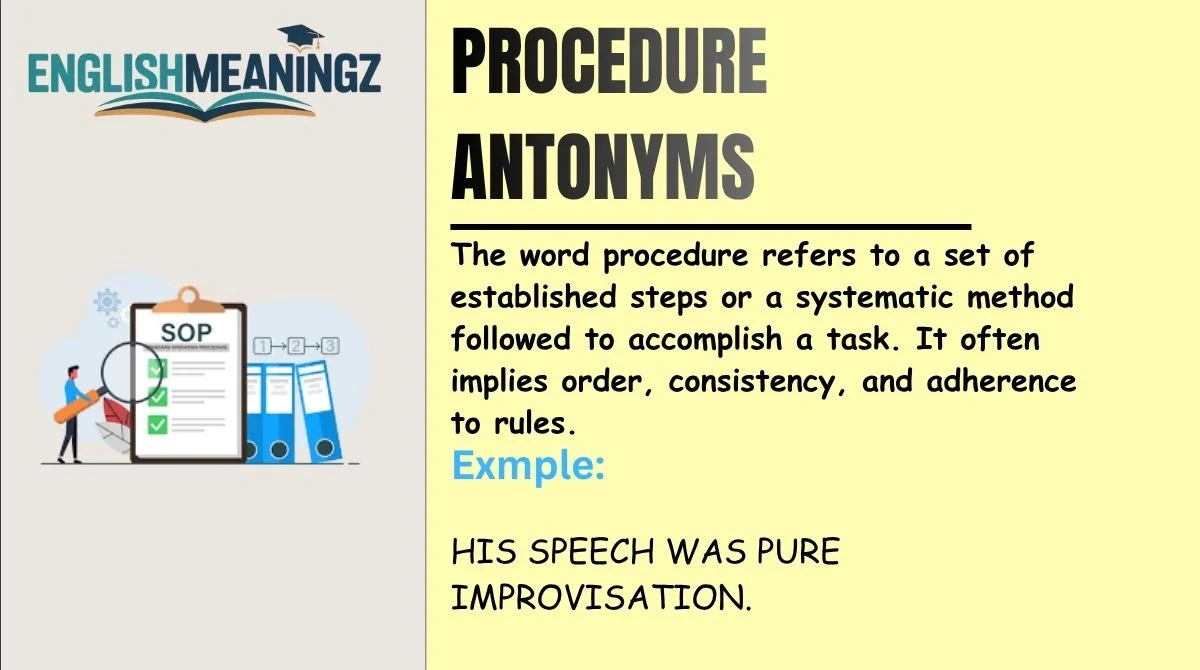
The word procedure refers to a set of established steps or a systematic method followed to accomplish a task. It often implies order, consistency, and adherence to rules.
Tone Explanation:
“Procedure” carries a formal and structured tone. It is commonly used in academic, medical, legal, and corporate contexts.
Intensity & Action Insight:
The word suggests controlled, step-by-step action rather than randomness or improvisation. It emphasizes predictability and repeatability.
20 Best Antonyms for “Procedure”
Chaos
Meaning: Complete disorder or lack of organization
Tone: Emotional
Example: The meeting turned into chaos without a clear plan.
Why Opposite: Procedure implies order, while chaos represents total disorder.
Improvisation
Meaning: Creating or performing without preparation
Tone: Informal
Example: His speech was pure improvisation.
Why Opposite: Procedure follows predefined steps; improvisation rejects them.
Spontaneity
Meaning: Acting on impulse without planning
Tone: Neutral
Example: She appreciated his spontaneity during the trip.
Why Opposite: Procedure is planned; spontaneity is unplanned.
Disorder
Meaning: Lack of structure or arrangement
Tone: Formal
Example: The system fell into disorder after the update.
Why Opposite: Procedure ensures structure, while disorder breaks it.
Randomness
Meaning: Lack of pattern or predictability
Tone: Academic
Example: The results showed randomness rather than consistency.
Why Opposite: Procedure is predictable; randomness is not.
Instinct
Meaning: Acting based on natural impulse rather than rules
Tone: Emotional
Example: He reacted on instinct.
Why Opposite: Procedure relies on logic; instinct relies on intuition.
Flexibility
Meaning: Ability to adapt or change easily
Tone: Professional
Example: The company values flexibility over rigid systems.
Why Opposite: Procedure is fixed; flexibility allows variation.
Freedom
Meaning: Absence of constraints or rules
Tone: Emotional
Example: Artists often seek creative freedom.
Why Opposite: Procedure imposes rules; freedom removes them.
Chaos Theory
Meaning: Study of unpredictable systems
Tone: Academic
Example: The model aligns with chaos theory principles.
Why Opposite: Procedure seeks control; chaos theory accepts unpredictability.
Disorganization
Meaning: Lack of planning or structure
Tone: Neutral
Example: Disorganization slowed the project.
Why Opposite: Procedure ensures organization.
Improperness
Meaning: Lack of correctness or standard method
Tone: Formal
Example: The improperness of the process caused issues.
Why Opposite: Procedure follows correctness.
Irregularity
Meaning: Deviation from a pattern
Tone: Academic
Example: The data showed irregularity.
Why Opposite: Procedure is regular and consistent.
Ad-libbing
Meaning: Speaking or acting without preparation
Tone: Informal
Example: He was ad-libbing during the presentation.
Why Opposite: Procedure is pre-planned; ad-libbing is not.
Unsystematic Approach
Meaning: Lack of method or system
Tone: Academic
Example: The unsystematic approach led to confusion.
Why Opposite: Procedure is systematic.
Haphazardness
Meaning: Random and careless behavior
Tone: Informal
Example: The work was done with haphazardness.
Why Opposite: Procedure requires care and order.
Improper Conduct
Meaning: Behavior not following rules
Tone: Formal
Example: The employee was warned for improper conduct.
Why Opposite: Procedure aligns with proper conduct.
Intuition
Meaning: Understanding without reasoning
Tone: Neutral
Example: She relied on intuition.
Why Opposite: Procedure depends on logic.
Experimentation
Meaning: Trying new methods without fixed rules
Tone: Academic
Example: The project encouraged experimentation.
Why Opposite: Procedure avoids deviation.
Unplanned Action
Meaning: Action without preparation
Tone: Neutral
Example: The decision was an unplanned action.
Why Opposite: Procedure requires planning.
Freeform Method
Meaning: No strict rules or structure
Tone: Informal
Example: The artist used a freeform method.
Why Opposite: Procedure is structured; freeform is not.
Strong vs Mild Opposites
Not all antonyms carry the same intensity. Some are direct and absolute, while others are softer contrasts.
Strong Opposites:
Words like chaos, disorder, and haphazardness completely negate the idea of procedure. They suggest total absence of structure.
Mild Opposites:
Words like flexibility, experimentation, and spontaneity do not entirely reject structure but reduce or relax it.
Understanding this scale helps you choose the right word based on how strongly you want to oppose “procedure.”
Context-Based Opposites
Antonyms often depend on context rather than strict dictionary definitions.
- In a medical context, “procedure” might contrast with emergency improvisation.
- In a business context, it may oppose flexible decision-making.
- In a creative context, it could contrast with freeform expression.
This shows that the “best” antonym depends on the situation, not just the definition.
Common Mistakes When Using Opposites
1. Using Weak Contrasts
Incorrect: The opposite of procedure is “method.”
Correct: Method is similar, not opposite.
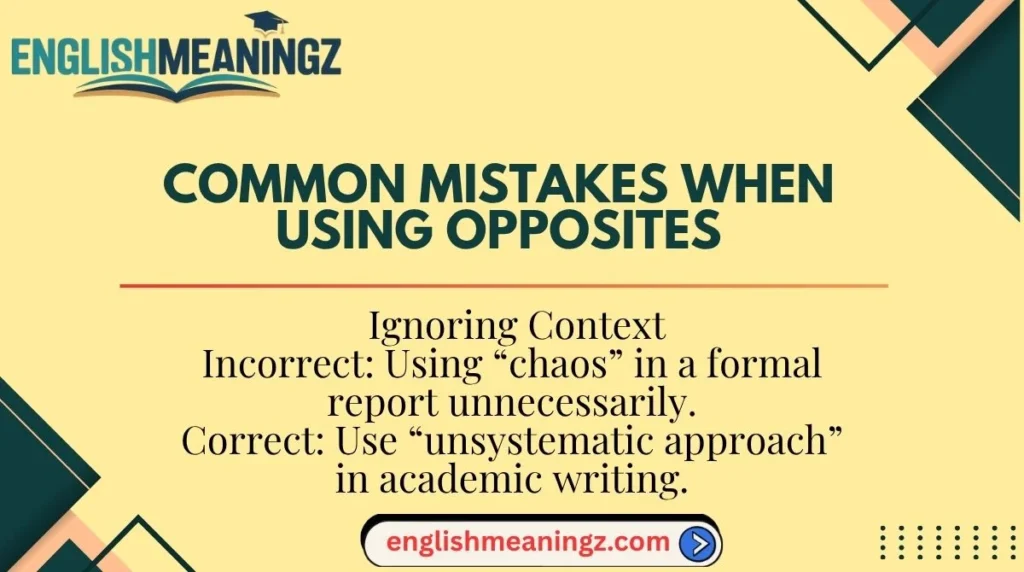
2. Ignoring Context
Incorrect: Using “chaos” in a formal report unnecessarily.
Correct: Use “unsystematic approach” in academic writing.
3. Confusing Tone
Incorrect: Using “ad-libbing” in legal writing.
Correct: Use “improvisation” or “unstructured action.”
4. Overgeneralization
Incorrect: Assuming one antonym fits all situations.
Correct: Choose based on context.
Sentence Transformation Examples
Original: The procedure must be followed strictly.
Rewritten: The task allows complete flexibility.
Original: The procedure ensures consistency.
Rewritten: The process relies on spontaneity.
Original: They followed the procedure carefully.
Rewritten: They acted on instinct.
Original: The procedure was clearly defined.
Rewritten: The approach was entirely freeform.
Original: The company relies on procedure.
Rewritten: The company encourages experimentation.
FAQs
What is the simplest antonym for “procedure”?
The simplest antonym is chaos because it directly opposes structure and order.
Is “method” an antonym of procedure?
No, it is actually a synonym, not an opposite.
Can “flexibility” be an antonym?
Yes, in contexts where procedure implies rigidity.
Which antonym is best for academic writing?
“Unsystematic approach” or “irregularity” works best in formal contexts.
Is improvisation always the opposite of procedure?
Not always, but it contrasts strongly when planning is absent.
Why are there multiple antonyms?
Because opposites depend on context, tone, and intensity.
How do I choose the right antonym?
Focus on context, tone, and how strongly you want to oppose the idea.
Conclusion
Mastering antonyms like those for “procedure” gives you greater control over language. Instead of repeating the same structured vocabulary, you can shift tone, meaning, and emphasis with precision.
Whether you’re writing academically, professionally, or creatively, understanding both structure and its opposites allows you to communicate with clarity and confidence.
The key is not just knowing words, but knowing when—and why—to use them.