Understanding opposites is one of the most underrated skills in strong writing. Whether you are crafting academic essays, professional emails, or SEO content, knowing the right antonym can completely shift tone, clarity, and impact.
When you replace a word with its precise opposite, you don’t just change meaning—you sharpen your message.
Writers who master antonyms gain control over nuance. They can express contrast, highlight arguments, and avoid redundancy. This is especially valuable in persuasive writing, where contrast builds stronger logic and clearer communication.
In academic and professional environments, precision matters. Using accurate opposites allows you to:
- Avoid vague or repetitive language
- Improve sentence variation
- Strengthen comparisons and arguments
- Communicate intent with clarity
In this article, you’ll explore 23 carefully selected antonyms for the word “priority,” along with meanings, tones, and real examples—so you can use them confidently in any context.
What Does “Priority” Mean?
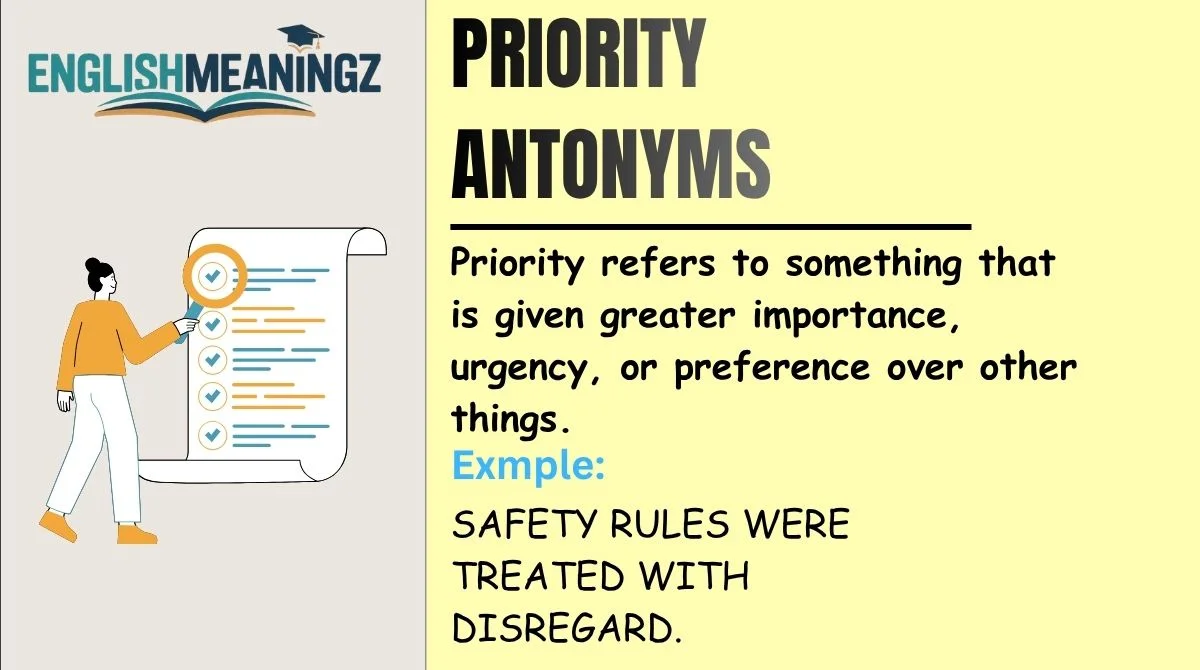
Priority refers to something that is given greater importance, urgency, or preference over other things. It indicates ranking—what comes first, what matters most, and what should be handled immediately.
Tone Explanation
The word carries a decisive and structured tone. It suggests organization, planning, and clear judgment. In formal and academic contexts, it often signals responsibility and focus.
Emotional or Action Intensity
“Priority” implies high urgency or importance. It reflects action-oriented thinking—something that demands attention now rather than later.
23 Best Antonyms for “Priority”
1. Neglect
Meaning: Failure to give attention or care
Tone: Emotional / Formal
Example: The project suffered due to complete neglect.
Why opposite: Priority demands attention; neglect ignores it entirely.
2. Ignorance
Meaning: Lack of awareness or consideration
Tone: Formal
Example: His ignorance of deadlines caused delays.
Why opposite: Priority involves awareness; ignorance lacks it.
3. Disregard
Meaning: Lack of respect or attention
Tone: Formal
Example: Safety rules were treated with disregard.
Why opposite: Priority values importance; disregard dismisses it.
4. Indifference
Meaning: Lack of interest or concern
Tone: Emotional
Example: Her indifference toward deadlines was obvious.
Why opposite: Priority shows care; indifference shows none.
5. Triviality
Meaning: Something unimportant
Tone: Academic
Example: The issue was reduced to triviality.
Why opposite: Priority emphasizes importance; triviality minimizes it.
6. Insignificance
Meaning: Lack of importance
Tone: Formal
Example: The detail was treated with insignificance.
Why opposite: Direct contrast in importance level.
7. Secondary Status
Meaning: Lower rank or importance
Tone: Formal
Example: Customer feedback was given secondary status.
Why opposite: Priority means first; this implies later.
8. Afterthought
Meaning: Considered too late
Tone: Informal
Example: Budget planning became an afterthought.
Why opposite: Priority is planned early; afterthought comes late.
9. Delay
Meaning: Postponement
Tone: Neutral
Example: The task faced unnecessary delay.
Why opposite: Priority accelerates action; delay slows it.
10. Postponement
Meaning: Rescheduling to a later time
Tone: Formal
Example: The meeting faced postponement.
Why opposite: Priority demands immediacy; postponement avoids it.
11. Deprioritization
Meaning: Lowering importance
Tone: Academic
Example: Marketing saw deprioritization this quarter.
Why opposite: Direct reversal of priority.
12. Negligence
Meaning: Careless inattention
Tone: Legal / Formal
Example: Negligence led to system failure.
Why opposite: Priority ensures care; negligence ignores it.
13. Oversight
Meaning: Unintentional omission
Tone: Formal
Example: The error occurred due to oversight.
Why opposite: Priority prevents missing details.
14. Disinterest
Meaning: Lack of enthusiasm
Tone: Neutral
Example: His disinterest affected productivity.
Why opposite: Priority requires engagement.
15. Apathy
Meaning: Emotional lack of concern
Tone: Emotional
Example: Apathy toward work leads to failure.
Why opposite: Priority reflects active concern.
16. Low Importance
Meaning: Minimal significance
Tone: Neutral
Example: The task was marked as low importance.
Why opposite: Direct contrast.
17. Background Concern
Meaning: Something not in focus
Tone: Formal
Example: The issue remained a background concern.
Why opposite: Priority is foreground focus.
18. Unimportance
Meaning: Lack of value
Tone: Formal
Example: The topic held unimportance.
Why opposite: Opposite in value.
19. Minor Issue
Meaning: Small problem
Tone: Informal
Example: It was treated as a minor issue.
Why opposite: Priority suggests major importance.
20. Low Rank
Meaning: Lower position
Tone: Formal
Example: The task had low rank in planning.
Why opposite: Priority implies top rank.
21. Delay of Action
Meaning: Lack of immediate response
Tone: Formal
Example: Delay of action caused losses.
Why opposite: Priority demands quick response.
22. Procrastination
Meaning: Delaying tasks
Tone: Informal
Example: Procrastination ruined his schedule.
Why opposite: Priority drives action; procrastination avoids it.
23. Inattention
Meaning: Lack of focus
Tone: Formal
Example: Inattention led to mistakes.
Why opposite: Priority ensures focus.
Strong vs Mild Opposites
Not all antonyms carry equal intensity. Understanding the scale helps you choose the right word.
Strong opposites completely negate priority:
- Neglect
- Apathy
- Negligence
- Disregard
These words imply total absence of importance or care.
Mild opposites suggest reduced importance:
- Secondary status
- Minor issue
- Background concern
- Low importance
These don’t eliminate importance—they simply lower it.
Choosing between strong and mild antonyms depends on context. Academic writing often prefers mild contrasts, while persuasive writing may use stronger ones for emphasis.
Context-Based Opposites
Antonyms are not always fixed—they change depending on context.
- In time-sensitive situations, “delay” or “postponement” works best.
- In emotional contexts, “apathy” or “indifference” fits better.
- In organizational settings, “secondary status” or “low rank” is more appropriate.
For example:
- “This task is not a priority” → “This task is a minor issue” (neutral)
- “This task is not a priority” → “This task is neglected” (strong and critical)
Context determines tone, impact, and clarity.
Common Mistakes When Using Opposites
Many writers misuse antonyms by ignoring tone or context.
Mistake 1: Using overly strong opposites
- Incorrect: The email was treated with negligence.
- Correct: The email was given low importance.
Mistake 2: Confusing delay with lack of importance
- Incorrect: The project was delayed, so it wasn’t important.
- Correct: The project was delayed despite being important.
Mistake 3: Mixing emotional and formal tones
- Incorrect: The policy showed apathy (too emotional for formal writing)
- Correct: The policy showed disregard
Mistake 4: Overusing generic terms
- Instead of repeating “not important,” use precise antonyms like “insignificant” or “secondary.”
Sentence Transformation Examples
Here are five examples showing how antonyms reshape meaning:
- Original: This task is a top priority.
Rewritten: This task is a minor issue. - Original: Safety is our priority.
Rewritten: Safety is often neglected. - Original: Customer satisfaction is a priority.
Rewritten: Customer satisfaction is treated with indifference. - Original: Meeting deadlines is a priority.
Rewritten: Deadlines face constant postponement. - Original: Education should be a priority.
Rewritten: Education should not be treated as triviality.
FAQs
What is the simplest antonym for priority?
The simplest antonym is “unimportance” or “low importance,” depending on context.
Can “delay” always be an antonym of priority?
Not always. Delay refers to time, while priority refers to importance. They overlap only in urgency-based contexts.
Is “neglect” a strong antonym?
Yes, it is one of the strongest opposites because it implies complete lack of attention.
Which antonym is best for academic writing?
“Insignificance,” “secondary status,” and “low importance” are most suitable.
Are emotional antonyms like apathy appropriate in formal writing?
Usually not. They are better for expressive or persuasive contexts.
How do I choose the right antonym?
Focus on context, tone, and intensity. Ask: Is the situation formal, emotional, or neutral?
Can one word have multiple antonyms?
Yes. Words like “priority” have many antonyms depending on usage and context.
Conclusion
Mastering antonyms for “priority” gives you a powerful advantage in writing. It allows you to express contrast clearly, refine tone, and communicate ideas with precision.
Whether you choose strong opposites like “neglect” or mild ones like “secondary status,” the key is context and intention.
Writers who understand opposites don’t just describe—they clarify, persuade, and elevate their language. By using these 23 antonyms effectively, you can transform ordinary writing into sharp, professional communication.