Understanding opposites is one of the fastest ways to sharpen your writing and thinking. Antonyms don’t just expand vocabulary—they refine meaning, improve clarity, and allow you to express contrast with precision.
Whether you are crafting academic essays, professional emails, or creative content, knowing the right opposite word can completely transform your message.
In academic and professional communication, precision matters. Using accurate antonyms helps avoid ambiguity, strengthens arguments, and enhances readability.
Instead of repeating similar ideas, opposites introduce balance, depth, and logical contrast—qualities that distinguish advanced writing from average content.
This guide focuses on the keyword “new antonyms”, exploring its meaning and presenting carefully selected opposites with clear explanations, tones, and usage examples.
What Does “New” Mean?
The word “new” refers to something recently created, discovered, introduced, or experienced for the first time. It implies freshness, originality, and a lack of prior use.
Tone Explanation:
“New” is neutral but often carries a positive tone. It suggests innovation, improvement, and modernity.
Emotional or Action Intensity:
The intensity of “new” is moderate. It can signal excitement (a new opportunity) or simply denote recency (a new document). The emotional impact depends heavily on context.
22 Best Antonyms for “New”
Old
Meaning: Existing for a long time
Tone: Neutral
Example: This is an old building with historical significance.
Why Opposite: Direct contrast to something recently created
Ancient
Meaning: Extremely old, from a distant past
Tone: Formal / Academic
Example: The artifact dates back to ancient civilizations.
Why Opposite: Opposes “new” with maximum time depth
Outdated
Meaning: No longer current or relevant
Tone: Professional
Example: The software became outdated quickly.
Why Opposite: Contrasts modern freshness
Obsolete
Meaning: No longer in use
Tone: Formal
Example: Typewriters are now obsolete.
Why Opposite: Indicates replacement by newer alternatives
Worn
Meaning: Damaged through use
Tone: Informal
Example: He wore a worn jacket.
Why Opposite: Opposes unused condition
Used
Meaning: Previously owned or utilized
Tone: Neutral
Example: She bought a used car.
Why Opposite: Direct opposite of unused/new
Aged
Meaning: Having existed for a long time
Tone: Neutral
Example: Aged wine has a richer taste.
Why Opposite: Suggests maturity rather than freshness
Vintage
Meaning: From a past era, often valued
Tone: Stylish / Informal
Example: He collects vintage watches.
Why Opposite: Highlights older origin instead of modernity
Antiquated
Meaning: Very old-fashioned
Tone: Academic
Example: The system feels antiquated.
Why Opposite: Opposes innovation
Dilapidated
Meaning: In poor condition due to age
Tone: Descriptive
Example: The house was dilapidated.
Why Opposite: Contrasts fresh condition
Secondhand
Meaning: Previously owned
Tone: Neutral
Example: She prefers secondhand books.
Why Opposite: Opposes first-time use
Stale
Meaning: No longer fresh
Tone: Informal
Example: The bread tasted stale.
Why Opposite: Opposes freshness
Timeworn
Meaning: Worn due to long use
Tone: Literary
Example: Timeworn traditions still exist.
Why Opposite: Suggests long passage of time
Former
Meaning: Belonging to the past
Tone: Formal
Example: The former president attended the event.
Why Opposite: Contrasts present/new
Preexisting
Meaning: Existing before something else
Tone: Academic
Example: The issue was preexisting.
Why Opposite: Opposes recent creation
Traditional
Meaning: Based on long-established customs
Tone: Neutral
Example: They follow traditional methods.
Why Opposite: Opposes innovation
Dated
Meaning: Old-fashioned
Tone: Informal
Example: The design looks dated.
Why Opposite: Contrasts modern appearance
Rusty
Meaning: Out of practice or old
Tone: Informal
Example: My skills are a bit rusty.
Why Opposite: Suggests decline over time
Longstanding
Meaning: Existing for a long duration
Tone: Formal
Example: A longstanding agreement was renewed.
Why Opposite: Opposes recent development
Mature
Meaning: Fully developed over time
Tone: Neutral
Example: The company is mature and stable.
Why Opposite: Contrasts early/new stage
Established
Meaning: Well-known and long-existing
Tone: Professional
Example: An established brand dominates the market.
Why Opposite: Opposes newly formed
Inherited
Meaning: Received from the past
Tone: Formal
Example: He inherited old traditions.
Why Opposite: Opposes newly acquired
Strong vs Mild Opposites
Not all antonyms carry the same intensity. Some are mild contrasts, while others represent extreme opposition.
- Mild Opposites:
Words like used, aged, and former simply indicate something is not new but don’t carry strong negative meaning. - Moderate Opposites:
Words like outdated, dated, and traditional add a sense of reduced relevance or modernity. - Strong Opposites:
Words like obsolete, ancient, and dilapidated imply extreme contrast—often signaling complete irrelevance or decay.
Choosing the right level depends on context. Overusing strong antonyms can make writing sound exaggerated, while mild ones may weaken your message.
Context-Based Opposites
Antonyms are not always fixed—they depend on context.
- New idea → Old idea
- New technology → Obsolete technology
- New clothes → Used clothes
- New concept → Traditional concept
For example, “traditional” may not always oppose “new” in a negative way—it can imply reliability instead of outdatedness. This is why context matters more than dictionary definitions.
Common Mistakes When Using Opposites
Using incorrect intensity
Wrong: This ancient phone is outdated.
Correct: This outdated phone lacks modern features.
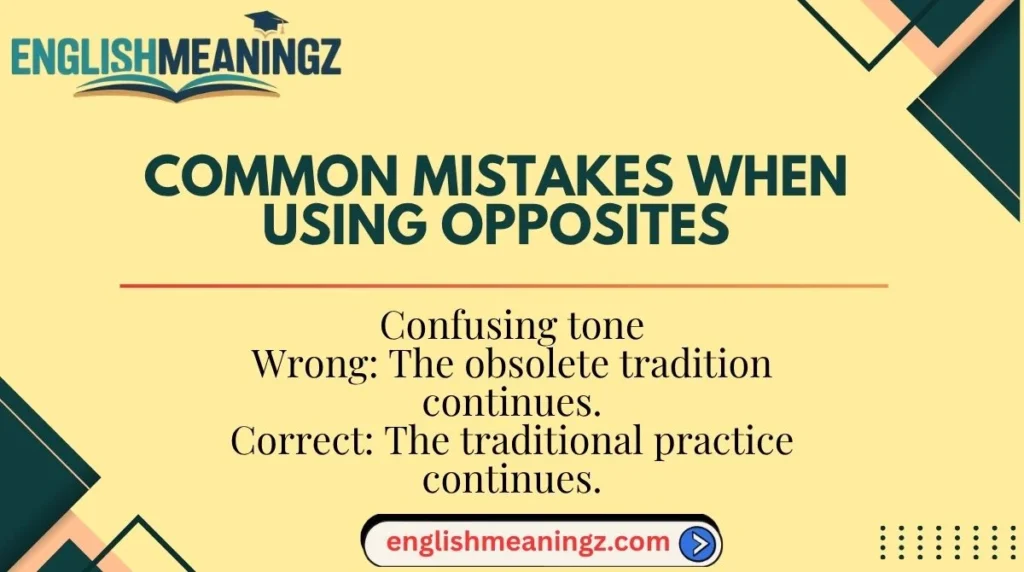
Confusing tone
Wrong: The obsolete tradition continues.
Correct: The traditional practice continues.
Overgeneralization
Not every “old” thing is “obsolete.” Some are valuable.
Mixing contexts
Wrong: He bought an obsolete shirt.
Correct: He bought a used shirt.
Ignoring nuance
Words like “vintage” are positive, not negative.
Sentence Transformation Examples
Original: She bought a new car.
Rewritten: She bought a used car.
Original: This is a new idea.
Rewritten: This is a traditional idea.
Original: The company launched a new system.
Rewritten: The company replaced an obsolete system.
Original: He has new skills.
Rewritten: His skills are a bit rusty.
Original: They built a new house.
Rewritten: They restored an old house.
FAQs
What is the exact opposite of “new”?
The most direct antonym is “old,” but context may require alternatives like “used” or “obsolete.”
Are all antonyms interchangeable?
No, each antonym carries a unique tone and intensity.
Is “vintage” a negative opposite?
Not necessarily. It can be positive, suggesting quality or classic value.
How do I choose the right antonym?
Consider tone, context, and intensity before selecting.
Can “traditional” mean the opposite of “new”?
Yes, especially when contrasting modern vs long-established practices.
Why are antonyms important in writing?
They improve clarity, contrast, and vocabulary depth.
Do antonyms always have negative meanings?
No. Some antonyms like “mature” or “established” can be positive.
Conclusion
Mastering antonyms for the word “new” goes beyond memorizing vocabulary—it’s about understanding nuance, tone, and context.
Whether you’re writing academically or professionally, the ability to choose the right opposite word enhances clarity, precision, and impact.
By using these 22 carefully explained antonyms, you can avoid repetition, strengthen contrast, and elevate your communication skills. The key is not just knowing opposites, but using them strategically.