Strong writing depends not only on ideas but also on the words used to express them. One of the most effective ways to improve clarity, readability, and impact is by using varied vocabulary.
When writers repeatedly use the same word, the text becomes monotonous and less engaging. This is why synonym variety is a crucial skill in modern writing.
Students preparing for academic exams, bloggers producing digital content, and professionals drafting reports or articles all benefit from a diverse vocabulary.
In standardized tests such as IELTS or university-level assessments, vocabulary range directly affects writing scores.
Similarly, online content creators must maintain reader engagement and avoid repetition for both readability and search engine optimization.
The word “makeshift” is commonly used to describe something temporary or improvised. However, relying on the same term repeatedly can weaken writing quality.
Learning appropriate alternatives allows writers to adapt their tone depending on context—formal, academic, technical, or informal.
This guide explores 15 makeshift synonyms, explaining their meanings, contexts, and examples so that writers can confidently expand their vocabulary and strengthen their writing in 2026 and beyond.
Definition and Core Meaning of “Makeshift”
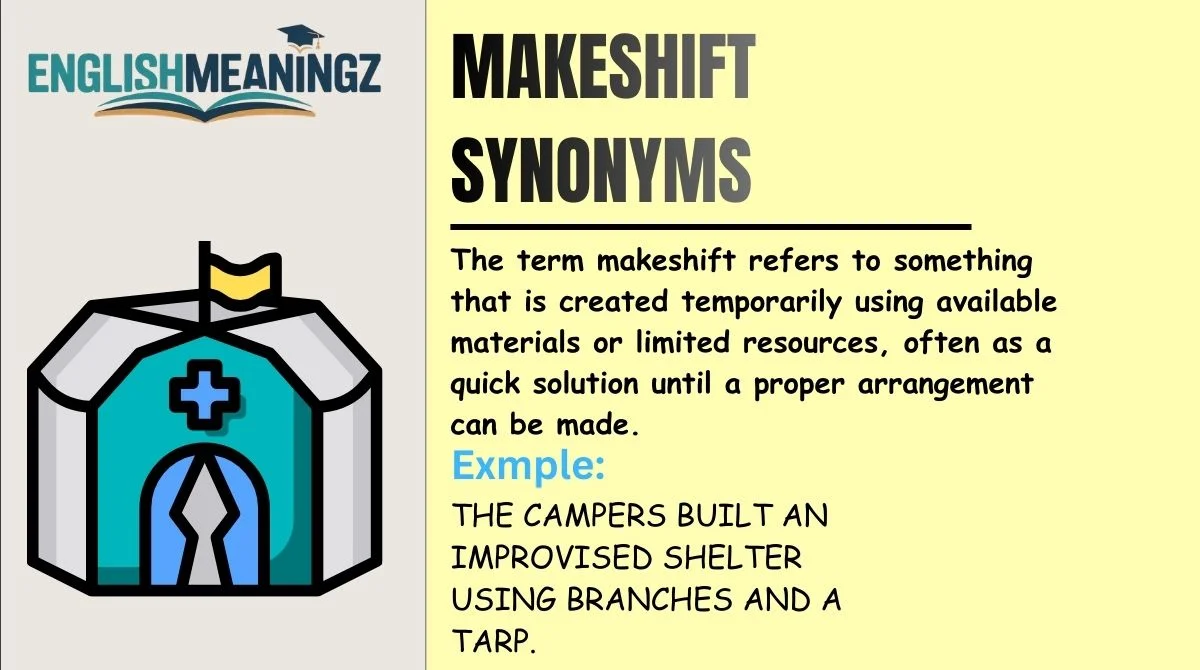
The term makeshift refers to something that is created temporarily using available materials or limited resources, often as a quick solution until a proper arrangement can be made.
A makeshift solution typically has the following characteristics:
- Temporary rather than permanent
- Created under resource limitations
- Often improvised or assembled quickly
- Intended to solve an immediate problem
For example, if a chair breaks during an event, someone might build a makeshift seat using stacked boxes. Similarly, emergency workers may create makeshift shelters after natural disasters when permanent housing is unavailable.
In academic writing, the word often appears in contexts such as:
- disaster relief
- engineering improvisation
- field research conditions
- historical wartime environments
Understanding this core meaning helps writers choose the correct synonym depending on tone and situation.
15 Synonyms Grouped by Context
General Use
Temporary
Meaning: Something designed to exist or function for a limited period.
Context: Used in everyday language as a neutral substitute for makeshift when referring to short-term solutions.
Example sentence:
The workers installed a temporary bridge while the permanent structure was under construction.
Improvised
Meaning: Created or performed spontaneously without preparation.
Context: Frequently used when something is assembled quickly using available resources.
Example sentence:
The campers built an improvised shelter using branches and a tarp.
Stopgap
Meaning: A short-term solution meant to fill a gap until something better is available.
Context: Often used in policy discussions, organizational management, and problem-solving situations.
Example sentence:
The company hired a consultant as a stopgap measure until a permanent manager could be recruited.
Ad hoc
Meaning: Created for a specific purpose without prior planning.
Context: Common in professional, organizational, and research environments.
Example sentence:
An ad hoc committee was formed to address the unexpected budget crisis.
Formal & Academic Writing
Provisional
Meaning: Arranged for the present time but likely to change later.
Context: Often used in academic research, legal writing, and policy discussions.
Example sentence:
The scientists proposed a provisional explanation until further data could confirm the theory.
Interim
Meaning: Existing during the period between two stages or events.
Context: Frequently used in institutional or governmental contexts.
Example sentence:
An interim director was appointed while the organization searched for a permanent leader.
Transitional
Meaning: Designed to support movement from one stage to another.
Context: Used in social sciences, policy discussions, and organizational transitions.
Example sentence:
The government introduced transitional housing programs for displaced families.
Substitute
Meaning: A replacement used in place of something else.
Context: Appears in academic, professional, and technical contexts.
Example sentence:
Online lectures served as a substitute for traditional classroom sessions during the pandemic.
Informal Usage
Jury-rigged
Meaning: Something assembled quickly using unconventional methods.
Context: Informal expression often used in engineering, mechanics, or everyday problem-solving.
Example sentence:
The technician jury-rigged the equipment to keep the system running temporarily.
Patchwork
Meaning: A combination of different pieces assembled together.
Context: Used metaphorically to describe inconsistent or temporary solutions.
Example sentence:
The city implemented a patchwork solution to address transportation problems.
Quick-fix
Meaning: A fast solution that may not solve the underlying issue.
Context: Informal discussions about policies, repairs, or strategies.
Example sentence:
Experts warned that the policy was only a quick-fix rather than a long-term solution.
Technical or Subject-Specific Use
Field-expedient
Meaning: A solution created in the field using available resources.
Context: Common in military, engineering, and emergency management situations.
Example sentence:
Rescue teams used field-expedient equipment to clear debris after the storm.
Improvised infrastructure
Meaning: Temporary systems created when formal infrastructure is unavailable.
Context: Often used in disaster response studies and humanitarian research.
Example sentence:
Aid organizations relied on improvised infrastructure to distribute supplies.
Temporary structure
Meaning: A building or installation intended for short-term use.
Context: Common in architecture, engineering, and construction studies.
Example sentence:
Workers built a temporary structure to house equipment during the renovation.
Emergency arrangement
Meaning: A rapidly organized solution during urgent circumstances.
Context: Used in crisis management, healthcare systems, and disaster planning.
Example sentence:
Hospitals created emergency arrangements to manage the sudden influx of patients.
Word Intensity & Tone Comparison Table
| Word | Formality Level | Emotional Strength | Typical Context |
|---|---|---|---|
| Temporary | Neutral | Low | Everyday situations |
| Improvised | Neutral | Moderate | Emergency or creative solutions |
| Stopgap | Semi-formal | Moderate | Policy or management |
| Ad hoc | Formal | Low | Academic or organizational |
| Provisional | Highly formal | Low | Legal or research writing |
| Interim | Formal | Low | Administrative contexts |
| Quick-fix | Informal | Moderate | Criticism of solutions |
| Jury-rigged | Informal | High | Mechanical or repair contexts |
| Transitional | Formal | Low | Social policy discussions |
| Patchwork | Informal | Moderate | Describing inconsistent systems |
This comparison helps writers choose the most suitable synonym depending on tone, audience, and context.
Common Mistakes When Using These Synonyms
Even experienced writers sometimes misuse synonyms when subtle differences in meaning are ignored. Understanding these distinctions prevents confusion.
Mistake 1: Using “temporary” when the meaning implies improvisation
Incorrect:
The engineer designed a temporary device using spare wires.
Correct:
The engineer designed an improvised device using spare wires.
Explanation:
“Temporary” focuses on duration, while “improvised” emphasizes creative assembly.
Mistake 2: Using “quick-fix” in formal academic writing
Incorrect:
The researchers proposed a quick-fix solution to the economic problem.
Correct:
The researchers proposed a provisional solution to the economic problem.
Explanation:
“Quick-fix” is informal and unsuitable for scholarly writing.
Mistake 3: Confusing “interim” with “stopgap”
Incorrect:
The company appointed a stopgap CEO.
Correct:
The company appointed an interim CEO.
Explanation:
“Interim” is the standard term for temporary leadership roles.
Mistake 4: Using “patchwork” incorrectly
Incorrect:
The scientist presented a patchwork theory.
Correct:
The scientist presented a provisional theory.
Explanation:
“Patchwork” implies inconsistency rather than a temporary explanation.
Synonyms in Academic Writing
Example Paragraph 1
In humanitarian crises, relief organizations often rely on provisional infrastructure to deliver essential services. Temporary shelters, improvised water systems, and emergency medical facilities allow communities to survive during the early stages of recovery. Although these solutions are not permanent, they play a crucial role in stabilizing affected populations until sustainable reconstruction can begin.
Example Paragraph 2
Educational institutions frequently adopt interim strategies during periods of rapid change. For instance, universities may implement online instruction as a stopgap measure while developing long-term digital learning platforms. Such transitional approaches ensure continuity of education while institutions adjust to evolving technological demands.
IELTS & Exam Writing Tips
1. Avoid repetition
Using the same word repeatedly reduces vocabulary range. Instead of writing “makeshift shelter” multiple times, you can alternate with:
- improvised shelter
- temporary shelter
- provisional accommodation
2. Choose synonyms based on context
Not all synonyms work in every situation. For example:
- Improvised suits emergency scenarios.
- Provisional fits academic writing.
- Quick-fix works only in informal commentary.
3. Maintain clarity
If a synonym changes the meaning, keep the original word. Accuracy is more important than variety.
4. Avoid forced replacement
Examiners value natural writing. Replacing words excessively can make sentences sound unnatural.
5. Build vocabulary gradually
Learning synonyms in groups based on context improves retention and writing fluency.
Similar Words vs True Synonyms
Not all related words are true synonyms. Some share partial meanings but differ in nuance.
Temporary vs Improvised
Temporary describes duration, while improvised describes method of creation.
Example:
A temporary office may be carefully designed, not improvised.
Stopgap vs Interim
Both refer to short-term solutions, but their usage differs.
- Interim commonly refers to positions or leadership roles.
- Stopgap usually refers to strategies or policies.
Quick-fix vs Provisional
- Quick-fix suggests a superficial solution.
- Provisional indicates a carefully considered but temporary arrangement.
Understanding these distinctions helps writers maintain precision.
Practice Sentences
Choose the correct synonym for each sentence.
- The rescue workers built an ______ shelter after the earthquake.
- The university appointed an ______ dean during the leadership transition.
- The government introduced a ______ policy until permanent reforms were implemented.
- The mechanic created a ______ repair to keep the engine running.
- The city relied on ______ transportation solutions while rebuilding infrastructure.
Possible answers: improvised, interim, provisional, jury-rigged, temporary.
Practicing these examples helps reinforce vocabulary usage.
FAQs
What is the closest synonym to makeshift?
The closest synonym is improvised, because both words emphasize creating something quickly using available resources.
Can “temporary” replace makeshift in all situations?
No. Temporary refers only to duration, while makeshift implies improvisation. The context determines which word is appropriate.
Is “ad hoc” formal or informal?
“Ad hoc” is considered formal and is commonly used in academic, administrative, and organizational writing.
Which synonym is best for academic essays?
Words such as provisional, interim, and transitional are usually most suitable for formal academic writing.
Why is learning synonyms important for exams like IELTS?
Vocabulary variety improves lexical resource scores, demonstrates language proficiency, and helps avoid repetitive writing.
Conclusion
Expanding vocabulary is one of the most effective ways to improve writing quality.
Words such as makeshift play an important role in describing temporary or improvised solutions, but relying on a single term repeatedly can weaken clarity and engagement.
By learning alternatives like improvised, provisional, interim, stopgap, and temporary, writers gain the flexibility to adjust tone across academic, professional, and informal contexts.
This skill benefits students preparing for exams, bloggers creating engaging content, and professionals producing polished reports.
Consistent vocabulary practice, careful attention to context, and thoughtful word choice will gradually strengthen writing ability.
Over time, these improvements lead to clearer communication, stronger academic performance, and more compelling written content.