Mastering opposites is one of the fastest ways to sharpen your writing. When you understand not just a word but also its semantic contrasts, you gain precision, flexibility, and control over tone.
Whether you’re crafting essays, reports, or persuasive content, knowing the right antonym allows you to express ideas with clarity instead of over-explaining.
In academic and professional communication, vocabulary depth signals credibility. Using accurate opposites of strong verbs like inundate helps you avoid exaggeration, maintain balance, and communicate nuance.
Instead of always describing overwhelming situations, you can articulate restraint, limitation, or scarcity—skills that distinguish advanced writers from average ones.
What Does “Inundate” Mean?
Definition:
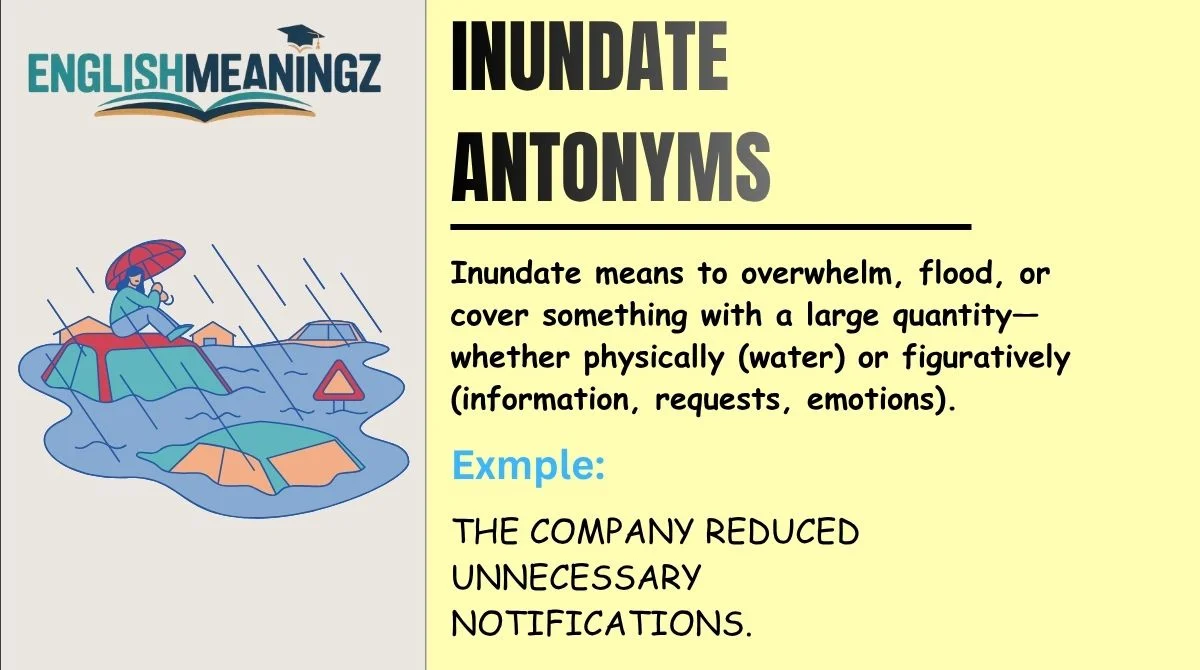
Inundate means to overwhelm, flood, or cover something with a large quantity—whether physically (water) or figuratively (information, requests, emotions).
Tone Explanation:
The word carries a strong, often intense tone. It implies excess, pressure, or overload.
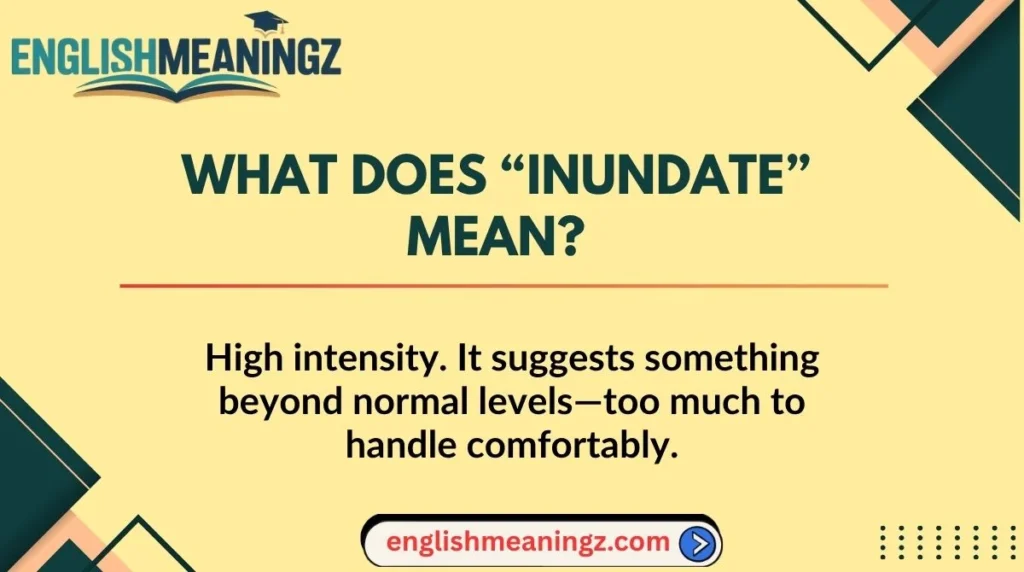
Emotional or Action Intensity:
High intensity. It suggests something beyond normal levels—too much to handle comfortably.
16 Best Antonyms for “Inundate”
1. Limit
Meaning: To restrict the amount or extent of something
Tone: Formal
Example: The manager decided to limit the number of emails sent daily.
Why It’s Opposite: Instead of overwhelming, it reduces quantity and prevents excess.
2. Restrict
Meaning: To control or keep within boundaries
Tone: Formal / Academic
Example: Access to the data was restricted to authorized personnel.
Why It’s Opposite: Inundating implies overflow; restricting prevents expansion.
3. Reduce
Meaning: To make smaller in size, amount, or degree
Tone: Neutral
Example: The company reduced unnecessary notifications.
Why It’s Opposite: It directly counters the idea of excess or overload.
4. Alleviate
Meaning: To make something less severe or intense
Tone: Formal / Emotional
Example: The new policy helped alleviate employee stress.
Why It’s Opposite: Instead of overwhelming, it relieves pressure.
5. Ease
Meaning: To make something more manageable or less difficult
Tone: Informal / Neutral
Example: The assistant helped ease the workload.
Why It’s Opposite: It reduces burden rather than increasing it.
6. Relieve
Meaning: To remove or reduce stress or pressure
Tone: Emotional / Formal
Example: The update relieved users from constant alerts.
Why It’s Opposite: Opposes the stress caused by inundation.
7. Drain
Meaning: To remove or take away gradually
Tone: Neutral
Example: The system drained excess data automatically.
Why It’s Opposite: Inundate adds excessively; drain removes.
8. Decrease
Meaning: To make something smaller or fewer
Tone: Academic
Example: Notifications were decreased to improve focus.
Why It’s Opposite: Directly reduces volume instead of increasing it.
9. Control
Meaning: To regulate or manage something effectively
Tone: Formal
Example: She controlled the flow of information during the meeting.
Why It’s Opposite: Prevents overwhelming situations.
10. Moderate
Meaning: To keep within reasonable limits
Tone: Academic
Example: The platform moderates user content carefully.
Why It’s Opposite: Maintains balance rather than excess.
11. Withhold
Meaning: To hold back or refrain from giving
Tone: Formal
Example: The company withheld unnecessary updates.
Why It’s Opposite: Stops the flow instead of flooding.
12. Contain
Meaning: To keep within limits or boundaries
Tone: Formal
Example: The team contained the spread of misinformation.
Why It’s Opposite: Prevents overflow and excess.
13. Filter
Meaning: To remove unwanted elements
Tone: Neutral / Technical
Example: The system filters irrelevant emails.
Why It’s Opposite: Instead of overwhelming, it refines and reduces input.
14. Curtail
Meaning: To reduce or cut short
Tone: Formal
Example: The company curtailed excessive messaging.
Why It’s Opposite: Limits volume and duration.
15. Diminish
Meaning: To make something less significant or intense
Tone: Academic
Example: The new policy diminished the number of complaints.
Why It’s Opposite: Reduces impact instead of intensifying it.
16. Suppress
Meaning: To stop or restrain something forcefully
Tone: Formal
Example: The system suppresses duplicate alerts.
Why It’s Opposite: Prevents overflow by stopping it entirely.
Strong vs Mild Opposites
Not all antonyms carry equal intensity. Understanding this spectrum helps you choose precisely the right word.
Strong Opposites (High Control / Reduction):
Suppress, Contain, Curtail, Restrict
These imply firm action and clear boundaries.
Moderate Opposites (Balanced Reduction):
Limit, Moderate, Control, Filter
These suggest measured, thoughtful control.
Mild Opposites (Gentle Relief):
Ease, Alleviate, Relieve, Diminish
These focus on reducing pressure rather than stopping flow entirely.
Insight:
If inundate represents extreme excess, then the strongest antonyms represent strict prevention, while milder ones represent relief or adjustment.
Context-Based Opposites
Antonyms depend heavily on context. A single opposite may not fit every situation.
1. Physical Context (Water/Flooding):
- Inundate → Drain, Contain
Example: The dam contained the water instead of letting it inundate the valley.
2. Information Context:
- Inundate → Filter, Limit
Example: The app filters messages rather than inundating users.
3. Emotional Context:
- Inundate → Alleviate, Ease
Example: Therapy helped alleviate overwhelming feelings.
4. Workload Context:
- Inundate → Reduce, Moderate
Example: The manager reduced tasks to prevent burnout.
Key Insight:
Choosing the correct antonym depends on whether you’re describing quantity, emotion, control, or physical action.
Common Mistakes When Using Opposites
1. Using Weak Opposites
Incorrect: The system “slightly changed” notifications.
Better: The system reduced notifications.
Why: “Changed” is not a true antonym of inundate.
2. Ignoring Tone
Incorrect: The policy “cut stuff.”
Better: The policy curtailed unnecessary updates.
Why: Informal tone weakens professional writing.
3. Context Mismatch
Incorrect: The dam alleviated the flood.
Better: The dam contained the flood.
Why: “Alleviate” is emotional, not physical.
4. Overgeneralization
Incorrect: Every opposite of inundate means “reduce.”
Why: Some imply control (restrict), others imply relief (ease).
Sentence Transformation Examples
Original 1: The manager inundated employees with emails.
Rewritten: The manager limited the number of emails sent.
Original 2: Social media inundates users with notifications.
Rewritten: Social media filters unnecessary notifications.
Original 3: The news inundated viewers with alarming updates.
Rewritten: The news moderated the flow of updates.
Original 4: The flood inundated the entire village.
Rewritten: The barrier contained the rising water.
Original 5: The workload inundated the team.
Rewritten: The supervisor reduced the workload.
FAQs
1. What is the simplest antonym of inundate?
“Reduce” is the most straightforward and widely applicable antonym.
2. Which antonym is best for formal writing?
“Restrict,” “curtail,” and “moderate” are ideal for academic and professional contexts.
3. Can “ease” be an antonym of inundate?
Yes, but only in emotional or workload contexts, not physical ones.
4. Is “drain” always an opposite of inundate?
No. It works mainly in physical or resource-related contexts.
5. What’s the strongest opposite of inundate?
“Suppress” or “contain,” as they imply complete control or prevention.
6. Are all antonyms interchangeable?
No. Context determines the most accurate choice.
7. Why is learning antonyms important?
It improves clarity, avoids repetition, and enhances expressive range in writing.
Conclusion
Understanding antonyms of inundate goes beyond simple vocabulary expansion—it transforms how you communicate intensity, balance, and control.
From strong terms like suppress and restrict to softer alternatives like ease and alleviate, each word serves a distinct purpose.
Mastering these differences allows you to write with precision, adapt to context, and elevate both academic and professional communication.
Instead of relying on repetitive language, you now have a refined toolkit to express the exact opposite of overwhelm—whether that means reducing, controlling, or relieving. This level of vocabulary awareness is what separates competent writers from exceptional ones.