Understanding opposites is one of the fastest ways to sharpen your writing. When you know not just what a word means—but also what it is not—you gain precision, clarity, and control over tone.
Antonyms help you avoid vague expression and replace it with deliberate language choices that match your intent.
In academic and professional communication, this skill becomes even more important. Whether you’re writing essays, reports, or persuasive content, the ability to contrast ideas effectively strengthens arguments and improves readability.
Knowing the antonyms of a word like “fossil” allows you to describe progress, innovation, and relevance with accuracy.
What Does “Fossil” Mean?
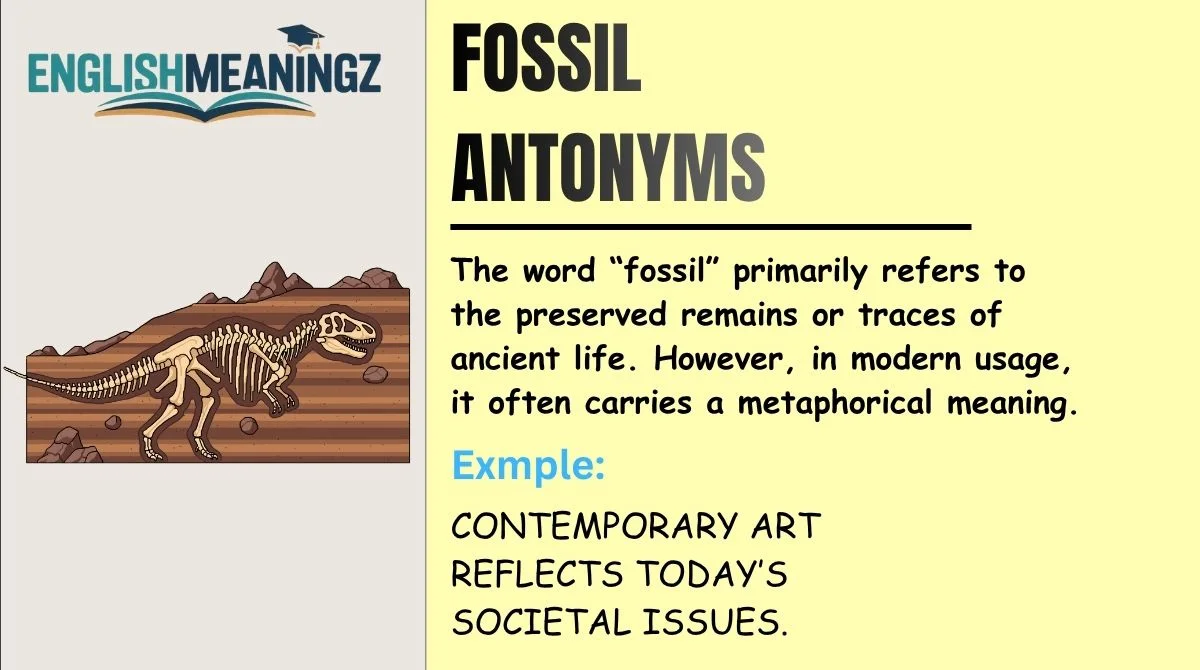
The word “fossil” primarily refers to the preserved remains or traces of ancient life. However, in modern usage, it often carries a metaphorical meaning.
Definition (Literal): Remains of organisms from prehistoric times preserved in rock.
Definition (Figurative): Something outdated, old-fashioned, or no longer relevant.
Tone: Often negative or critical when used metaphorically
Intensity: Medium to strong—implies stagnation, irrelevance, or resistance to change
For example:
“He’s a fossil in his thinking” suggests someone is stuck in outdated beliefs.
18 Best Antonyms for “Fossil”
Modern
Meaning: Current, up-to-date
Tone: Formal / Academic
Example: The company adopted modern practices to stay competitive.
Why it’s opposite: “Modern” directly contrasts with outdated or ancient.
Contemporary
Meaning: Belonging to the present time
Tone: Academic
Example: Contemporary art reflects today’s societal issues.
Why it’s opposite: Opposes the ancient nature of fossils.
Innovative
Meaning: Introducing new ideas
Tone: Professional
Example: The startup is known for its innovative solutions.
Why it’s opposite: Fossils imply stagnation; innovation implies progress.
Progressive
Meaning: Advancing or promoting change
Tone: Formal
Example: Progressive policies improved education standards.
Why it’s opposite: Fossils represent the past; progressive suggests forward movement.
Updated
Meaning: Brought up to current standards
Tone: Neutral
Example: The software was updated for better performance.
Why it’s opposite: Fossils are unchanged; updated means improved.
Advanced
Meaning: Highly developed
Tone: Academic
Example: Advanced technology drives efficiency.
Why it’s opposite: Fossils are early compared to advanced systems.
Evolving
Meaning: Gradually developing
Tone: Academic
Example: Language is constantly evolving.
Why it’s opposite: Fossils are static; evolving is dynamic.
Dynamic
Meaning: Energetic and constantly changing
Tone: Professional
Example: A dynamic environment fosters creativity.
Why it’s opposite: Fossils symbolize stillness.
Fresh
Meaning: New or recently created
Tone: Informal
Example: She brought fresh ideas to the team.
Why it’s opposite: Fossils are ancient; fresh is new.
Cutting-edge
Meaning: Highly advanced or innovative
Tone: Professional
Example: Cutting-edge research transforms industries.
Why it’s opposite: Fossils are outdated; this is the newest.
Current
Meaning: Present or happening now
Tone: Neutral
Example: Current trends influence marketing strategies.
Why it’s opposite: Fossils belong to the distant past.
Relevant
Meaning: Closely connected to the present topic
Tone: Academic
Example: His ideas remain relevant today.
Why it’s opposite: Fossils often imply irrelevance.
Trendy
Meaning: Fashionable or popular
Tone: Informal
Example: Trendy designs attract younger audiences.
Why it’s opposite: Fossils are unfashionable.
Alive
Meaning: Living or active
Tone: Emotional
Example: The city feels alive at night.
Why it’s opposite: Fossils are remnants of dead organisms.
New
Meaning: Recently created or discovered
Tone: Neutral
Example: They launched a new product line.
Why it’s opposite: Fossils are ancient.
Modernized
Meaning: Updated with current features
Tone: Professional
Example: The building was modernized for efficiency.
Why it’s opposite: Fossils remain unchanged.
Revived
Meaning: Brought back to life or use
Tone: Emotional
Example: The brand was revived with new strategies.
Why it’s opposite: Fossils cannot be revived.
Forward-thinking
Meaning: Planning for the future
Tone: Professional
Example: Forward-thinking leaders embrace innovation.
Why it’s opposite: Fossils represent backward thinking.
Strong vs Mild Opposites
Not all antonyms carry the same intensity. Some completely reverse the meaning, while others provide a softer contrast.
Strong Opposites:
Words like modern, innovative, and cutting-edge sharply contrast with “fossil.” They emphasize a complete break from the past.
Mild Opposites:
Words like current, relevant, and updated offer a softer contrast. They indicate change but not radical transformation.
Intensity Scale Example:
Fossil → Outdated → Current → Modern → Cutting-edge
Understanding this scale helps you choose the right level of contrast depending on your context.
Context-Based Opposites
Antonyms are not always fixed—they depend on usage.
- Scientific context:
Fossil ↔ Living organism - Technology context:
Fossil ↔ Advanced system - Cultural context:
Fossil ↔ Trendy or contemporary - Personal behavior context:
Fossil ↔ Progressive thinker
Choosing the right antonym depends on what aspect of “fossil” you are addressing—age, relevance, or adaptability.
Common Mistakes When Using Opposites
Mistake 1: Using weak opposites
Incorrect: “Fossil vs old”
Why: Both imply age, not contrast.
Mistake 2: Ignoring tone
Incorrect: Using “trendy” in academic writing
Better: Use “contemporary” or “modern”
Mistake 3: Misunderstanding context
Incorrect: “Fossil vs alive” in a business context
Better: “Fossil vs innovative”
Mistake 4: Overusing one antonym
Repeating “modern” reduces impact. Vary your vocabulary.
Sentence Transformation Examples
Original: His ideas are fossil-like.
Rewritten: His ideas are modern and forward-thinking.
Original: The system is a fossil in the industry.
Rewritten: The system is outdated compared to current technologies.
Original: Their methods feel like fossils.
Rewritten: Their methods lack innovation.
Original: That mindset is a fossil.
Rewritten: That mindset needs to evolve.
Original: The company operates like a fossil.
Rewritten: The company must adopt cutting-edge strategies.
FAQs
What is the simplest antonym of fossil?
The simplest antonym is “modern” because it directly contrasts with something ancient or outdated.
Can “alive” be an antonym of fossil?
Yes, in a biological sense, since fossils represent remains of dead organisms.
Is “new” always the best opposite?
Not always. It works in general contexts, but “innovative” or “advanced” may be more precise.
Are antonyms always exact opposites?
No, many antonyms vary in intensity and context rather than being perfect reversals.
Which antonym is best for academic writing?
“Contemporary,” “modern,” and “relevant” are ideal for academic contexts.
Can fossil be used metaphorically?
Yes, it often describes outdated ideas or systems.
Why should I learn antonyms?
They improve clarity, enhance expression, and strengthen writing quality.
Conclusion
Mastering antonyms of “fossil” gives you the ability to express contrast with precision and sophistication.
Whether you’re writing academically, professionally, or creatively, these opposites allow you to highlight change, progress, and relevance effectively.
By understanding tone, intensity, and context, you can choose the most impactful word every time—transforming ordinary writing into compelling communication.