Understanding opposites is one of the most powerful ways to strengthen your vocabulary and refine your writing. When you know not only what a word means but also what it does not mean, your ability to express ideas becomes sharper, clearer, and more precise.
In academic and professional communication, this skill is essential. Writers often need to contrast ideas, describe conditions accurately, and avoid ambiguity.
Knowing antonyms allows you to present balanced arguments, highlight differences, and improve clarity without overexplaining.
In this article, we explore the concept of “bacteria antonyms”—a unique linguistic challenge because bacteria is a scientific noun rather than a typical descriptive word. This makes identifying its opposites more contextual and intellectually engaging.
What Does “Bacteria” Mean?
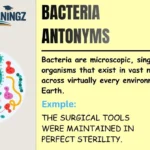
Bacteria are microscopic, single-celled organisms that exist in vast numbers across virtually every environment on Earth. They can be beneficial, neutral, or harmful depending on their type and context.
Tone Explanation
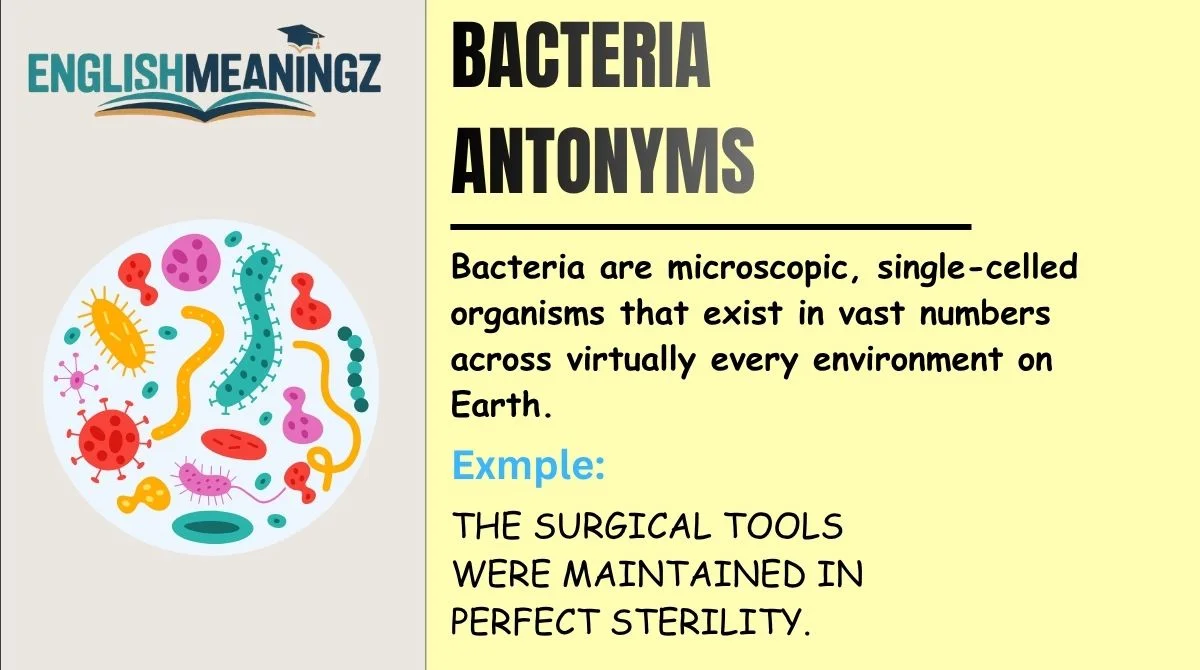
The word bacteria carries a neutral to scientific tone. However, in everyday usage, it often leans slightly negative because people associate it with disease, infection, and contamination.
Emotional or Action Intensity
- Low emotional intensity in academic use
- Moderate negative intensity in casual contexts
- Often implies presence of microscopic life, contamination, or biological activity
Because bacteria refers to living microorganisms, its antonyms are not direct opposites in a simple sense. Instead, they relate to ideas such as cleanliness, sterility, lifelessness, or purity.
18 Best Antonyms for “Bacteria”
Sterility
Meaning: Complete absence of microorganisms
Tone: Academic
Example: The surgical tools were maintained in perfect sterility.
Why it’s opposite: Bacteria represent microbial presence; sterility represents total absence.
Cleanliness
Meaning: State of being free from dirt or contamination
Tone: Neutral/Formal
Example: Cleanliness in the lab reduces the risk of bacterial growth.
Why it’s opposite: Cleanliness minimizes or removes bacteria.
Purity
Meaning: Freedom from contaminants or impurities
Tone: Formal/Academic
Example: The water was tested for purity before consumption.
Why it’s opposite: Bacteria introduce impurity, while purity eliminates it.
Disinfection
Meaning: Process of eliminating harmful microorganisms
Tone: Technical
Example: Regular disinfection is essential in hospitals.
Why it’s opposite: It actively destroys bacteria.
Sanitation
Meaning: Maintenance of hygienic conditions
Tone: Formal
Example: Proper sanitation prevents bacterial outbreaks.
Why it’s opposite: It prevents bacterial accumulation.
Hygiene
Meaning: Practices that maintain health and cleanliness
Tone: Neutral
Example: Good hygiene reduces bacterial infections.
Why it’s opposite: Hygiene controls or eliminates bacteria.
Sterilization
Meaning: Complete removal or destruction of all microorganisms
Tone: Academic
Example: Equipment undergoes sterilization before use.
Why it’s opposite: It ensures zero bacterial presence.
Antisepsis
Meaning: Prevention of infection by inhibiting microbes
Tone: Medical
Example: Antisepsis is critical during surgeries.
Why it’s opposite: It suppresses bacterial activity.
Purification
Meaning: Process of removing impurities
Tone: Formal
Example: Air purification systems reduce harmful bacteria.
Why it’s opposite: Removes bacteria as contaminants.
Decontamination
Meaning: Removal of hazardous substances
Tone: Technical
Example: The lab underwent full decontamination.
Why it’s opposite: Eliminates bacterial contamination.
Asepsis
Meaning: State of being free from disease-causing microorganisms
Tone: Medical/Academic
Example: Asepsis is vital in operating rooms.
Why it’s opposite: Prevents bacterial presence entirely.
Clean Environment
Meaning: Area free from pollutants and microbes
Tone: Neutral
Example: A clean environment discourages bacterial growth.
Why it’s opposite: Opposes bacterial-rich conditions.
Germ-Free
Meaning: Completely free of germs
Tone: Informal/Neutral
Example: The surface was advertised as germ-free.
Why it’s opposite: Directly negates bacterial existence.
Sterile Surface
Meaning: Surface devoid of microorganisms
Tone: Technical
Example: The sterile surface ensured safe experimentation.
Why it’s opposite: No bacteria can exist there.
Antibacterial State
Meaning: Condition that prevents bacterial growth
Tone: Scientific
Example: The coating creates an antibacterial state.
Why it’s opposite: Actively resists bacteria.
Non-living Matter
Meaning: Material without life
Tone: Academic
Example: Rocks are examples of non-living matter.
Why it’s opposite: Bacteria are living organisms.
Vacuum
Meaning: Space devoid of matter and organisms
Tone: Scientific
Example: A vacuum cannot support bacterial life.
Why it’s opposite: No environment for bacteria to exist.
Sterile Zone
Meaning: Area strictly maintained free of microbes
Tone: Formal
Example: Only authorized staff may enter the sterile zone.
Why it’s opposite: Designed to exclude bacteria completely.
Strong vs Mild Opposites
Not all antonyms carry the same intensity. Some completely negate the concept of bacteria, while others simply reduce or control it.
Strong Opposites
- Sterility
- Sterilization
- Asepsis
- Vacuum
- Germ-free
These represent absolute absence of bacteria.
Mild Opposites
- Cleanliness
- Hygiene
- Sanitation
- Purification
These indicate reduction or control, not total elimination.
Understanding this scale helps you choose the right word depending on context. For example, in scientific writing, sterility is more precise than cleanliness.
Context-Based Opposites
Because bacteria is a scientific term, its antonyms depend heavily on context.
Medical Context
- Antisepsis
- Sterilization
- Asepsis
Everyday Context
- Cleanliness
- Hygiene
- Germ-free
Scientific Context
- Vacuum
- Non-living matter
- Sterility
Environmental Context
- Clean environment
- Purification
Choosing the correct antonym depends on where and how the word is used.
Common Mistakes When Using Opposites
Mistake 1: Using “virus” as an antonym
Incorrect: Virus is the opposite of bacteria.
Correct: Virus is another microorganism, not an opposite.
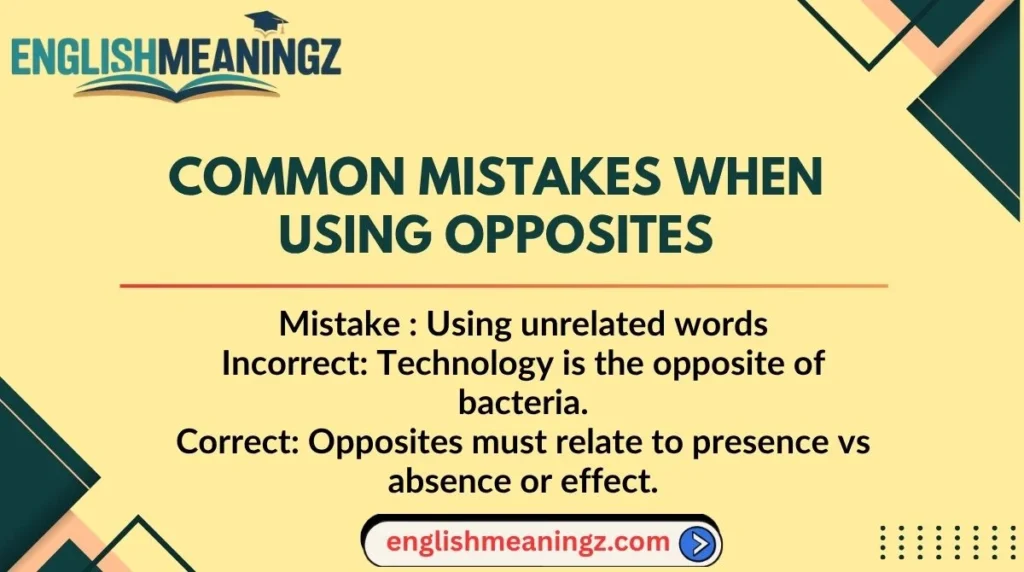
Mistake 2: Using unrelated words
Incorrect: Technology is the opposite of bacteria.
Correct: Opposites must relate to presence vs absence or effect.
Mistake 3: Confusing “clean” with “sterile”
Incorrect: Clean surfaces have no bacteria.
Correct: Clean surfaces may still contain bacteria; sterile surfaces do not.
Mistake 4: Overgeneralization
Incorrect: All bacteria are harmful, so their opposite is “health.”
Correct: Many bacteria are beneficial; opposites should reflect context.
Sentence Transformation Examples
Original 1
The surface was covered in bacteria.
Rewritten: The surface was completely sterile.
Original 2
Poor hygiene leads to bacterial growth.
Rewritten: Proper hygiene prevents contamination.
Original 3
The lab contained harmful bacteria.
Rewritten: The lab maintained strict asepsis.
Original 4
Bacteria spread rapidly in dirty environments.
Rewritten: Clean environments inhibit microbial growth.
Original 5
The equipment was exposed to bacteria.
Rewritten: The equipment underwent full sterilization.
FAQs
What is the direct antonym of bacteria?
There is no single direct antonym, but sterility is the closest equivalent.
Can “clean” be an antonym of bacteria?
Partially. It suggests reduced bacteria but not complete absence.
Is “virus” an antonym of bacteria?
No, both are microorganisms and not opposites.
Why are bacteria antonyms context-based?
Because bacteria is a scientific noun, its opposites depend on situation and usage.
What is the strongest opposite of bacteria?
Sterility or vacuum, as both imply complete absence.
Are all bacteria harmful?
No, many are beneficial, especially in digestion and ecosystems.
Which antonym is best for academic writing?
Asepsis, sterility, and sterilization are most appropriate.
Conclusion
Mastering antonyms—even for complex scientific terms like bacteria—enhances your vocabulary and sharpens your communication skills.
Unlike simple adjectives, bacteria requires contextual thinking to identify its opposites, making it a valuable exercise in linguistic precision.
By understanding concepts like sterility, hygiene, and purification, you gain the ability to express contrasts clearly in academic, professional, and everyday writing. The key is not just memorizing words, but recognizing their intensity, context, and practical application.