Vocabulary diversity is one of the most important elements of strong writing.
Whether you are a student preparing essays, a blogger creating engaging content, or a professional writing reports and emails, the ability to replace repetitive words with precise synonyms significantly improves the quality of writing.
One word that frequently appears in academic and professional writing is “superfluous.” Writers often struggle to vary this word without changing the meaning of their sentences.
Overusing a single word can reduce clarity, weaken style, and negatively affect writing scores in exams such as IELTS, TOEFL, or university assessments.
Using appropriate synonyms helps writers:
- Avoid repetition
- Improve lexical variety
- Enhance clarity and precision
- Strengthen academic tone
- Achieve higher writing scores
However, not all synonyms function the same way. Some are formal and appropriate for academic essays, while others are better suited for casual communication.
This article explores 16 powerful synonyms for “superfluous,” explains their meanings, shows how they differ in tone and intensity, and demonstrates how to use them correctly in academic and professional contexts.
Definition and Core Meaning of “Superfluous”
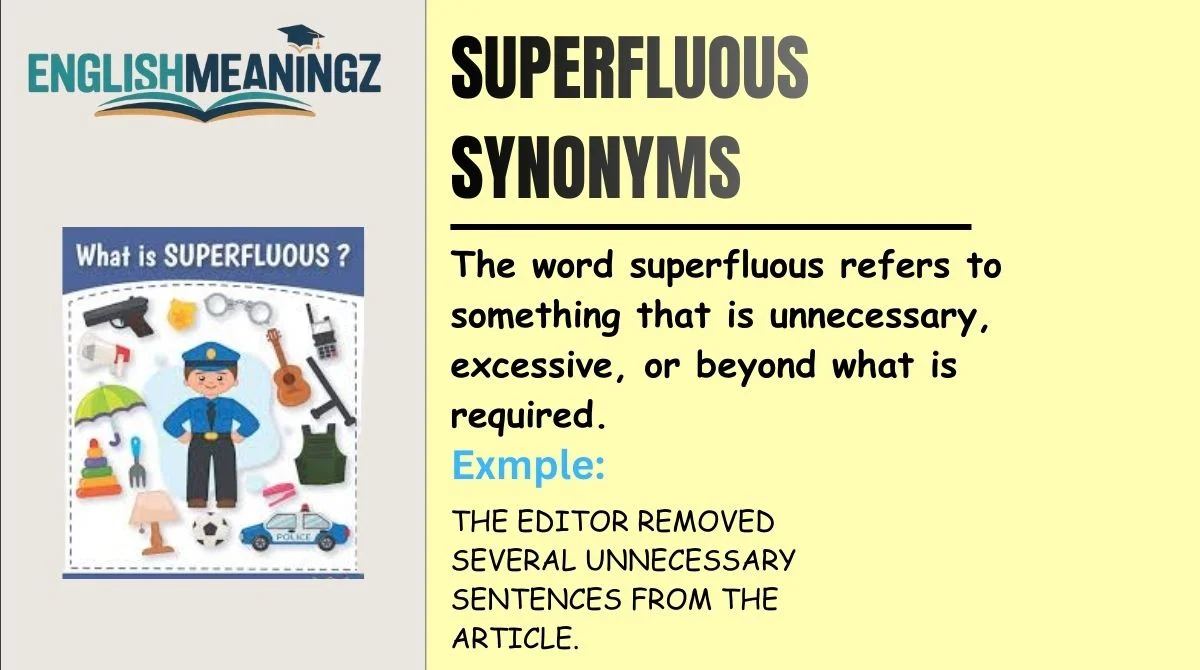
The word superfluous refers to something that is unnecessary, excessive, or beyond what is required.
In general usage, it describes anything that serves no essential purpose and can be removed without affecting the main function or meaning.
In academic and professional contexts, the term is often used to describe:
- unnecessary words in writing
- extra steps in a process
- redundant information
- excessive features in systems or products
Simple Definition
Superfluous: Something that is more than what is needed or useful.
Example
The report contained several superfluous details that distracted readers from the main argument.
In writing and editing, eliminating superfluous elements improves clarity and efficiency.
16 Synonyms Grouped by Context
General Use
1. Unnecessary
Meaning: Not needed or required.
Context: This is the most common and widely understood alternative to “superfluous.” It is suitable for both everyday and semi-formal writing.
Example Sentence:
The editor removed several unnecessary sentences from the article.
2. Excess
Meaning: More than what is needed or acceptable.
Context: Often used when referring to quantities, actions, or behavior that go beyond reasonable limits.
Example Sentence:
The project failed due to excess spending and poor budget management.
3. Extra
Meaning: Something additional beyond what is required.
Context: Common in everyday communication and informal writing.
Example Sentence:
The company decided to remove extra features from the software to improve performance.
4. Surplus
Meaning: An amount that remains after requirements have been met.
Context: Frequently used in economics, finance, and resource management.
Example Sentence:
The factory sold its surplus materials to smaller manufacturers.
Formal & Academic Writing
5. Redundant
Meaning: Repeating something unnecessarily or being no longer useful.
Context: Common in academic writing, editing, engineering, and technology discussions.
Example Sentence:
The author removed several redundant phrases to improve the clarity of the essay.
6. Extraneous
Meaning: Irrelevant or unrelated to the main subject.
Context: Often used in academic writing, research papers, and scientific discussions.
Example Sentence:
The researcher eliminated extraneous variables from the experiment.
7. Needless
Meaning: Something that could easily be avoided or is not required.
Context: Frequently used in formal discussions about mistakes, complications, or harm.
Example Sentence:
The misunderstanding caused needless delays in the project.
8. Nonessential
Meaning: Not vital or necessary.
Context: Common in academic writing, technical documentation, and policy analysis.
Example Sentence:
The professor advised students to remove nonessential details from their essays.
9. Dispensable
Meaning: Able to be removed without negative consequences.
Context: Often used in academic, business, or philosophical discussions.
Example Sentence:
Many experts consider printed manuals dispensable in the digital era.
Informal Usage
10. Overkill
Meaning: Doing far more than is required.
Context: Informal language commonly used in conversation and casual writing.
Example Sentence:
Adding ten images to a short blog post is complete overkill.
11. Too Much
Meaning: An excessive amount of something.
Context: Very informal and often used in spoken English.
Example Sentence:
The presentation included too much information for a ten-minute talk.
12. Unneeded
Meaning: Something that is not required.
Context: Similar to “unnecessary” but slightly more casual.
Example Sentence:
The software update removed several unneeded features.
Technical or Subject-Specific Use
13. Supernumerary
Meaning: Present in greater numbers than required.
Context: Often used in academic or organizational contexts.
Example Sentence:
The committee discovered several supernumerary administrative roles.
14. Perfunctory
Meaning: Done with minimal effort because it is unnecessary or routine.
Context: Used in academic or professional discussions.
Example Sentence:
The review process became perfunctory because many steps were unnecessary.
15. Expendable
Meaning: Something that can be sacrificed or discarded.
Context: Used in business, military, or organizational contexts.
Example Sentence:
Management considered the outdated equipment expendable.
16. Unwarranted
Meaning: Not justified or necessary.
Context: Often used in formal writing and legal discussions.
Example Sentence:
The criticism was unwarranted and lacked factual support.
Word Intensity & Tone Comparison Table
| Synonym | Formal Level | Emotional Strength | Typical Context |
|---|---|---|---|
| Unnecessary | Neutral | Low | Everyday writing |
| Redundant | High | Low | Academic writing |
| Extraneous | Very High | Low | Research and analysis |
| Needless | Medium | Medium | Criticism or explanation |
| Surplus | High | Low | Economics and resources |
| Dispensable | High | Medium | Policy or philosophy |
| Overkill | Informal | High | Casual conversation |
| Extra | Informal | Low | Everyday language |
| Expendable | Medium | Medium | Organizational contexts |
| Supernumerary | Very High | Low | Formal academic writing |
Understanding the tone and intensity of each synonym helps writers choose the most appropriate word for different situations.
Common Mistakes When Using These Synonyms
Even advanced writers sometimes misuse synonyms because subtle differences exist between them.
Mistake 1: Using “redundant” instead of “extraneous”
Incorrect:
The experiment included several redundant variables.
Correct:
The experiment included several extraneous variables.
Explanation:
Variables are unrelated rather than repeated, so “extraneous” is more accurate.
Mistake 2: Using “extra” in academic writing
Incorrect:
The essay contains extra information.
Correct:
The essay contains superfluous information.
Explanation:
“Extra” is informal and not ideal for academic contexts.
Mistake 3: Confusing “surplus” with “unnecessary”
Incorrect:
The introduction contains surplus words.
Correct:
The introduction contains unnecessary words.
Explanation:
“Surplus” usually refers to quantities such as goods or resources.
Synonyms in Academic Writing
Example Paragraph 1
In academic writing, clarity and conciseness are essential. Writers should avoid including extraneous information that does not directly support their arguments. When essays contain redundant phrases or unnecessary explanations, readers may struggle to identify the central ideas. Therefore, effective editing involves identifying and removing superfluous elements to strengthen the overall structure of the text.
Example Paragraph 2
Research papers must maintain a high level of precision and focus. Including nonessential details can weaken the argument and reduce the impact of the analysis. Scholars should aim to eliminate dispensable information and concentrate on evidence that directly supports their claims. By removing extraneous material, writers can ensure that their research remains clear and persuasive.
IELTS & Exam Writing Tips
Students preparing for IELTS or academic exams should use synonyms strategically.
1. Avoid Repetition
If the word “superfluous” appears multiple times, replace it with suitable alternatives such as:
- unnecessary
- redundant
- extraneous
- nonessential
2. Use Formal Synonyms
Exams reward academic vocabulary. Words like extraneous, redundant, and dispensable are more suitable than informal options like “extra.”
3. Do Not Replace Key Terms
In some contexts, replacing a word may reduce clarity. For example, in technical writing, the original term may be more precise.
4. Focus on Accuracy
Using an incorrect synonym can damage coherence. Always ensure that the replacement word matches the intended meaning.
Similar Words vs True Synonyms
Some words appear similar to “superfluous” but do not always function as direct substitutes.
Superfluous vs Redundant
- Superfluous: unnecessary or excessive
- Redundant: repetitive or no longer useful
Example:
The paragraph contained redundant phrases that made it superfluous.
Superfluous vs Extraneous
- Superfluous: unnecessary addition
- Extraneous: unrelated to the main topic
Example:
The report included extraneous information that seemed superfluous.
Superfluous vs Surplus
- Superfluous: unnecessary
- Surplus: remaining after needs are met
Example:
The company sold its surplus equipment that had become superfluous.
Practice Sentences
Choose the correct synonym for each sentence.
- The report contained several ______ details that distracted from the main argument.
- The scientist removed ______ variables from the experiment.
- The company sold its ______ inventory after meeting demand.
- The essay included ______ phrases that repeated the same idea.
- Adding complex animations to a simple website would be ______.
Suggested answers:
- unnecessary
- extraneous
- surplus
- redundant
- overkill
These exercises help learners understand how synonyms function in real contexts.
FAQs
What is the closest synonym for superfluous?
The closest synonym is unnecessary, because both words describe something that is not required or useful.
What is a formal synonym for superfluous?
Formal alternatives include extraneous, redundant, nonessential, and dispensable, which are commonly used in academic writing.
Is “redundant” the same as “superfluous”?
Not exactly. “Redundant” usually refers to repetition, while “superfluous” refers to anything unnecessary.
Can “extra” replace “superfluous”?
Yes in informal contexts, but it is not appropriate for academic writing.
Why is vocabulary variety important in essays?
Using diverse vocabulary improves clarity, avoids repetition, and increases lexical resource scores in exams like IELTS.
Conclusion
Strong writing requires precision, clarity, and vocabulary variety. The word superfluous is useful, but relying on it repeatedly can make writing appear repetitive and less engaging.
Learning synonyms such as extraneous, redundant, unnecessary, nonessential, and dispensable allows writers to express ideas more accurately and effectively.
For students, bloggers, and professionals, expanding vocabulary improves communication, enhances writing quality, and increases academic and professional credibility.
By understanding the subtle differences between synonyms and practicing their correct usage, writers can eliminate superfluous language and create clearer, more powerful content.