Understanding opposites is one of the fastest ways to sharpen your writing, expand your vocabulary, and communicate with precision. When you know not just what a word means—but also what it does not mean—you gain control over nuance, tone, and clarity.
Opposites (antonyms) are especially important in academic and professional communication. They allow you to compare ideas, construct arguments, and express contrast without ambiguity.
Whether you’re writing essays, business emails, or creative content, the ability to switch between a word and its antonym gives your language flexibility and depth.
In this guide, we explore 24 smart antonyms of the word “smart”—each explained clearly, with tone, usage, and context. This is not just a list; it’s a complete vocabulary upgrade.
What Does “Smart” Mean?
The word “smart” is highly versatile, which is why its antonyms vary depending on context.
Core Definition
“Smart” generally refers to:
- Intelligence or mental sharpness
- Quick thinking or problem-solving ability
- Sometimes appearance (stylish, well-dressed)
- Occasionally behavior (clever, strategic, or even sarcastic)
Tone Explanation
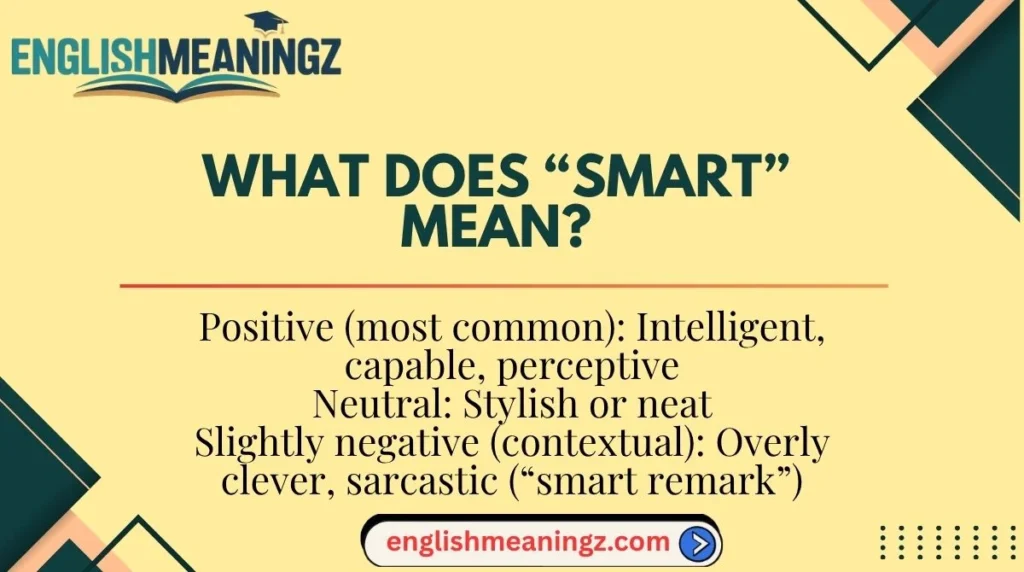
- Positive (most common): Intelligent, capable, perceptive
- Neutral: Stylish or neat
- Slightly negative (contextual): Overly clever, sarcastic (“smart remark”)
Emotional / Action Intensity
“Smart” often implies:
- Speed of thought
- Accuracy in judgment
- Efficiency in action
Because of this layered meaning, its antonyms can range from mild (e.g., unaware) to strong (e.g., ignorant).
24 Best Antonyms for “Smart”
1.Ignorant
Meaning: Lacking intelligence or common sense
Tone: Informal / Harsh
Example: That was a ignorant decision to ignore the warning signs.
Why Opposite: Directly contradicts intelligence and reasoning ability
2. Ignorant
Meaning: Lacking knowledge or awareness
Tone: Formal / Academic
Example: He remained ignorant of the basic principles of the subject.
Why Opposite: Smart implies knowledge; ignorant means absence of it
3. Foolish
Meaning: Showing poor judgment or lack of wisdom
Tone: Neutral / Slightly Critical
Example: It was foolish to invest without research.
Why Opposite: Smart decisions are rational; foolish ones are not
4. Unintelligent
Meaning: Not intellectually capable
Tone: Formal
Example: The argument appeared unintelligent and poorly structured.
Why Opposite: Direct academic opposite of intelligence
5. Dull
Meaning: Slow to understand or lacking mental sharpness
Tone: Neutral
Example: He seemed dull compared to his peers.
Why Opposite: Smart implies sharpness; dull implies slowness
6. Dense
Meaning: Slow to comprehend things
Tone: Informal
Example: Don’t be dense—this concept is simple.
Why Opposite: Opposes quick thinking
7. Witless
Meaning: Without intelligence or humor
Tone: Formal / Literary
Example: The witless response disappointed the audience.
Why Opposite: Smart often includes wit; this removes it
8. Mindless
Meaning: Acting without thinking
Tone: Neutral / Critical
Example: The protest turned into mindless chaos.
Why Opposite: Smart involves thoughtful action
9. Clueless
Meaning: Completely unaware or uninformed
Tone: Informal
Example: He was clueless about the situation.
Why Opposite: Smart people are aware; clueless people are not
10. Naive
Meaning: Lacking experience or judgment
Tone: Neutral
Example: She was naive about business negotiations.
Why Opposite: Smart includes awareness and experience
11. Illogical
Meaning: Not reasoning correctly
Tone: Academic
Example: His conclusion was illogical and unsupported.
Why Opposite: Smart thinking follows logic
12. Unwise
Meaning: Not sensible or prudent
Tone: Formal
Example: It would be unwise to ignore expert advice.
Why Opposite: Smart decisions are wise
13. Reckless
Meaning: Careless and without thought
Tone: Emotional
Example: His reckless behavior caused problems.
Why Opposite: Smart implies careful planning
14. Careless
Meaning: Not paying attention
Tone: Neutral
Example: A careless mistake ruined the report.
Why Opposite: Smart involves attention to detail
15. Unthinking
Meaning: Acting without consideration
Tone: Formal
Example: It was an unthinking reaction.
Why Opposite: Smart requires thinking
16. Slow-witted
Meaning: Slow to understand
Tone: Informal
Example: He was considered slow-witted in class.
Why Opposite: Opposes quick intelligence
17. Brainless
Meaning: Extremely lacking intelligence
Tone: Informal / Harsh
Example: That was a brainless move.
Why Opposite: Extreme contrast to intelligence
18. Unaware
Meaning: Not conscious or informed
Tone: Neutral
Example: She was unaware of the changes.
Why Opposite: Smart people stay informed
19. Incompetent
Meaning: Lacking ability or skill
Tone: Formal
Example: The manager was incompetent in handling the crisis.
Why Opposite: Smart includes competence
20. Unskilled
Meaning: Not trained or capable
Tone: Neutral
Example: The worker was unskilled in technical tasks.
Why Opposite: Smart often implies skill
21. Inept
Meaning: Clumsy or ineffective
Tone: Formal
Example: His inept handling of the situation worsened it.
Why Opposite: Smart actions are effective
22. Vacant
Meaning: Showing lack of thought or awareness
Tone: Neutral
Example: She had a vacant expression.
Why Opposite: Smart implies alertness
23. Absurd
Meaning: Completely unreasonable
Tone: Academic
Example: The idea sounded absurd.
Why Opposite: Smart thinking is rational
24. Silly
Meaning: Lacking seriousness or good sense
Tone: Informal
Example: That was a silly mistake.
Why Opposite: Smart implies seriousness and accuracy
Strong vs Mild Opposites
Not all antonyms carry the same intensity. Understanding this helps you choose the right word.
Strong Opposites
These are harsh and direct:
- Ignorant
- Brainless
- Witless
- Ignorant
Use them carefully, especially in professional writing.
Mild Opposites
These are softer and more neutral:
- Unaware
- Careless
- Naive
- Unskilled
Ideal for academic or polite communication.
Moderate Opposites
Balanced tone:
- Foolish
- Unwise
- Inept
- Illogical
These are widely acceptable in essays and reports.
Context-Based Opposites
The antonym of “smart” changes depending on usage.
Intelligence Context
Smart → Intelligent
Opposites:
- Ignorant
- Unintelligent
- Dense
Decision-Making Context
Smart → Wise
Opposites:
- Foolish
- Reckless
- Unwise
Behavior Context
Smart → Thoughtful
Opposites:
- Mindless
- Careless
- Unthinking
Appearance Context
Smart → Stylish
Opposites:
- Untidy
- Sloppy
- Unkempt
Understanding context prevents misuse and improves clarity.
Common Mistakes When Using Opposites
1. Using Harsh Words in Formal Writing
❌ “The student gave a ignorant answer.”
✔ “The response lacked clarity.”
2. Confusing Ignorance with Low Intelligence
❌ Ignorant = unintelligent
✔ Ignorant = uninformed
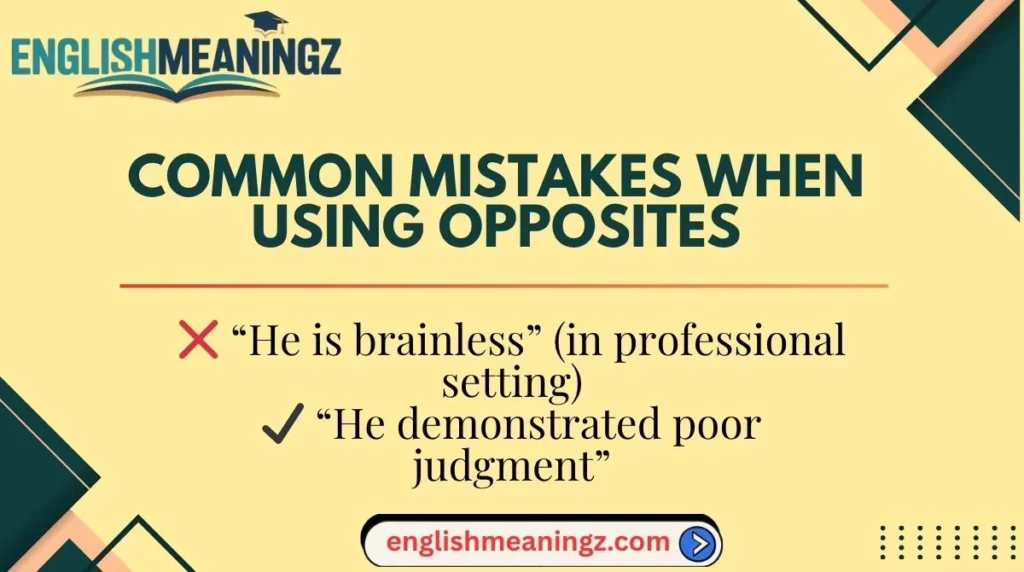
3. Misusing Tone
❌ “He is brainless” (in professional setting)
✔ “He demonstrated poor judgment”
4. Using Incorrect Context
❌ “His outfit was ignorant.”
✔ “His outfit was sloppy.”
5. Overusing One Antonym
Repeating “ignorant” weakens writing—vary your vocabulary.
Sentence Transformation Examples
1
Original: She made a smart decision.
Rewritten: She made a foolish decision.
2
Original: He is a smart student.
Rewritten: He is an unintelligent student.
3
Original: That was a smart move.
Rewritten: That was a reckless move.
4
Original: She gave a smart response.
Rewritten: She gave an illogical response.
5
Original: He handled the situation smartly.
Rewritten: He handled the situation carelessly.
FAQs
What is the most accurate antonym of “smart”?
“Unintelligent” is the most precise in academic contexts, while “ignorant” is more informal.
Are all antonyms of “smart” negative?
Yes, most carry negative connotations because they imply lack of intelligence or judgment.
Can “naive” be an antonym of “smart”?
Yes, in contexts involving experience and awareness.
Is “ignorant” the same as “ignorant”?
No. “Ignorant” means lacking knowledge, while “ignorant” implies lack of intelligence.
Which antonyms are safe for professional writing?
Use words like “unwise,” “illogical,” “inept,” or “incompetent.”
Can antonyms change based on context?
Absolutely. The meaning of “smart” shifts, so its opposite also changes.
How can I improve my vocabulary using antonyms?
Practice writing sentences using both a word and its opposite to understand nuance.
Conclusion
Mastering antonyms of “smart” is more than memorizing opposites—it’s about understanding nuance, tone, and context.
From mild terms like unaware to strong ones like ignorant, each word carries a different level of intensity and appropriateness.
When used correctly, these antonyms help you:
- Write more precisely
- Communicate ideas clearly
- Adapt tone for different audiences
In 2026 and beyond, strong vocabulary isn’t optional—it’s essential. And knowing both sides of a word is what truly makes your language powerful.