Understanding opposites—also known as antonyms—is one of the fastest ways to elevate your writing from basic to compelling.
When you know how to contrast ideas effectively, your sentences gain clarity, depth, and precision. Instead of sounding repetitive or vague, your communication becomes sharp and purposeful.
In academic and professional settings, antonyms are especially valuable. They help you compare arguments, highlight differences, and structure logical discussions.
Whether you’re writing essays, reports, or content for SEO, mastering antonyms ensures your message is not only understood but also impactful.
What Does “Positive” Mean?
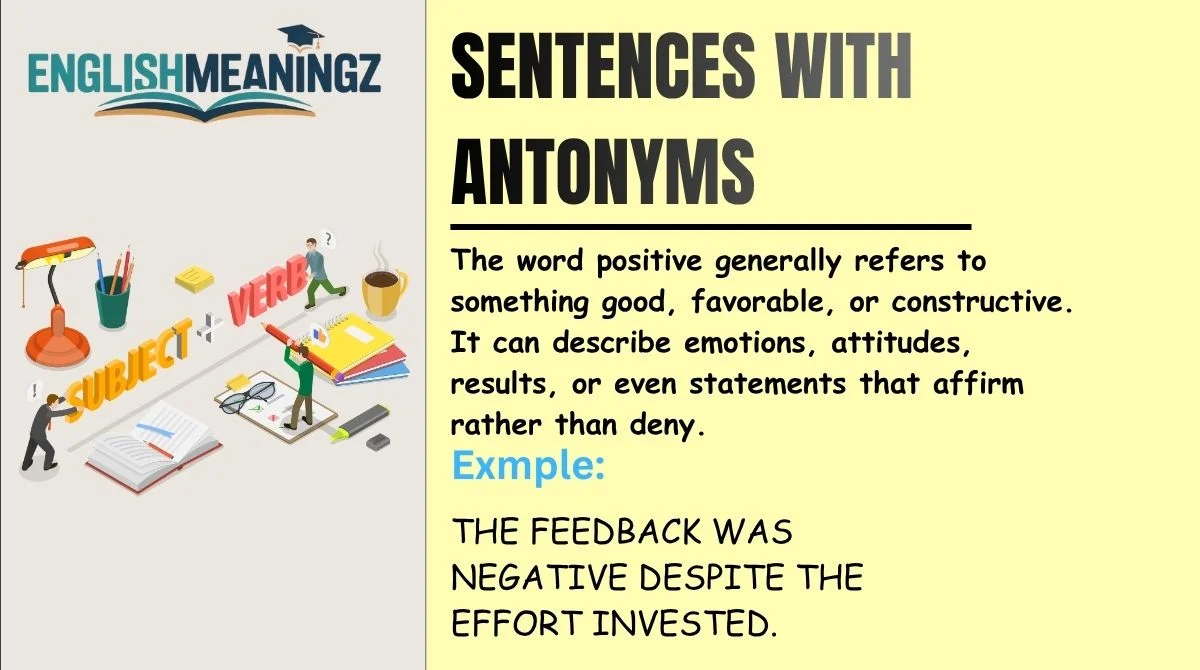
The word positive generally refers to something good, favorable, or constructive. It can describe emotions, attitudes, results, or even statements that affirm rather than deny.
In tone, positive is often associated with optimism, encouragement, and approval. It conveys a sense of confidence and forward momentum.
From an emotional perspective, positive has a strong uplifting intensity. It suggests energy, hope, and agreement. Because of this, its antonyms often carry contrasting emotional weight—ranging from mild disagreement to strong negativity.
17 Best Antonyms for “Positive”
Negative
Meaning: Expressing denial, refusal, or pessimism
Tone: Formal / Academic
Example: The feedback was negative despite the effort invested.
Why it’s opposite: It directly contrasts affirmation with rejection.
Pessimistic
Meaning: Expecting the worst outcome
Tone: Emotional / Academic
Example: His pessimistic outlook affected the entire team.
Why it’s opposite: It replaces optimism with doubt.
Unfavorable
Meaning: Not beneficial or supportive
Tone: Formal
Example: The report presented an unfavorable conclusion.
Why it’s opposite: It contrasts supportive outcomes with disadvantage.
Adverse
Meaning: Harmful or opposing
Tone: Academic
Example: The project faced adverse conditions.
Why it’s opposite: It shifts from helpful to harmful.
Critical
Meaning: Expressing disapproval
Tone: Formal
Example: The manager was critical of the results.
Why it’s opposite: It contrasts approval with judgment.
Hostile
Meaning: Aggressive or unfriendly
Tone: Emotional
Example: The response from the audience was hostile.
Why it’s opposite: It opposes friendliness and support.
Dismal
Meaning: Gloomy or depressing
Tone: Emotional
Example: The company faced dismal performance this quarter.
Why it’s opposite: It contrasts optimism with despair.
Discouraging
Meaning: Causing loss of confidence
Tone: Emotional
Example: The results were discouraging for the team.
Why it’s opposite: It replaces motivation with doubt.
Unpromising
Meaning: Showing little chance of success
Tone: Formal
Example: The early signs were unpromising.
Why it’s opposite: It contrasts hopeful potential with uncertainty.
Doubtful
Meaning: Uncertain or unlikely
Tone: Academic
Example: The success of the plan remains doubtful.
Why it’s opposite: It replaces certainty with hesitation.
Bleak
Meaning: Without hope or encouragement
Tone: Emotional
Example: The future looked bleak after the failure.
Why it’s opposite: It removes hope entirely.
Gloomy
Meaning: Dark or depressing
Tone: Informal / Emotional
Example: His gloomy attitude affected morale.
Why it’s opposite: It contrasts brightness with sadness.
Cynical
Meaning: Distrusting others’ intentions
Tone: Academic
Example: She had a cynical view of success.
Why it’s opposite: It opposes belief with skepticism.
Uncertain
Meaning: Not sure or definite
Tone: Formal
Example: The outcome is still uncertain.
Why it’s opposite: It contrasts confidence with ambiguity.
Rejecting
Meaning: Refusing acceptance
Tone: Formal
Example: The proposal received a rejecting response.
Why it’s opposite: It contrasts acceptance with denial.
Disapproving
Meaning: Showing dislike or rejection
Tone: Formal
Example: His disapproving tone was obvious.
Why it’s opposite: It contrasts approval with dissatisfaction.
Defeatist
Meaning: Expecting failure
Tone: Emotional
Example: A defeatist mindset can ruin opportunities.
Why it’s opposite: It replaces confidence with surrender.
Strong vs Mild Opposites
Not all antonyms carry the same intensity. Some are mild contrasts, while others completely reverse the meaning.
- Mild opposites: uncertain, doubtful, unpromising
These suggest a lack of positivity but not full negativity. - Moderate opposites: unfavorable, discouraging, critical
These clearly contrast positivity but still allow nuance. - Strong opposites: hostile, bleak, defeatist
These completely reverse the emotional tone.
Understanding this scale helps you choose the right word for your context. For example, “uncertain” is appropriate in academic writing, while “bleak” adds emotional intensity.
Context-Based Opposites
Antonyms are not always fixed—they depend on context.
- In emotional writing: positive → gloomy
- In academic analysis: positive → unfavorable
- In business communication: positive → negative
- In personal mindset: positive → pessimistic
For example:
- “The results were positive” → “The results were unfavorable” (formal)
- “She stayed positive” → “She became pessimistic” (emotional)
Choosing the right antonym depends on tone, audience, and purpose.
Common Mistakes When Using Opposites
1. Using weak antonyms
Incorrect: The results were positive → The results were not good
Better: The results were negative
2. Ignoring tone mismatch
Incorrect: Formal report uses “gloomy”
Better: Use “unfavorable” in academic writing
3. Overusing simple opposites
Incorrect: good → bad repeatedly
Better: Use varied antonyms like adverse, discouraging, bleak
4. Confusing context
Incorrect: “hostile” for neutral situations
Better: Use “uncertain” if the tone is mild
5. Repetition of same antonym
Avoid using “negative” repeatedly—diversify vocabulary.
Sentence Transformation Examples
Here are 5 sentence rewrites using antonyms:
- Original: The feedback was positive.
Transformed: The feedback was critical. - Original: She maintained a positive attitude.
Transformed: She adopted a pessimistic attitude. - Original: The results were positive for the company.
Transformed: The results were unfavorable for the company. - Original: He gave a positive response.
Transformed: He gave a rejecting response. - Original: The future looks positive.
Transformed: The future looks bleak.
FAQs
What is an antonym?
An antonym is a word that has the opposite meaning of another word.
Why are antonyms important in writing?
They improve clarity, contrast, and help express ideas more precisely.
Can a word have multiple antonyms?
Yes, depending on context and tone, a word can have several opposites.
What is the difference between strong and mild antonyms?
Strong antonyms completely reverse meaning, while mild ones only slightly contrast it.
Are antonyms always exact opposites?
No, many antonyms are context-based and not perfectly opposite.
How can I learn antonyms faster?
Practice sentence rewriting and group words by intensity and tone.
Are antonyms useful in SEO writing?
Yes, they improve keyword variation, readability, and engagement.
Conclusion
Mastering antonyms is more than just learning opposites—it’s about understanding nuance, tone, and context.
When used effectively, antonyms bring balance and contrast to your writing, making your ideas clearer and more persuasive.
Whether you’re crafting academic essays or SEO-driven content, a strong command of opposites ensures your communication remains dynamic, precise, and engaging.