Understanding opposites is one of the fastest ways to sharpen your language skills. When you know not only what a word means but also what it doesn’t mean, your vocabulary becomes more precise, expressive, and versatile.
This is especially valuable in academic writing, professional communication, and persuasive content creation.
Writers who master antonyms gain control over tone. Instead of sounding repetitive or vague, they can shift emotional intensity, adjust formality, and communicate nuanced ideas with clarity.
Whether you are writing essays, reports, or SEO content, knowing the right opposite word can completely transform your message.
In this guide, we will explore 18 scoff antonyms, understand their meanings, and learn how to use them effectively in real contexts.
What Does “Scoff” Mean?
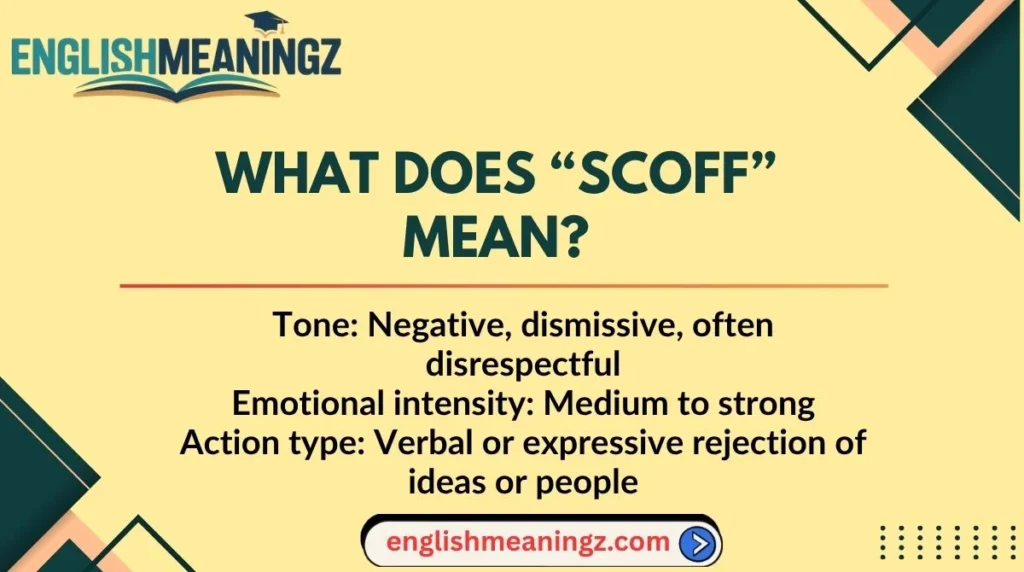
The word “scoff” means to mock, ridicule, or express contempt toward someone or something. It often involves dismissive laughter or sarcastic remarks.
- Tone: Negative, dismissive, often disrespectful
- Emotional intensity: Medium to strong
- Action type: Verbal or expressive rejection of ideas or people
When someone scoffs, they are not just disagreeing—they are doing so in a way that shows disdain or superiority.
Example:
He scoffed at the idea, calling it unrealistic.
So, antonyms of “scoff” will typically reflect respect, approval, acceptance, or admiration.
18 Best Antonyms for “Scoff”
Respect
Meaning: Showing admiration or regard
Tone: Formal / Professional
Example: She respected his opinion even though she disagreed.
Why it’s opposite: Instead of mocking, respect values the other person.
Admire
Meaning: To feel approval or appreciation
Tone: Emotional / Positive
Example: They admired her dedication to the project.
Why it’s opposite: Admiration replaces ridicule with appreciation.
Praise
Meaning: To express approval or admiration
Tone: Formal / Academic
Example: The teacher praised the student’s effort.
Why it’s opposite: Praise uplifts instead of belittling.
Appreciate
Meaning: Recognize the value of something
Tone: Professional / Neutral
Example: I appreciate your honesty in this matter.
Why it’s opposite: Appreciation acknowledges worth rather than dismissing it.
Encourage
Meaning: To give support or confidence
Tone: Emotional / Supportive
Example: Her mentor encouraged her to keep going.
Why it’s opposite: Encouragement builds up instead of tearing down.
Support
Meaning: To back or defend someone
Tone: Neutral / Professional
Example: The team supported his innovative idea.
Why it’s opposite: Support replaces rejection with acceptance.
Approve
Meaning: To agree with or accept
Tone: Formal
Example: The committee approved the proposal.
Why it’s opposite: Approval validates rather than mocks.
Endorse
Meaning: Publicly support or recommend
Tone: Formal / Academic
Example: Experts endorsed the new policy.
Why it’s opposite: Endorsement shows confidence, not contempt.
Accept
Meaning: To receive or agree with
Tone: Neutral
Example: She accepted the feedback gracefully.
Why it’s opposite: Acceptance is the opposite of rejection and ridicule.
Value
Meaning: To consider important
Tone: Professional
Example: We value diverse perspectives in discussions.
Why it’s opposite: Valuing something prevents dismissive behavior.
Honor
Meaning: To show high respect
Tone: Formal / Emotional
Example: They honored her achievements at the ceremony.
Why it’s opposite: Honor elevates instead of degrading.
Revere
Meaning: Deep respect or admiration
Tone: Academic / Formal
Example: Many revere him as a visionary leader.
Why it’s opposite: Reverence is the strongest form of respect.
Compliment
Meaning: To express praise politely
Tone: Informal / Professional
Example: He complimented her presentation skills.
Why it’s opposite: Compliments are positive expressions, not mocking ones.
Applaud
Meaning: To show strong approval
Tone: Emotional / Formal
Example: The audience applauded her performance.
Why it’s opposite: Applause replaces ridicule with recognition.
Agree
Meaning: To share the same opinion
Tone: Neutral
Example: I agree with your perspective on this issue.
Why it’s opposite: Agreement eliminates the need for mockery.
Acknowledge
Meaning: To recognize or admit
Tone: Academic
Example: He acknowledged the importance of teamwork.
Why it’s opposite: Acknowledgment shows consideration rather than dismissal.
Defend
Meaning: To support against criticism
Tone: Formal
Example: She defended her colleague’s idea in the meeting.
Why it’s opposite: Defense protects instead of ridicules.
Celebrate
Meaning: To honor or praise publicly
Tone: Emotional / Positive
Example: The team celebrated their success.
Why it’s opposite: Celebration highlights positivity instead of negativity.
Strong vs Mild Opposites
Not all antonyms carry the same intensity. Some directly counter scoffing, while others offer softer contrasts.
- Strong opposites: Revere, honor, celebrate
These express deep admiration and are the complete emotional opposite of scoffing. - Moderate opposites: Respect, admire, praise
These are balanced and commonly used in both academic and professional writing. - Mild opposites: Accept, acknowledge, agree
These do not strongly express positivity but still avoid ridicule.
Understanding this scale helps you choose the right word depending on context. For example, “accept” works in neutral discussions, while “celebrate” fits emotional or inspirational writing.
Context-Based Opposites
The best antonym depends on the situation:
- In academic writing: acknowledge, endorse, approve
- In workplace communication: respect, support, appreciate
- In emotional or personal contexts: admire, encourage, celebrate
- In debates: agree, accept, defend
For instance, replacing “scoff” in a research paper with “acknowledge” maintains professionalism, while “admire” might feel too emotional.
Common Mistakes When Using Opposites
Using weak antonyms
❌ He scoffed at the idea → He noticed the idea
✔ Better: He respected the idea
“Notice” is not a true opposite—it lacks emotional contrast.
Ignoring tone mismatch
❌ The professor admired the flawed theory
✔ Better: The professor acknowledged the theory
“Admired” may sound too positive for academic critique.
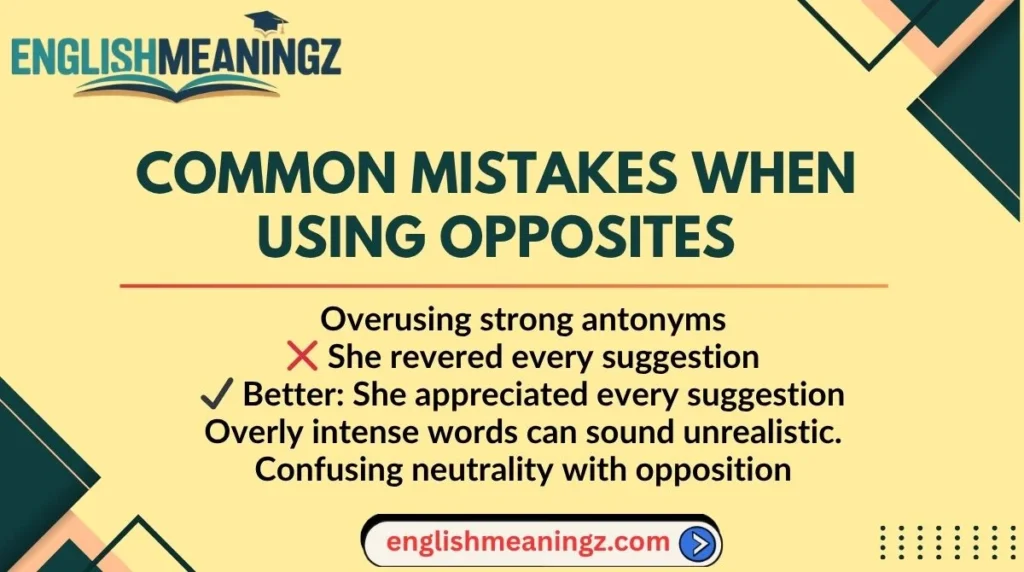
Overusing strong antonyms
❌ She revered every suggestion
✔ Better: She appreciated every suggestion
Overly intense words can sound unrealistic.
Confusing neutrality with opposition
❌ He scoffed → He listened
✔ Better: He supported
Listening is not the opposite of mocking—it’s just passive.
Sentence Transformation Examples
Here are five examples showing how antonyms transform tone:
- Original: He scoffed at the proposal.
Rewritten: He approved the proposal. - Original: She scoffed at his ambition.
Rewritten: She admired his ambition. - Original: They scoffed at the suggestion.
Rewritten: They considered and accepted the suggestion. - Original: He scoffed at her creativity.
Rewritten: He praised her creativity. - Original: The audience scoffed at the idea.
Rewritten: The audience applauded the idea.
These transformations show how antonyms can completely shift meaning and tone.
FAQs
What is the simplest antonym of scoff?
The simplest antonym is respect, as it directly contrasts mockery with regard.
Are “accept” and “agree” true opposites of scoff?
Yes, but they are mild opposites. They remove rejection but don’t add strong positivity.
Which antonym is best for academic writing?
Words like acknowledge, endorse, and approve work best in formal contexts.
Can “admire” replace scoff in all cases?
No. “Admire” is emotional and may not fit neutral or professional settings.
What is the strongest antonym of scoff?
Revere is one of the strongest, as it expresses deep respect.
Is “ignore” an antonym of scoff?
No. Ignoring is passive, while scoffing is active ridicule.
Why is learning antonyms important?
It improves clarity, tone control, and helps avoid repetitive language in writing.
Conclusion
Mastering antonyms of “scoff” allows you to move from negative, dismissive language to expressions of respect, support, and appreciation.
Whether you choose mild opposites like “acknowledge” or stronger ones like “celebrate,” each word gives you greater control over tone and meaning.
For writers, students, and professionals, this skill is essential. It enhances communication, strengthens arguments, and ensures your message is both clear and impactful.
By applying these 18 antonyms thoughtfully, you can elevate your vocabulary and communicate with precision in any context.