Understanding opposites is one of the fastest ways to sharpen your writing. When you know not just what a word means—but what it doesn’t mean—you gain control over tone, clarity, and precision.
This is especially useful in persuasive writing, storytelling, and academic analysis, where subtle shifts in meaning can dramatically change the message.
In both academic and professional communication, antonyms help avoid ambiguity. They allow you to contrast ideas, highlight arguments, and present balanced viewpoints.
For example, replacing a vague term with a precise opposite can turn a weak sentence into a compelling one. That’s why mastering antonyms of words like prey is essential for anyone serious about language mastery.
What Does “Prey” Mean?
Definition:
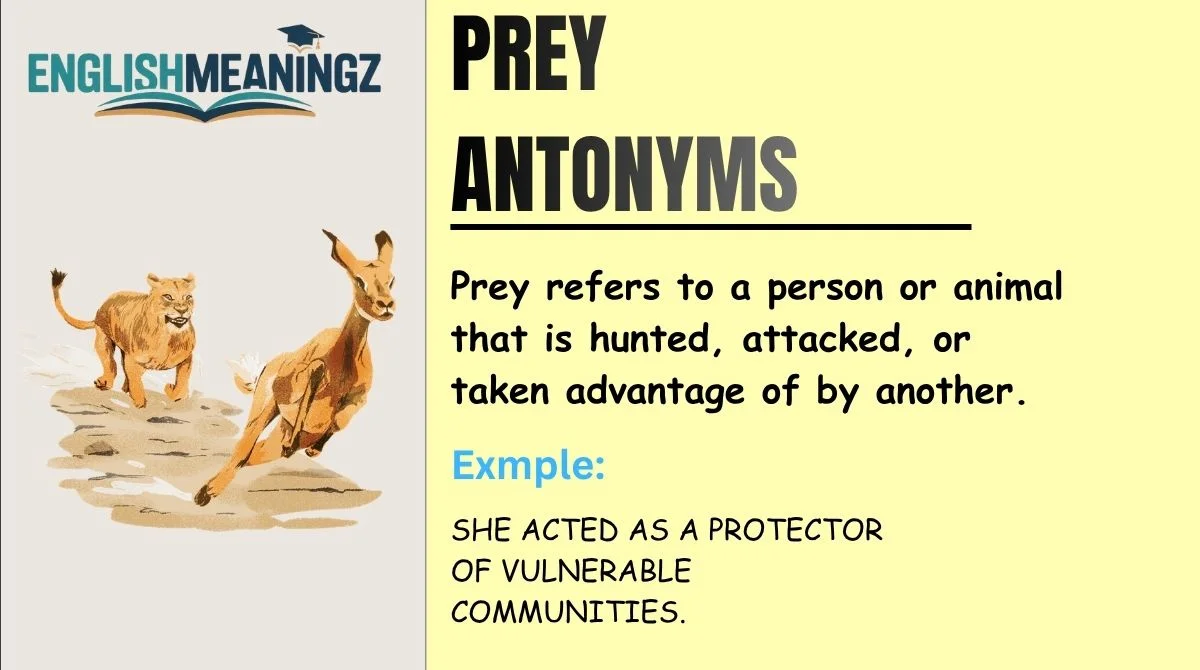
Prey refers to a person or animal that is hunted, attacked, or taken advantage of by another.
Tone Explanation:
The word carries a negative and vulnerable tone. It often implies weakness, helplessness, or being targeted.
Emotional / Action Intensity:
- Emotionally: Suggests fear, danger, or exploitation
- Action-wise: Indicates passivity (being acted upon rather than acting)
In both literal and figurative contexts, prey represents the receiving end of harm or control.
23 Best Antonyms for “Prey”
Predator
Meaning: One who hunts or attacks
Tone: Academic
Example: The lion is a powerful predator in the wild.
Why Opposite: A predator is the active hunter, directly opposing the passive nature of prey.
Hunter
Meaning: One who pursues targets
Tone: Neutral
Example: The hunter tracked the deer silently.
Why Opposite: Hunters initiate action rather than being targeted.
Protector
Meaning: One who defends others
Tone: Formal
Example: She acted as a protector of vulnerable communities.
Why Opposite: A protector prevents harm instead of receiving it.
Defender
Meaning: One who resists attack
Tone: Academic
Example: The defender blocked every attempt.
Why Opposite: Represents resistance rather than vulnerability.
Guardian
Meaning: One who safeguards
Tone: Formal
Example: He served as the guardian of the forest.
Why Opposite: Guardians ensure safety instead of being endangered.
Survivor
Meaning: One who overcomes danger
Tone: Emotional
Example: She is a survivor of extreme hardship.
Why Opposite: Survivors escape or endure harm, unlike prey.
Victor
Meaning: One who wins
Tone: Formal
Example: The victor celebrated his success.
Why Opposite: Victory implies dominance, not victimhood.
Conqueror
Meaning: One who defeats others
Tone: Academic
Example: The conqueror expanded his empire.
Why Opposite: Conquerors overpower, not get overpowered.
Aggressor
Meaning: One who initiates conflict
Tone: Formal
Example: The aggressor launched the attack.
Why Opposite: Aggressors act, prey reacts.
Attacker
Meaning: One who assaults
Tone: Neutral
Example: The attacker struck suddenly.
Why Opposite: The attacker is the source of harm.
Leader
Meaning: One who guides
Tone: Professional
Example: A strong leader inspires confidence.
Why Opposite: Leaders control direction rather than being controlled.
Controller
Meaning: One who has authority
Tone: Formal
Example: The controller managed all operations.
Why Opposite: Control contrasts with helplessness.
Dominator
Meaning: One who dominates
Tone: Academic
Example: The team was a dominator in the league.
Why Opposite: Dominance is the reverse of vulnerability.
Winner
Meaning: One who succeeds
Tone: Informal
Example: She emerged as the winner.
Why Opposite: Winners are empowered, not targeted.
Rescuer
Meaning: One who saves others
Tone: Emotional
Example: The rescuer pulled them to safety.
Why Opposite: Rescuers reverse the fate of prey.
Liberator
Meaning: One who frees
Tone: Formal
Example: The liberator ended oppression.
Why Opposite: Liberation removes the condition of being prey.
Authority
Meaning: One with power
Tone: Academic
Example: The authority enforced strict rules.
Why Opposite: Authority implies dominance and control.
Master
Meaning: One in command
Tone: Formal
Example: He became a master of his craft.
Why Opposite: Masters are in control, not controlled.
Champion
Meaning: One who excels or defends
Tone: Professional
Example: She is a champion of justice.
Why Opposite: Champions stand strong, not vulnerable.
Fighter
Meaning: One who resists
Tone: Emotional
Example: He is a fighter who never gives up.
Why Opposite: Fighters oppose harm actively.
Strategist
Meaning: One who plans actions
Tone: Academic
Example: The strategist predicted every move.
Why Opposite: Strategic thinking removes vulnerability.
Enforcer
Meaning: One who imposes rules
Tone: Formal
Example: The enforcer maintained discipline.
Why Opposite: Enforcers hold power, not weakness.
Protectorate Leader
Meaning: One who governs safely
Tone: Formal
Example: The leader ensured national security.
Why Opposite: Represents organized protection rather than exposure.
Strong vs Mild Opposites
Not all antonyms carry equal strength. Some directly reverse the meaning of prey, while others offer softer contrasts.
Strong Opposites:
Predator, Conqueror, Dominator, Aggressor
→ These completely invert the meaning by emphasizing power and control.
Moderate Opposites:
Protector, Defender, Guardian
→ These shift the role from vulnerable to safe.
Mild Opposites:
Survivor, Fighter, Strategist
→ These suggest resistance rather than total dominance.
Understanding this scale helps you choose the right word depending on how strong a contrast you want to create.
Context-Based Opposites
Antonyms of prey vary depending on context:
- Wildlife context: Predator, Hunter
- Emotional context: Survivor, Fighter
- Professional context: Leader, Authority
- Conflict context: Aggressor, Attacker
- Moral context: Protector, Rescuer
Choosing the right antonym depends on whether you’re discussing physical danger, emotional struggle, or social dynamics.
Common Mistakes When Using Opposites
Mistake 1: Using unrelated words
Incorrect: Prey → Friend
Correct: Use a word that directly contrasts vulnerability, like Protector
Mistake 2: Ignoring tone
Using Aggressor in a positive context can sound inappropriate.
Mistake 3: Overgeneralization
Not every opposite fits every sentence.
Mistake 4: Confusing roles
Survivor is not always a full opposite—it depends on context.
Mistake 5: Misplacing intensity
Using a strong antonym where a mild one fits better can distort meaning.
Sentence Transformation Examples
Original: The animal became prey to the lion.
Rewritten: The lion acted as the predator in the hunt.
Original: He felt like prey in the hostile environment.
Rewritten: He became a fighter in the hostile environment.
Original: The scam targeted vulnerable prey.
Rewritten: The authority intervened to stop the scam.
Original: She was easy prey for manipulation.
Rewritten: She became a strong defender against manipulation.
Original: The weak are often prey in competition.
Rewritten: The strong emerge as leaders in competition.
FAQs
What is the exact opposite of prey?
The closest direct opposite is predator, as it represents the active hunter.
Can “survivor” be an antonym of prey?
Yes, in emotional contexts where overcoming danger contrasts vulnerability.
Is “hunter” always an opposite?
In literal contexts, yes. In metaphorical contexts, it depends on usage.
Are all antonyms interchangeable?
No, context determines which antonym is appropriate.
Why does tone matter in antonyms?
Tone affects how the message is perceived—formal, emotional, or neutral.
Can prey have multiple opposites?
Yes, because it applies to different contexts (physical, emotional, social).
How do I choose the best antonym?
Focus on context, intensity, and tone of your sentence.
Conclusion
Mastering antonyms of prey gives you a powerful advantage in writing and communication. It allows you to shift perspective—from vulnerability to strength, from passivity to control.
Whether you’re crafting academic arguments, professional reports, or creative stories, choosing the right opposite word enhances clarity and impact.
By understanding tone, intensity, and context, you don’t just replace words—you elevate your entire message. Keep practicing these antonyms, and your vocabulary will become sharper, more precise, and far more persuasive.