Understanding opposites is one of the most effective ways to sharpen your vocabulary and elevate your writing. When you learn antonyms, you don’t just memorize words—you gain control over tone, clarity, and precision.
This is especially valuable when dealing with expressive words like pantomime, which carry nuanced meanings beyond simple definitions.
In academic and professional communication, choosing the right opposite can completely transform a sentence.
Whether you’re writing essays, crafting dialogue, or improving SEO content, knowing accurate antonyms helps you avoid vague language and communicate ideas with confidence.
It also enhances readability and ensures your message aligns with your intended tone.
What Does “Pantomime” Mean?
Definition:
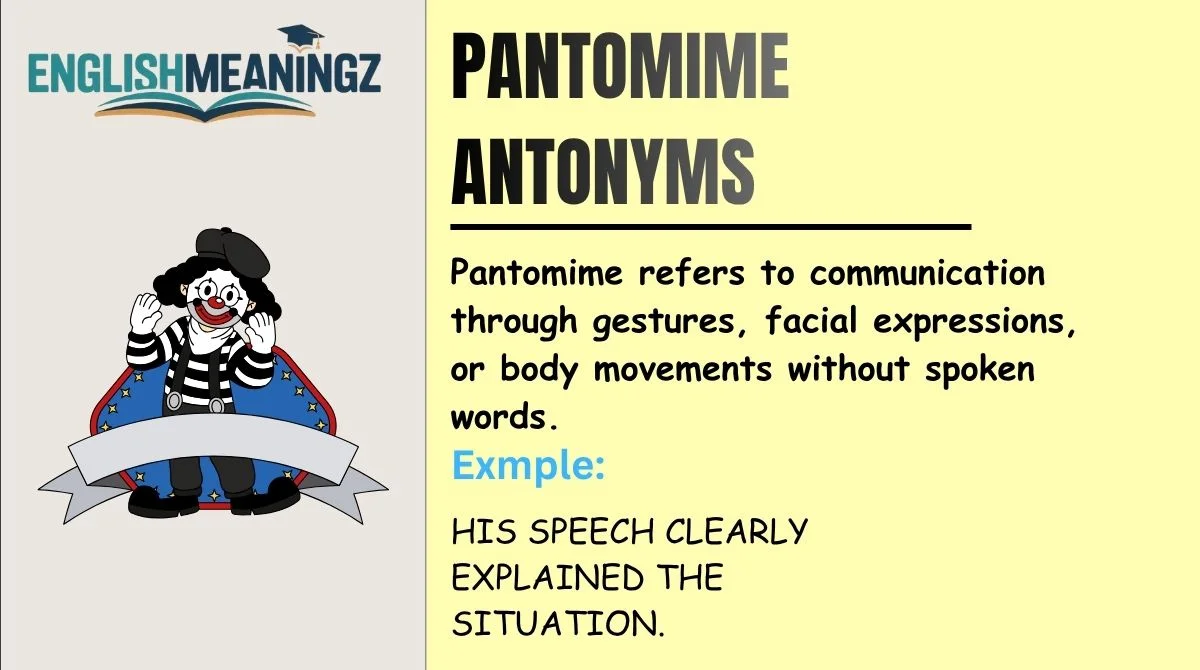
Pantomime refers to communication through gestures, facial expressions, or body movements without spoken words. It can also describe exaggerated or theatrical silent acting.
Tone Explanation:
The tone of pantomime is often expressive, theatrical, and non-verbal. It may be playful, dramatic, or symbolic depending on context.
Emotional or Action Intensity:
Pantomime can range from subtle gestures to highly exaggerated physical actions. Its intensity is tied to visual expression rather than vocal communication.
17 Best Antonyms for “Pantomime”
1. Verbal Communication
Meaning: Communication using spoken words
Tone: Formal / Academic
Example: She preferred verbal communication over silent gestures.
Why Opposite: Pantomime avoids speech, while verbal communication depends entirely on it.
2. Speech
Meaning: The act of speaking or expressing thoughts aloud
Tone: Neutral / Formal
Example: His speech clearly explained the situation.
Why Opposite: Speech replaces silent expression with audible language.
3. Dialogue
Meaning: A conversation between two or more people
Tone: Formal / Academic
Example: The film relied on sharp dialogue instead of visual acting.
Why Opposite: Dialogue involves words, unlike pantomime’s silence.
4. Explanation
Meaning: A detailed verbal clarification
Tone: Academic
Example: The teacher gave a full explanation rather than acting it out.
Why Opposite: Explanation uses language instead of physical gestures.
5. Articulation
Meaning: Clear expression of ideas through speech
Tone: Formal
Example: His articulation made the message easy to understand.
Why Opposite: Articulation emphasizes spoken clarity, unlike silent acting.
6. Narration
Meaning: Telling a story using spoken or written words
Tone: Formal / Literary
Example: The narration guided the audience through the plot.
Why Opposite: Narration uses language rather than visual mimicry.
7. Conversation
Meaning: Informal spoken exchange
Tone: Informal
Example: They had a lively conversation instead of using gestures.
Why Opposite: Conversation relies on speech, not silent expression.
8. Declaration
Meaning: A clear and formal statement
Tone: Formal
Example: The leader made a public declaration.
Why Opposite: Declarations are explicit and verbal.
9. Expression (Verbal)
Meaning: Conveying thoughts through words
Tone: Neutral
Example: Verbal expression is essential in debates.
Why Opposite: Opposes non-verbal expression.
10. Statement
Meaning: A definite spoken or written assertion
Tone: Formal
Example: Her statement clarified everything.
Why Opposite: Statements use direct language instead of gestures.
11. Announcement
Meaning: A public spoken declaration
Tone: Formal
Example: The announcement was made over the microphone.
Why Opposite: Involves audible communication.
12. Disclosure
Meaning: Revealing information through words
Tone: Formal / Legal
Example: The company made full disclosure of its plans.
Why Opposite: Focuses on verbal revelation.
13. Clarification
Meaning: Making something clear through explanation
Tone: Academic
Example: He offered clarification instead of acting silently.
Why Opposite: Clarification uses words to remove ambiguity.
14. Vocalization
Meaning: Producing sounds or speech
Tone: Technical
Example: Vocalization is key in language learning.
Why Opposite: Direct contrast to silence.
15. Communication (Oral)
Meaning: Spoken exchange of information
Tone: Academic
Example: Oral communication skills are essential in business.
Why Opposite: Opposes non-verbal communication.
16. Debate
Meaning: Formal discussion involving arguments
Tone: Academic
Example: The debate required clear spoken reasoning.
Why Opposite: Debate relies on spoken arguments.
17. Lecture
Meaning: A formal spoken presentation
Tone: Academic
Example: The professor delivered a detailed lecture.
Why Opposite: Lectures are structured verbal expressions.
Strong vs Mild Opposites
Not all antonyms carry the same level of contrast. Some are strong opposites, while others are mild or contextual opposites.
Strong Opposites:
These completely reverse the meaning of pantomime.
Examples: speech, vocalization, verbal communication
They directly replace silence with sound.
Mild Opposites:
These shift the meaning but don’t fully negate pantomime.
Examples: explanation, clarification, narration
They involve communication but may still include visual elements.
Intensity Scale:
- Highest Contrast: Vocalization → Speech
- Medium Contrast: Dialogue → Conversation
- Lower Contrast: Explanation → Clarification
Understanding this scale helps you choose the most precise antonym depending on your context.
Context-Based Opposites
Antonyms can vary depending on the situation in which pantomime is used.
In Theatre:
- Opposite: Dialogue
Because stage acting often contrasts silent performance with spoken lines.
In Communication Skills:
- Opposite: Verbal Communication
Focuses on spoken clarity instead of gestures.
In Education:
- Opposite: Lecture or Explanation
Teachers typically rely on words rather than silent acting.
In Everyday Interaction:
- Opposite: Conversation
Casual speech replaces non-verbal cues.
This shows that antonyms are not fixed—they adapt to context.
Common Mistakes When Using Opposites
1. Using unrelated words
Incorrect: Writing is the opposite of pantomime.
Correct: Speech is the opposite of pantomime.
2. Confusing non-verbal with opposite
Incorrect: Sign language is an antonym.
Reason: It is still non-verbal, like pantomime.
3. Choosing weak contrasts
Incorrect: Gesture is an antonym.
Reason: It’s actually similar, not opposite.
4. Ignoring context
Incorrect: Using lecture in casual conversation contexts
Better: Use conversation for informal tone
5. Overgeneralization
Not all communication types are opposites—only those that rely on speech.
Sentence Transformation Examples
1. Original: He used pantomime to tell the story.
Rewritten: He used narration to tell the story.
2. Original: The actor relied on pantomime.
Rewritten: The actor relied on dialogue.
3. Original: She explained everything through pantomime.
Rewritten: She explained everything through speech.
4. Original: The performance was entirely pantomime.
Rewritten: The performance was filled with verbal communication.
5. Original: He expressed his feelings through pantomime.
Rewritten: He expressed his feelings through conversation.
FAQs
What is the simplest antonym of pantomime?
The simplest antonym is speech, as it directly contrasts silence with spoken words.
Are all verbal words antonyms of pantomime?
No, only those emphasizing spoken communication act as true opposites.
Is writing an antonym of pantomime?
Not exactly. Writing is non-verbal but still not the direct opposite, since it lacks speech.
Can dialogue be an antonym?
Yes, especially in theatrical contexts where speech replaces silent acting.
Is pantomime always silent?
Yes, pantomime typically excludes spoken words and relies on gestures.
Why are antonyms important in writing?
They improve clarity, contrast, and help express ideas more precisely.
Which antonym is best for academic use?
Verbal communication or articulation are ideal in academic writing.
Conclusion
Mastering antonyms of pantomime gives you more than just vocabulary—it provides control over how you communicate ideas.
By understanding the contrast between silent expression and spoken language, you can choose words that fit your tone, context, and purpose with precision.
Whether you’re writing academically, professionally, or creatively, these 17 antonyms help you replace vague expressions with clear, impactful language.
The key is not just knowing the opposites, but knowing when and how to use them effectively.