Mastering opposites is one of the fastest ways to elevate your writing from average to powerful. When you understand antonyms deeply, you gain precision, flexibility, and control over tone. Instead of repeating the same idea, you can contrast, emphasize, and clarify your message effortlessly.
In academic and professional communication, this skill becomes even more valuable. Whether you’re crafting essays, reports, or persuasive content, knowing the right opposite word helps you avoid ambiguity and express nuanced meaning.
It also improves readability, making your writing more engaging and authoritative.
This guide focuses on “mausoleum antonyms”—a niche yet powerful vocabulary topic that can significantly sharpen your descriptive ability.
What Does “Mausoleum” Mean?
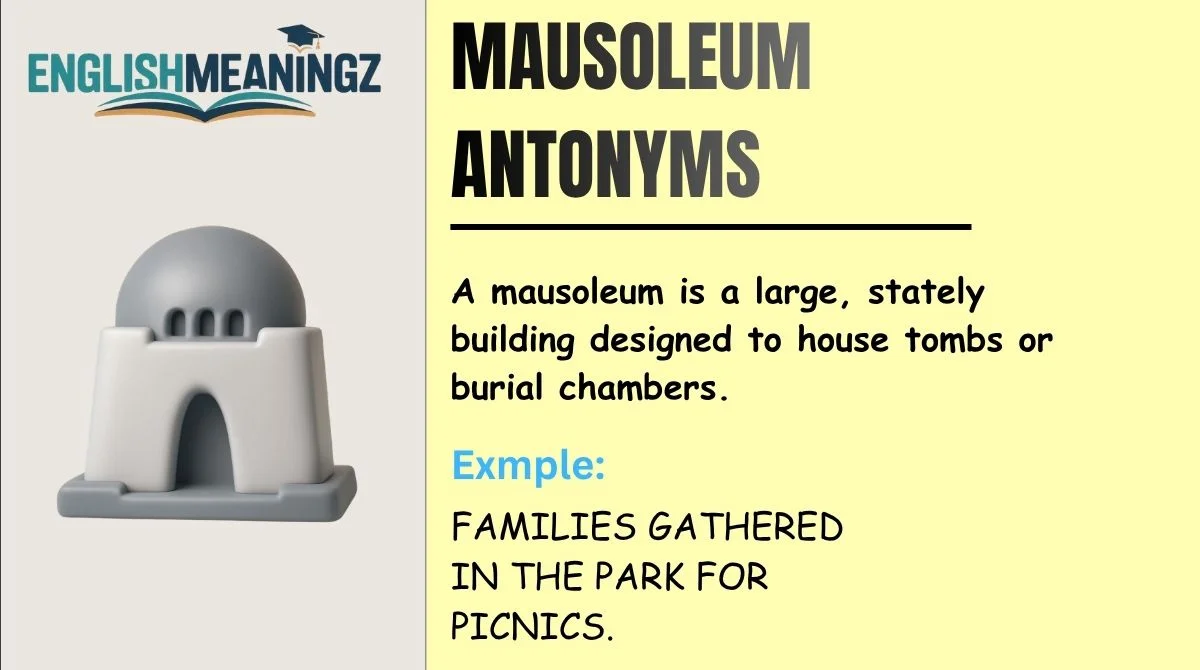
A mausoleum is a large, stately building designed to house tombs or burial chambers. Unlike a simple grave, it is often grand, enclosed, and permanent—built to preserve the remains of the deceased with dignity and architectural significance.
Tone Explanation:
The word carries a formal and solemn tone. It is associated with death, permanence, silence, and reverence.
Emotional and Intensity Insight:
“Mausoleum” suggests stillness, closure, and finality. It evokes a sense of lifelessness and immobility, often with a heavy emotional weight.
Because of this, its antonyms typically represent:
- Life
- Activity
- Openness
- Movement
- Energy
22 Best Antonyms for “Mausoleum”
1. Home
Meaning: A place where people live
Tone: Neutral
Example: After years abroad, she finally returned to her warm home.
Why it’s opposite: A home represents life and activity, unlike a mausoleum’s stillness.
2. Playground
Meaning: Area for play and recreation
Tone: Informal
Example: The children laughed loudly in the playground.
Why it’s opposite: Full of noise and energy, contrasting with silence and death.
3. Marketplace
Meaning: A busy area for trade
Tone: Neutral
Example: The marketplace was crowded with vendors and buyers.
Why it’s opposite: Symbolizes movement and interaction.
4. Garden
Meaning: A place where plants grow
Tone: Emotional
Example: The garden bloomed with vibrant colors in spring.
Why it’s opposite: Represents growth and life instead of death.
5. School
Meaning: Institution for education
Tone: Formal
Example: The school buzzed with eager students.
Why it’s opposite: Associated with learning and activity.
6. Office
Meaning: Workplace for professionals
Tone: Formal
Example: The office remained active late into the evening.
Why it’s opposite: Continuous productivity vs. stillness.
7. Park
Meaning: Public recreational space
Tone: Neutral
Example: Families gathered in the park for picnics.
Why it’s opposite: Social and lively.
8. Stadium
Meaning: Venue for sports and events
Tone: Formal
Example: The stadium roared with excitement.
Why it’s opposite: Loud and energetic.
9. Restaurant
Meaning: Place where food is served
Tone: Neutral
Example: The restaurant was filled with chatter.
Why it’s opposite: Social interaction replaces isolation.
10. Nursery
Meaning: Place for growing plants or caring for children
Tone: Emotional
Example: The nursery was full of fresh seedlings.
Why it’s opposite: Symbol of beginnings and life.
11. Festival Ground
Meaning: Area for celebrations
Tone: Informal
Example: The festival ground sparkled with lights and music.
Why it’s opposite: Joyful and vibrant atmosphere.
12. Gym
Meaning: Place for exercise
Tone: Informal
Example: The gym was full of energy and motion.
Why it’s opposite: Movement contrasts with stillness.
13. Theater
Meaning: Venue for performances
Tone: Formal
Example: The theater audience applauded loudly.
Why it’s opposite: Expression and emotion vs. silence.
14. Library (in active sense)
Meaning: Place of learning and study
Tone: Academic
Example: The library was filled with focused readers.
Why it’s opposite: Though quiet, it supports intellectual activity, not death.
15. City Center
Meaning: Central busy part of a city
Tone: Neutral
Example: The city center never sleeps.
Why it’s opposite: Constant motion and life.
16. Farm
Meaning: Land used for growing crops
Tone: Neutral
Example: The farm thrived during harvest season.
Why it’s opposite: Growth and productivity.
17. Workshop
Meaning: Place for making or repairing things
Tone: Neutral
Example: The workshop echoed with tools and activity.
Why it’s opposite: Creation vs. finality.
18. Playground Hall
Meaning: Indoor play area
Tone: Informal
Example: Kids ran freely in the playground hall.
Why it’s opposite: Active and joyful.
19. Resort
Meaning: Place for relaxation and leisure
Tone: Formal
Example: The resort was alive with tourists.
Why it’s opposite: Enjoyment and life energy.
20. University Campus
Meaning: Area for higher education
Tone: Academic
Example: The campus was buzzing with ideas.
Why it’s opposite: Intellectual life vs. stillness.
21. Street Market
Meaning: Open-air selling area
Tone: Informal
Example: The street market was lively and colorful.
Why it’s opposite: Open, dynamic environment.
22. Playground Field
Meaning: Open space for sports
Tone: Neutral
Example: The playground field echoed with laughter.
Why it’s opposite: Movement and sound replace silence.
Strong vs Mild Opposites
Not all antonyms carry the same intensity. Some create a direct and dramatic contrast, while others offer a softer, contextual opposition.
Strong Opposites:
- Playground
- Stadium
- Festival Ground
These emphasize noise, energy, and life, making them powerful contrasts.
Mild Opposites:
- Library
- Office
- Home
These are less intense but still contrast by representing functionality and life rather than death.
Understanding this scale helps you choose the right word depending on how strong you want your contrast to feel.
Context-Based Opposites
Antonyms are not always fixed—they depend on context.
- In an architectural context, a mausoleum might contrast with a residential building.
- In an emotional context, it may oppose celebration or joyful gathering.
- In a literary context, it could contrast with a place of life or rebirth.
For example:
“The abandoned hall felt like a mausoleum” → Opposite could be a lively arena.
Choosing the right antonym depends on what aspect you’re contrasting:
- Silence vs noise
- Death vs life
- Stillness vs movement
Common Mistakes When Using Opposites
Mistake 1: Using unrelated words
Incorrect: Mausoleum → Sky
Correct: Mausoleum → Playground
Mistake 2: Ignoring tone
Using informal words in academic writing reduces clarity.
Mistake 3: Overgeneralization
Not every “building” is an antonym. It must contrast in meaning.
Mistake 4: Emotional mismatch
A weak emotional contrast can confuse readers.
Mistake 5: Literal-only thinking
Sometimes metaphorical opposites work better in writing.
Sentence Transformation Examples
Original: The hall felt like a mausoleum.
Rewritten: The hall felt like a lively playground.
Original: The building stood silent like a mausoleum.
Rewritten: The building buzzed like a busy marketplace.
Original: The room had a mausoleum-like stillness.
Rewritten: The room pulsed with energy like a festival ground.
Original: His office felt like a mausoleum.
Rewritten: His office felt like a vibrant workshop.
Original: The area resembled a mausoleum at night.
Rewritten: The area resembled a lively city center at night.
FAQs
What is the simplest antonym of mausoleum?
The simplest antonym is home, as it represents life and daily activity.
Are mausoleum antonyms always places?
Mostly yes, because the word itself refers to a structure.
Can abstract words be antonyms of mausoleum?
Yes, in context—words like life or activity can serve as conceptual opposites.
Is “graveyard” an antonym of mausoleum?
No, it’s similar in meaning, not opposite.
Which antonym is best for creative writing?
Words like festival ground or playground work best due to vivid contrast.
Can I use these antonyms metaphorically?
Yes, metaphorical use enhances expressive writing.
Why is learning antonyms important?
It improves clarity, creativity, and precision in communication.
Conclusion
Understanding the antonyms of “mausoleum” goes far beyond memorizing words—it transforms how you express contrast, emotion, and imagery in writing.
From lively spaces like playgrounds and markets to productive environments like offices and campuses, each antonym reflects life, motion, and energy in its own way.
By mastering these opposites, you gain the ability to create sharper comparisons, stronger arguments, and more engaging narratives.
Whether you’re writing academically or creatively, this knowledge will make your language more dynamic, precise, and impactful.