Understanding opposites—also known as antonyms—is one of the most powerful ways to sharpen your writing. When you know how to contrast words effectively, you gain control over tone, clarity, and emotional impact. Instead of repeating similar expressions, you can vary your language and communicate with precision.
In academic and professional communication, this skill becomes even more important. Whether you’re writing essays, reports, or content for digital platforms, the ability to switch between elevated and grounded language helps you adapt to different audiences.
Words like “loftily” carry a sense of superiority or distance—but what if you want to sound humble, relatable, or practical instead? That’s where antonyms come in.
This guide explores 21 powerful antonyms of “loftily”—along with meanings, tones, examples, and practical usage—so you can write with balance, clarity, and confidence.
What Does “Loftily” Mean?
Definition:
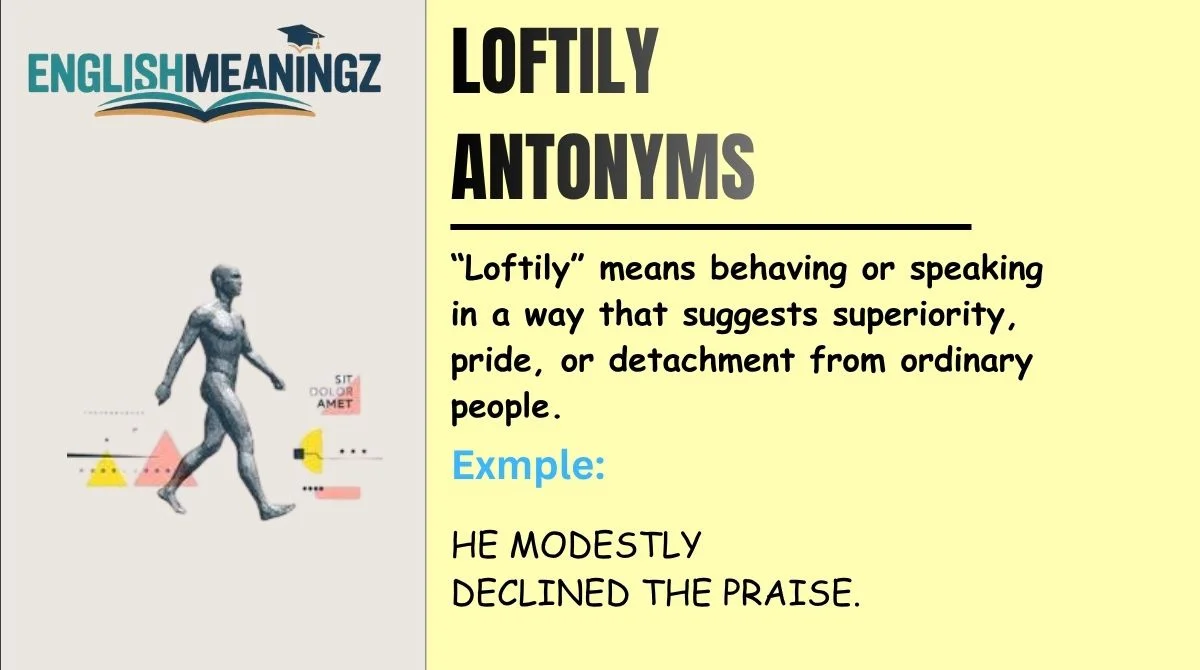
“Loftily” means behaving or speaking in a way that suggests superiority, pride, or detachment from ordinary people.
Tone Explanation:
The tone is typically formal, elevated, and often arrogant or condescending. It can imply that someone sees themselves as above others—intellectually, socially, or morally.
Emotional / Action Intensity:
“Loftily” carries a high emotional intensity. It signals distance, authority, or even coldness. It often creates a barrier between the speaker and the audience.
21 Best Antonyms for “Loftily”
1. Humbly
Meaning: In a modest, unpretentious manner
Tone: Emotional / Formal
Example: She spoke humbly about her achievements.
Why Opposite: Removes superiority and replaces it with modesty.
2. Modestly
Meaning: Without showing off or exaggeration
Tone: Formal / Academic
Example: He modestly declined the praise.
Why Opposite: Contrasts pride with restraint.
3. Simply
Meaning: In a plain, uncomplicated way
Tone: Informal
Example: She explained the idea simply.
Why Opposite: Opposes complexity and elevated tone.
4. Plainly
Meaning: Clearly and directly
Tone: Academic
Example: He stated his opinion plainly.
Why Opposite: Replaces lofty expression with clarity.
5. Casually
Meaning: In a relaxed and informal way
Tone: Informal
Example: They spoke casually about the issue.
Why Opposite: Removes formality and superiority.
6. Naturally
Meaning: In an authentic, unforced way
Tone: Neutral
Example: She responded naturally to the question.
Why Opposite: Opposes artificial elevation.
7. Down-to-earth
Meaning: Practical and realistic
Tone: Informal
Example: He gave a down-to-earth explanation.
Why Opposite: Eliminates distance and abstraction.
8. Honestly
Meaning: With sincerity and truthfulness
Tone: Emotional
Example: She spoke honestly about her struggles.
Why Opposite: Replaces pretension with sincerity.
9. Frankly
Meaning: Directly and openly
Tone: Formal / Informal
Example: He spoke frankly about the issue.
Why Opposite: Opposes indirect, elevated speech.
10. Directly
Meaning: In a straightforward way
Tone: Academic
Example: She answered directly.
Why Opposite: Removes layered, lofty expression.
11. Gently
Meaning: In a soft and kind manner
Tone: Emotional
Example: He spoke gently to the child.
Why Opposite: Contrasts harsh superiority.
12. Warmly
Meaning: In a friendly and kind way
Tone: Emotional
Example: She greeted them warmly.
Why Opposite: Opposes cold, distant tone.
13. Kindly
Meaning: With care and compassion
Tone: Emotional
Example: He kindly offered help.
Why Opposite: Replaces arrogance with empathy.
14. Relatably
Meaning: In a way people can connect with
Tone: Informal
Example: She spoke relatably about her experiences.
Why Opposite: Removes distance between speaker and audience.
15. Practically
Meaning: Focused on real-world application
Tone: Academic
Example: He explained the solution practically.
Why Opposite: Opposes abstract or elevated ideas.
16. Realistically
Meaning: Based on real conditions
Tone: Academic
Example: She assessed the situation realistically.
Why Opposite: Counters idealistic loftiness.
17. Appropriately
Meaning: In a suitable manner
Tone: Formal
Example: He responded appropriately.
Why Opposite: Avoids exaggerated expression.
18. Respectfully
Meaning: Showing regard for others
Tone: Formal
Example: She spoke respectfully to her colleagues.
Why Opposite: Opposes condescending tone.
19. Softly
Meaning: In a quiet and gentle way
Tone: Emotional
Example: He spoke softly during the meeting.
Why Opposite: Reduces intensity and dominance.
20. Unpretentiously
Meaning: Without attempting to impress
Tone: Formal
Example: She lived unpretentiously.
Why Opposite: Directly counters pretension.
21. Informally
Meaning: In a relaxed, non-formal way
Tone: Informal
Example: They discussed the topic informally.
Why Opposite: Removes structured, elevated tone.
Strong vs Mild Opposites
Not all antonyms carry the same intensity. Some directly oppose the arrogance of “loftily,” while others simply reduce its formality.
Strong Opposites:
- Humbly
- Modestly
- Unpretentiously
- Down-to-earth
These completely reverse the tone, shifting from superiority to humility.
Moderate Opposites:
- Frankly
- Directly
- Honestly
These focus on clarity rather than emotional tone.
Mild Opposites:
- Simply
- Casually
- Informally
These reduce the elevated tone but don’t strongly challenge it.
Understanding this scale helps you choose the right word depending on how much contrast you want.
Context-Based Opposites
The best antonym depends on the situation:
- Professional writing: Use modestly, appropriately, or respectfully
- Casual conversation: Use casually, simply, or relatably
- Emotional tone: Use kindly, warmly, or gently
- Academic clarity: Use plainly, directly, or practically
For example:
A CEO speaking to employees should avoid sounding “lofty” and instead communicate clearly and respectfully.
Common Mistakes When Using Opposites
1. Using weak contrasts
Wrong: He spoke loftily, then casually.
→ “Casually” may not fully counter arrogance.
2. Ignoring tone
Wrong: She spoke loftily but gently.
→ These can conflict unless used carefully.
3. Overusing informal antonyms in formal writing
Wrong: The professor explained it casually.
→ Better: “plainly” or “clearly”
4. Misunderstanding meaning
Wrong: Loftily vs loudly
→ Volume is not the same as tone.
Sentence Transformation Examples
1. Original: He spoke loftily about his success.
Rewritten: He spoke humbly about his success.
2. Original: She responded loftily to criticism.
Rewritten: She responded respectfully to criticism.
3. Original: The leader addressed the team loftily.
Rewritten: The leader addressed the team directly.
4. Original: He explained the idea loftily.
Rewritten: He explained the idea simply.
5. Original: She carried herself loftily in meetings.
Rewritten: She carried herself modestly in meetings.
FAQs
What is the simplest antonym of “loftily”?
“Humbly” is the most direct and commonly used opposite.
Can “casually” always replace “loftily”?
No. It works in informal contexts but may not suit academic or professional writing.
Is “loftily” always negative?
Not always, but it often implies arrogance or distance.
Which antonym is best for formal writing?
“Modestly,” “appropriately,” and “respectfully” are ideal choices.
What is the strongest opposite in tone?
“Unpretentiously” directly counters the idea of pretension.
Can antonyms change meaning completely?
Yes. Switching tone can alter how a message is perceived.
Why should writers learn antonyms?
They improve clarity, tone control, and vocabulary variety.
Conclusion
Mastering antonyms of “loftily” allows you to shift your tone from distant and superior to approachable and clear.
Whether you’re writing academically, professionally, or creatively, choosing the right opposite can transform your message and make it more effective.
By understanding the intensity, context, and nuance of each alternative, you gain full control over how your words are perceived.
Instead of sounding detached or arrogant, you can communicate with humility, clarity, and impact—qualities that define strong, modern writing in 2K26 and beyond.