Understanding opposites is one of the fastest ways to sharpen your vocabulary and elevate your writing. When you learn antonyms, you don’t just memorize new words—you gain control over contrast, nuance, and clarity.
This is especially important when working with a concept like integration, which appears frequently in academic, professional, and everyday communication.
In academic writing, precise opposites help you define arguments more clearly. In professional settings, they allow you to communicate distinctions, conflicts, or alternatives without confusion.
Whether you’re writing essays, reports, or content for SEO, mastering antonyms of “integration” gives your language depth and authority.
What Does “Integration” Mean?
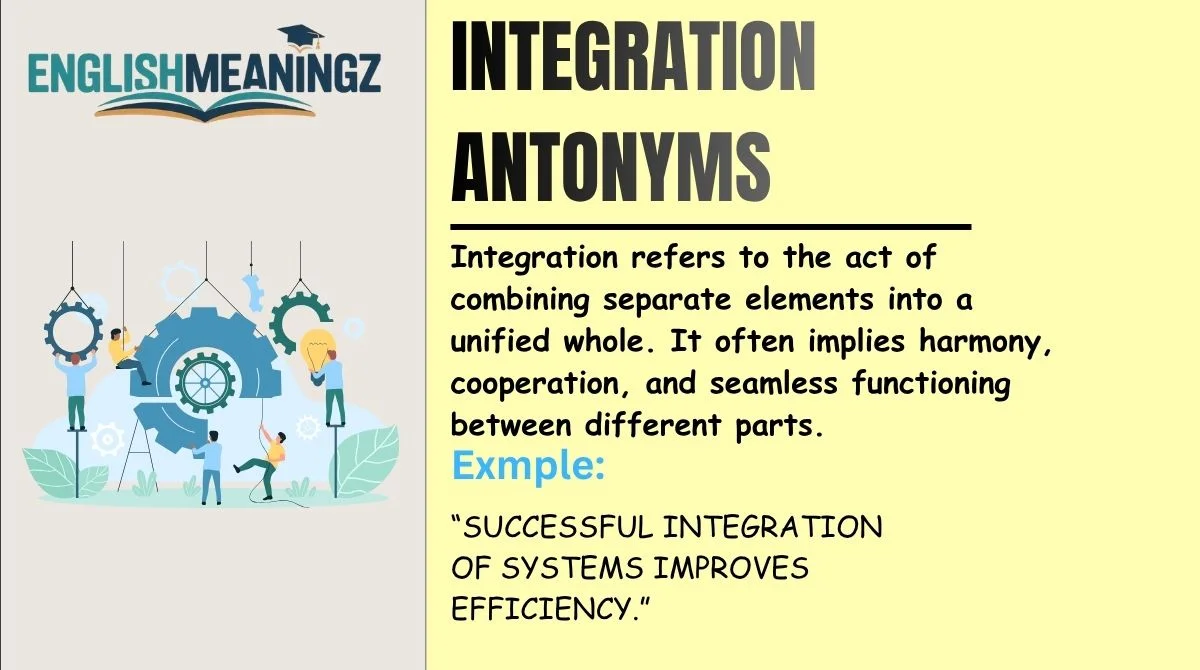
Integration refers to the act of combining separate elements into a unified whole. It often implies harmony, cooperation, and seamless functioning between different parts.
- Tone: Typically formal, academic, and neutral-positive
- Usage Contexts: Sociology, technology, business, education
- Emotional/Action Intensity: Moderate to strong — suggests purposeful merging or coordination
For example:
“Successful integration of systems improves efficiency.”
Integration carries a constructive tone—it implies progress, unity, and alignment. Its antonyms, therefore, often reflect division, separation, or conflict.
16 Best Antonyms for “Integration”
1. Separation
- Meaning: The act of dividing or keeping things apart
- Tone: Formal
- Example: “The separation of departments reduced collaboration.”
- Why Opposite: Integration combines; separation divides.
2. Segregation
- Meaning: Forced or systematic separation, often by category
- Tone: Academic / Social
- Example: “Segregation in systems creates inefficiencies.”
- Why Opposite: It prevents unity, directly opposing integration.
3. Division
- Meaning: Splitting into parts or groups
- Tone: Neutral
- Example: “The division of resources weakened the project.”
- Why Opposite: It breaks unity rather than forming it.
4. Disconnection
- Meaning: Lack of link or relationship
- Tone: Informal / Neutral
- Example: “There is a disconnection between teams.”
- Why Opposite: Integration builds connections; disconnection removes them.
5. Isolation
- Meaning: Being set apart from others
- Tone: Emotional / Academic
- Example: “Isolation of units caused delays.”
- Why Opposite: Integration brings together; isolation separates completely.
6. Fragmentation
- Meaning: Breaking into smaller disconnected parts
- Tone: Academic
- Example: “Data fragmentation affects performance.”
- Why Opposite: Integration unifies; fragmentation shatters unity.
7. Disunity
- Meaning: Lack of harmony or agreement
- Tone: Emotional
- Example: “Disunity among members slowed progress.”
- Why Opposite: Integration creates harmony; disunity destroys it.
8. Disorganization
- Meaning: Lack of structure or order
- Tone: Neutral
- Example: “Disorganization made integration difficult.”
- Why Opposite: Integration implies structured combination.
9. Alienation
- Meaning: Feeling of being excluded or disconnected
- Tone: Emotional / Formal
- Example: “Employees felt alienation after the policy change.”
- Why Opposite: Integration fosters belonging; alienation removes it.
10. Detachment
- Meaning: Emotional or physical separation
- Tone: Formal
- Example: “Detachment from the system caused inefficiency.”
- Why Opposite: Integration involves engagement, not distance.
11. Disintegration
- Meaning: Breaking apart into pieces
- Tone: Strong / Academic
- Example: “The disintegration of the network caused failure.”
- Why Opposite: It is the direct reverse of integration.
12. Decentralization
- Meaning: Distribution away from a central point
- Tone: Formal / Technical
- Example: “Decentralization reduced system integration.”
- Why Opposite: Integration often centralizes or unifies processes.
13. Withdrawal
- Meaning: Pulling back or removing participation
- Tone: Neutral
- Example: “Withdrawal from collaboration halted integration.”
- Why Opposite: Integration requires active involvement.
14. Disassociation
- Meaning: Lack of connection or involvement
- Tone: Formal
- Example: “Disassociation from the group affected results.”
- Why Opposite: Integration builds association.
15. Polarization
- Meaning: Division into opposing groups
- Tone: Academic / Political
- Example: “Polarization reduced social integration.”
- Why Opposite: It creates extremes instead of unity.
16. Splitting
- Meaning: Breaking into parts
- Tone: Informal
- Example: “Splitting the team slowed progress.”
- Why Opposite: Integration combines, while splitting separates.
Strong vs Mild Opposites
Not all antonyms carry the same intensity. Some completely reverse the meaning of integration, while others only partially oppose it.
- Strong Opposites: Disintegration, fragmentation, segregation
- These imply complete breakdown or active separation
- Moderate Opposites: Division, separation, disunity
- These indicate noticeable but not extreme contrast
- Mild Opposites: Detachment, disconnection, withdrawal
- These suggest partial lack of integration rather than total absence
Understanding this scale helps you choose the right word based on context. For academic writing, strong antonyms are often preferred. For conversational tone, milder ones work better.
Context-Based Opposites
The best antonym depends on the situation. “Integration” changes meaning across contexts, so its opposite must match the scenario.
- In Technology:
Integration → Disconnection / Fragmentation - In Society:
Integration → Segregation / Alienation - In Business:
Integration → Decentralization / Division - In Psychology:
Integration → Disassociation / Isolation
Choosing the wrong antonym can weaken your message. Always match the word to the domain you’re writing in.
Common Mistakes When Using Opposites
1. Using Weak Contrasts
Incorrect: “Integration vs difference”
Correct: “Integration vs separation”
Difference is not a direct opposite.
2. Confusing Tone
Incorrect: “Integration vs splitting” in formal writing
Correct: “Integration vs division”
Match tone with context.
3. Overusing One Antonym
Repeating “separation” reduces variety. Use alternatives like fragmentation, disunity, or segregation.
4. Ignoring Context
Using “alienation” in a technical system discussion is inappropriate. Use “disconnection” instead.
5. Misinterpreting Meaning
“Decentralization” is not always a perfect opposite—it depends on whether integration implies centralization.
Sentence Transformation Examples
Here are five examples showing how antonyms can reshape meaning:
- Original: “The integration of teams improved productivity.”
Rewritten: “The division of teams reduced productivity.” - Original: “System integration ensures efficiency.”
Rewritten: “System fragmentation reduces efficiency.” - Original: “Social integration promotes harmony.”
Rewritten: “Social segregation creates inequality.” - Original: “Integration of ideas leads to innovation.”
Rewritten: “Disconnection of ideas limits innovation.” - Original: “Cultural integration strengthens unity.”
Rewritten: “Cultural polarization weakens unity.”
FAQs
What is the exact opposite of integration?
The closest direct opposite is disintegration, as it represents complete breakdown.
Is separation always the best antonym?
No. It’s a general opposite, but context may require more precise words like fragmentation or segregation.
Can integration have emotional opposites?
Yes. Words like alienation and isolation reflect emotional or social contrast.
What is the academic antonym of integration?
Common academic antonyms include fragmentation, segregation, and disintegration.
Are all antonyms interchangeable?
No. Each has a different nuance, tone, and intensity level.
Why is context important for antonyms?
Because integration applies to multiple fields, and each requires a specific type of opposite.
How can I improve my vocabulary with antonyms?
Practice rewriting sentences and learning words in context rather than memorizing lists.
Conclusion
Mastering antonyms of “integration” gives you a powerful advantage in communication. Instead of relying on basic vocabulary, you gain the ability to express contrast with precision and clarity.
Whether you’re writing academically, professionally, or creatively, choosing the right opposite—like fragmentation, segregation, or disintegration—can completely transform your message.
The key is not just knowing these words, but understanding their tone, intensity, and context. Once you do, your writing becomes sharper, more persuasive, and far more impactful.