Mastering opposites is one of the fastest ways to sharpen your writing. When you understand how to contrast ideas precisely, your sentences gain clarity, emotional balance, and stylistic control.
Instead of relying on repetitive vocabulary, you can choose words that create impact through contrast.
In academic and professional communication, this skill is even more critical. Whether you’re writing essays, reports, or persuasive content, using the right antonym helps you express nuance.
It allows you to shift tone—from intense to calm, from dramatic to neutral—without losing meaning. This is especially important when dealing with emotionally charged words like excruciating.
What Does “Excruciating” Mean?
Definition:
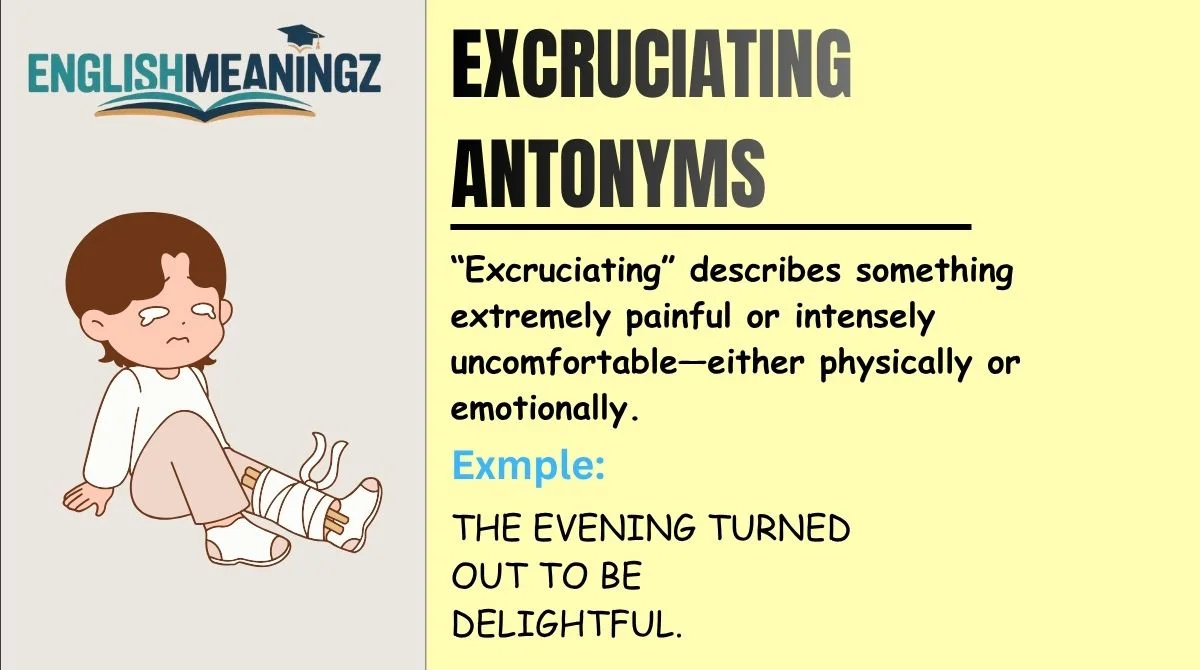
“Excruciating” describes something extremely painful or intensely uncomfortable—either physically or emotionally.
Tone Explanation:
This word carries a high-intensity emotional tone. It is often used in formal, descriptive, or expressive writing to emphasize severity.
Intensity Insight:
“Excruciating” sits at the extreme end of the discomfort scale. It doesn’t just mean painful—it suggests unbearable, overwhelming suffering. Because of this intensity, its antonyms typically fall on the opposite end of the spectrum, representing comfort, ease, or relief.
24 Best Antonyms for “Excruciating”
Comfortable
Meaning: Free from pain or distress
Tone: Neutral
Example: The chair was so comfortable that she could sit for hours.
Why It’s Opposite: Replaces extreme pain with ease and physical relaxation.
Pleasant
Meaning: Enjoyable and agreeable
Tone: Informal
Example: The weather was pleasant and calming.
Why It’s Opposite: Shifts from intense suffering to mild enjoyment.
Soothing
Meaning: Calming or relieving discomfort
Tone: Emotional
Example: The music had a soothing effect on his nerves.
Why It’s Opposite: Directly reduces pain and emotional strain.
Painless
Meaning: Without any pain
Tone: Formal
Example: The procedure was quick and painless.
Why It’s Opposite: Eliminates pain entirely, contrasting with extreme suffering.
Easy
Meaning: Not difficult or demanding
Tone: Informal
Example: The task was surprisingly easy to complete.
Why It’s Opposite: Removes struggle and intensity.
Mild
Meaning: Not severe or intense
Tone: Academic
Example: She experienced only mild discomfort.
Why It’s Opposite: Represents the lowest level of discomfort.
Gentle
Meaning: Soft and not harsh
Tone: Emotional
Example: He spoke in a gentle tone.
Why It’s Opposite: Opposes harsh intensity with softness.
Relaxing
Meaning: Reducing stress or tension
Tone: Informal
Example: A walk by the beach is relaxing.
Why It’s Opposite: Moves from stress and pain to calmness.
Comfortable
Meaning: Providing physical ease
Tone: Neutral
Example: The bed felt comfortable after a long day.
Why It’s Opposite: Directly contrasts discomfort.
Delightful
Meaning: Highly pleasing
Tone: Emotional
Example: The evening turned out to be delightful.
Why It’s Opposite: Converts suffering into enjoyment.
Enjoyable
Meaning: Giving pleasure
Tone: Neutral
Example: The movie was enjoyable from start to finish.
Why It’s Opposite: Opposes pain with pleasure.
Calming
Meaning: Reducing agitation
Tone: Emotional
Example: Her voice was calming during the crisis.
Why It’s Opposite: Removes emotional intensity.
Restful
Meaning: Promoting rest
Tone: Formal
Example: The environment was quiet and restful.
Why It’s Opposite: Replaces strain with recovery.
Tranquil
Meaning: Peaceful and quiet
Tone: Academic
Example: The lake looked tranquil at sunset.
Why It’s Opposite: Opposes turmoil and distress.
Comforting
Meaning: Providing reassurance
Tone: Emotional
Example: His words were comforting during hard times.
Why It’s Opposite: Relieves emotional pain.
Effortless
Meaning: Requiring no effort
Tone: Formal
Example: She made the performance look effortless.
Why It’s Opposite: Eliminates struggle and strain.
Smooth
Meaning: Free from difficulty
Tone: Neutral
Example: The process went smoothly.
Why It’s Opposite: Contrasts difficulty and hardship.
Easygoing
Meaning: Relaxed and carefree
Tone: Informal
Example: He has an easygoing personality.
Why It’s Opposite: Opposes tension and stress.
Light
Meaning: Not heavy or intense
Tone: Neutral
Example: She preferred light exercises.
Why It’s Opposite: Reduces intensity.
Agreeable
Meaning: Pleasant and acceptable
Tone: Formal
Example: The terms were agreeable to both parties.
Why It’s Opposite: Replaces discomfort with acceptance.
Mildly Pleasant
Meaning: Slightly enjoyable
Tone: Neutral
Example: The evening was mildly pleasant.
Why It’s Opposite: Represents low-level positivity.
Healing
Meaning: Promoting recovery
Tone: Emotional
Example: Nature has a healing effect.
Why It’s Opposite: Reverses pain into recovery.
Comfortable
Meaning: Physically at ease
Tone: Neutral
Example: He felt comfortable in the new environment.
Why It’s Opposite: Removes distress.
Reassuring
Meaning: Reducing worry
Tone: Emotional
Example: Her smile was reassuring.
Why It’s Opposite: Opposes emotional agony.
Strong vs Mild Opposites
Not all antonyms function at the same intensity level. Understanding this scale helps you choose the right word for the right context.
Strong Opposites:
Words like painless, effortless, and tranquil sit at the far opposite end. They completely remove the idea of pain or discomfort.
Moderate Opposites:
Words such as pleasant, comfortable, and relaxing reduce intensity but still allow for some minor discomfort.
Mild Opposites:
Terms like mild or light only slightly oppose “excruciating,” making them useful in academic or precise writing.
Using the wrong intensity can distort meaning. For example, describing a minor inconvenience as “effortless” may sound exaggerated.
Context-Based Opposites
Antonyms depend heavily on context. “Excruciating” can describe physical pain, emotional distress, or even tedious experiences.
Physical Context:
Excruciating pain → painless, comfortable, soothing
Emotional Context:
Excruciating heartbreak → comforting, calming, reassuring
Situational Context:
Excruciating wait → easy, smooth, effortless
Choosing the correct antonym requires understanding what kind of “pain” is being described.
Common Mistakes When Using Opposites
1. Using weak opposites for strong words
Incorrect: The pain was excruciating, but later it became okay.
Better: The pain was excruciating, but later it became painless.
2. Ignoring tone mismatch
Incorrect: The experience was excruciating, then kind of nice.
Better: The experience was excruciating, then deeply soothing.
3. Overgeneralization
Not all pleasant words are true antonyms. Context matters.
4. Repetition of the same antonym
Avoid using “comfortable” repeatedly—vary your vocabulary.
Sentence Transformation Examples
1. Original: The pain was excruciating.
Rewritten: The experience was completely painless.
2. Original: Waiting in line felt excruciating.
Rewritten: The process was smooth and effortless.
3. Original: The noise was excruciating.
Rewritten: The environment was calm and soothing.
4. Original: His injury caused excruciating discomfort.
Rewritten: His recovery was comfortable and healing.
5. Original: The meeting was excruciatingly long.
Rewritten: The meeting was easygoing and relaxed.
FAQs
What is the exact opposite of excruciating?
There is no single perfect opposite, but “painless” and “comfortable” are the closest depending on context.
Can “pleasant” always replace excruciating?
No. “Pleasant” works only when describing experiences, not intense physical pain.
Is “easy” a strong antonym?
It is moderate. It removes difficulty but doesn’t always address pain directly.
Are antonyms always exact opposites?
Not always. Many are context-based rather than absolute.
Which antonym is best for academic writing?
“Mild,” “painless,” and “tranquil” are more suitable for formal contexts.
Can excruciating be used metaphorically?
Yes. It can describe boredom, embarrassment, or emotional stress.
How can I improve my antonym usage?
Practice rewriting sentences and focus on tone, intensity, and context.
Conclusion
Understanding antonyms for “excruciating” goes beyond memorizing vocabulary—it’s about mastering contrast.
When you can shift from extreme pain to comfort, from tension to calm, your writing becomes more dynamic and precise.
By choosing the right antonym based on tone, intensity, and context, you not only improve clarity but also elevate the emotional impact of your work.
Develop this skill consistently, and you’ll notice a significant improvement in both academic and professional communication.