Understanding opposites is one of the fastest ways to sharpen your vocabulary and elevate your writing. When you learn antonyms effectively, you don’t just memorize words—you develop a deeper sense of contrast, tone, and clarity.
This helps you express ideas with precision instead of relying on vague or repetitive language.
In academic and professional communication, the ability to switch between contrasting ideas is essential. Whether you’re writing essays, reports, or persuasive content, antonyms allow you to highlight differences, strengthen arguments, and create impactful sentences.
Instead of saying something is “not good,” you can confidently say it is “ineffective,” “poor,” or “deficient,” depending on context.
This guide explores 21 powerful antonyms for “element”, explained in a clear, human-centered way to help you understand not just the words—but how to use them strategically.
What Does “Element” Mean?
The word “element” has multiple meanings depending on context, but its core idea remains consistent.
Definition:
An element refers to a fundamental part, component, or essential unit that contributes to a whole.
Tone Explanation:
- Neutral and versatile
- Common in academic, scientific, and professional contexts
- Often used in structured or analytical writing
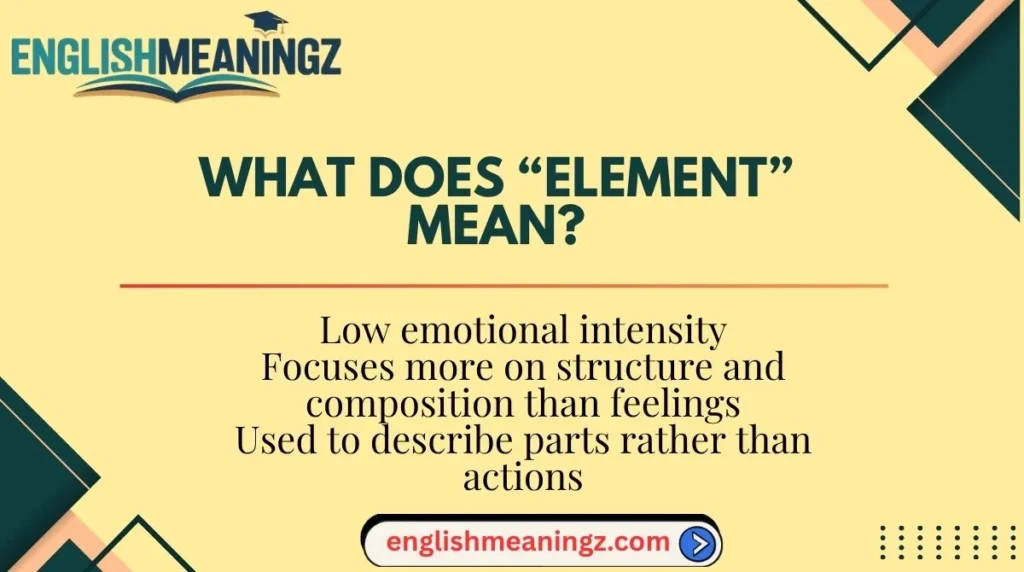
Emotional or Action Intensity:
- Low emotional intensity
- Focuses more on structure and composition than feelings
- Used to describe parts rather than actions
For example:
- “Trust is a key element of a healthy relationship.”
- “Water is composed of chemical elements.”
Because “element” represents a building block, its antonyms usually refer to:
- Wholes instead of parts
- Absence instead of presence
- Complexity instead of simplicity
- Unity instead of division
21 Best Antonyms for “Element”
1. Whole
Meaning: A complete entity
Tone: Formal / Academic
Example: The system must be analyzed as a whole.
Why Opposite: “Element” is a part; “whole” is the complete structure.
2. Entirety
Meaning: The total sum of something
Tone: Formal
Example: She reviewed the entirety of the document.
Why Opposite: It removes the idea of division into parts.
3. Total
Meaning: Full amount without division
Tone: Neutral
Example: The total cost exceeded expectations.
Why Opposite: Opposes the partial nature of an element.
4. Unity
Meaning: State of being one
Tone: Emotional / Formal
Example: The team worked in perfect unity.
Why Opposite: “Element” implies separation; unity implies togetherness.
5. Whole Entity
Meaning: Complete being or system
Tone: Academic
Example: The organization functions as a whole entity.
Why Opposite: Focus shifts from parts to the complete system.
6. Aggregate
Meaning: A whole formed by combining parts
Tone: Academic
Example: The data represents an aggregate of responses.
Why Opposite: Focuses on the combined result, not individual elements.
7. Composite
Meaning: Made of various parts forming a whole
Tone: Technical
Example: The material is a composite of different substances.
Why Opposite: Emphasizes the finished structure over components.
8. Totality
Meaning: The complete state of something
Tone: Formal
Example: The totality of evidence supports the claim.
Why Opposite: Eliminates focus on individual pieces.
9. Mass
Meaning: A large unified body
Tone: Neutral
Example: A mass of people gathered outside.
Why Opposite: Suggests a unified group instead of individual parts.
10. Whole System
Meaning: Entire interconnected structure
Tone: Academic
Example: The whole system needs redesigning.
Why Opposite: Contrasts isolated elements with full systems.
11. Entire Structure
Meaning: Complete framework
Tone: Formal
Example: The entire structure collapsed overnight.
Why Opposite: Focus is on completeness, not parts.
12. Unit
Meaning: Single complete entity
Tone: Academic
Example: The department operates as a single unit.
Why Opposite: A unit is whole, not divisible like elements.
13. Whole Piece
Meaning: Complete object
Tone: Informal
Example: He ate the whole piece of cake.
Why Opposite: Indicates no division into parts.
14. Entire Composition
Meaning: Full creative or structural work
Tone: Formal
Example: The entire composition reflects harmony.
Why Opposite: Opposes breaking into smaller components.
15. Whole Form
Meaning: Complete shape or structure
Tone: Academic
Example: The sculpture is admired as a whole form.
Why Opposite: Focus is on entirety, not individual elements.
16. Collective
Meaning: Group considered as one
Tone: Formal
Example: The collective effort led to success.
Why Opposite: Emphasizes unity rather than separateness.
17. Entire Body
Meaning: Whole physical or conceptual entity
Tone: Formal
Example: The entire body of work is impressive.
Why Opposite: Eliminates focus on individual parts.
18. Complete System
Meaning: Fully functioning structure
Tone: Technical
Example: Engineers designed a complete system.
Why Opposite: Highlights completeness over components.
19. Whole Framework
Meaning: Entire supporting structure
Tone: Academic
Example: The theory fits into a whole framework.
Why Opposite: Framework represents total structure.
20. Entire Mechanism
Meaning: Fully working process or system
Tone: Technical
Example: The entire mechanism failed due to one flaw.
Why Opposite: Contrasts a single element with full operation.
21. Whole Concept
Meaning: Complete idea
Tone: Academic
Example: You must understand the whole concept.
Why Opposite: Focuses on complete understanding, not fragments.
Strong vs Mild Opposites
Not all antonyms carry the same intensity. Some create a sharp contrast, while others provide a softer shift in meaning.
Strong Opposites:
- Whole
- Totality
- Entirety
- Complete system
These completely reverse the idea of “element” by removing any sense of division.
Mild Opposites:
- Aggregate
- Composite
- Collective
These still involve parts but emphasize the combined result, making them less direct opposites.
Intensity Scale:
Element → Component → Group → Aggregate → Whole → Totality
The further you move right, the stronger the opposition becomes.
Context-Based Opposites
Antonyms depend heavily on context. “Element” changes meaning across different fields.
Scientific Context:
- Element → Compound
(Here, compound is not purely opposite but functionally contrasting)
Writing Context:
- Element → Whole structure
Design Context:
- Element → Complete layout
Social Context:
- Element (individual role) → Collective (group identity)
Understanding context ensures you pick the most accurate antonym instead of a generic one.
Common Mistakes When Using Opposites
1. Using unrelated words
- Incorrect: Element → Big
- Correct: Element → Whole
2. Ignoring context
- Wrong: Element → Chaos
- Better: Element → Totality
3. Choosing weak contrasts
- Weak: Element → Group
- Stronger: Element → Entire system
4. Overusing one antonym
Repeating “whole” reduces writing quality. Use variety.
5. Confusing synonyms with antonyms
- Composite is not always a direct opposite—it can be contextual.
Sentence Transformation Examples
1. Original: Trust is an important element of leadership.
Rewritten: Trust defines the whole structure of effective leadership.
2. Original: This element is missing from the design.
Rewritten: The entire design lacks completeness.
3. Original: Each element contributes to success.
Rewritten: The collective effort leads to success.
4. Original: Focus on one element at a time.
Rewritten: Consider the whole system instead of isolated parts.
5. Original: This element is weak.
Rewritten: The entire framework is unstable.
FAQs
What is the simplest antonym of “element”?
The simplest and most direct antonym is “whole.”
Are antonyms always exact opposites?
No. Some are contextual and depend on usage.
Can “composite” be an antonym?
Yes, but it’s a contextual opposite, not a strict one.
Why are antonyms important in writing?
They improve clarity, contrast, and expression.
Is “total” better than “whole”?
Both work, but “total” sounds more formal.
Do antonyms change based on subject?
Yes, especially in science, literature, and design.
How can I remember antonyms easily?
Group them by concept (part vs whole, simple vs complete).
Conclusion
Mastering antonyms like those for “element” transforms your writing from basic to powerful. Instead of thinking in isolated words, you begin to understand relationships—parts versus wholes, fragments versus systems, and simplicity versus completeness.
By using the 21 antonyms covered in this guide, you can:
- Write with precision
- Avoid repetition
- Strengthen arguments
- Improve clarity
The key is not memorization—but application. Practice using these words in real sentences, and your vocabulary will naturally expand.