Understanding opposites is one of the most effective ways to sharpen your writing and communication skills. Antonyms don’t just expand your vocabulary—they refine your ability to express contrast, nuance, and precision.
When you know both a word and its opposite, you gain control over tone, clarity, and meaning.
In academic and professional communication, this skill becomes even more important. Whether you’re writing essays, reports, or business content, using the right contrasting terms helps avoid ambiguity and strengthens your arguments.
Mastering antonyms for terms like “cash crop” is especially useful in economics, agriculture, and environmental discussions where context matters deeply.
What Does “Cash Crop” Mean?
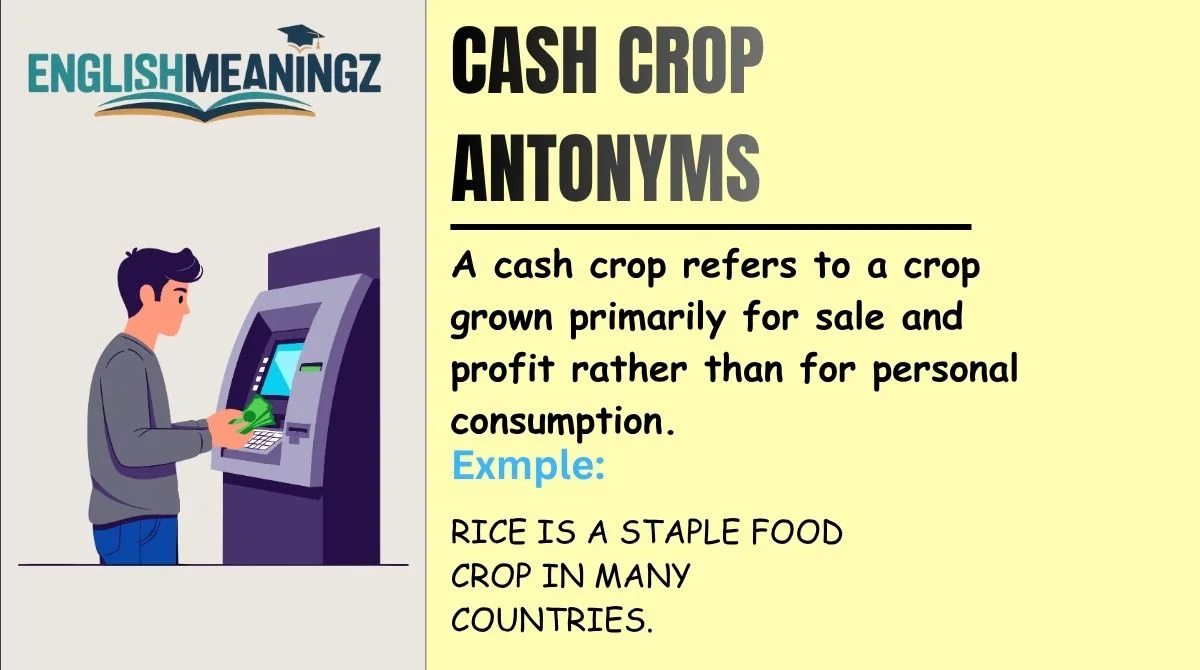
A cash crop refers to a crop grown primarily for sale and profit rather than for personal consumption. Examples include cotton, coffee, tobacco, and sugarcane—products cultivated to generate income in local or global markets.
Tone Explanation
The term carries a neutral to formal tone, commonly used in academic, agricultural, and economic contexts.
Emotional or Action Intensity
“Cash crop” suggests commercial intent and economic productivity. It emphasizes profit-driven agriculture rather than subsistence or sustainability.
22 Best Antonyms for “Cash Crop”
1. Subsistence Crop
Meaning: Crops grown for personal or local consumption
Tone: Academic
Example: The farmer relied on subsistence crops to feed his family.
Why Opposite: Focuses on survival, not profit.
2. Food Crop
Meaning: Crops grown primarily for eating
Tone: Neutral
Example: Rice is a staple food crop in many countries.
Why Opposite: Prioritizes nourishment over market sale.
3. Survival Crop
Meaning: Crops essential for basic living needs
Tone: Emotional
Example: During drought, farmers turned to survival crops.
Why Opposite: Emphasizes necessity rather than income.
4. Local Crop
Meaning: Grown for nearby consumption
Tone: Informal
Example: They focused on local crops for community markets.
Why Opposite: Limited trade scope, not global profit.
5. Household Crop
Meaning: Cultivated for family use
Tone: Neutral
Example: Vegetables in the backyard served as household crops.
Why Opposite: Not intended for sale.
6. Noncommercial Crop
Meaning: Not grown for business purposes
Tone: Formal
Example: These herbs are noncommercial crops.
Why Opposite: Explicitly rejects profit motive.
7. Staple Crop
Meaning: Basic dietary crop
Tone: Academic
Example: Wheat is a staple crop worldwide.
Why Opposite: Focuses on sustenance rather than revenue.
8. Garden Crop
Meaning: Small-scale personal cultivation
Tone: Informal
Example: Tomatoes are common garden crops.
Why Opposite: Minimal commercial value.
9. Subsidiary Crop
Meaning: Secondary or supporting crop
Tone: Formal
Example: Beans were grown as a subsidiary crop.
Why Opposite: Not the main income source.
10. Natural Growth
Meaning: Plants growing without intentional cultivation for profit
Tone: Neutral
Example: Wild berries are natural growth.
Why Opposite: No economic intent.
11. Wild Crop
Meaning: Naturally occurring edible plants
Tone: Informal
Example: They collected wild crops from the forest.
Why Opposite: Not cultivated for sale.
12. Domestic Crop
Meaning: Grown for home use
Tone: Neutral
Example: Corn served as a domestic crop.
Why Opposite: Internal consumption focus.
13. Organic Subsistence Crop
Meaning: Naturally grown for survival
Tone: Academic
Example: The farm specialized in organic subsistence crops.
Why Opposite: Sustainability over profit.
14. Self-Sufficiency Crop
Meaning: Supports independent living
Tone: Formal
Example: Potatoes are ideal self-sufficiency crops.
Why Opposite: Independence rather than commerce.
15. Aid Crop
Meaning: Grown for relief or humanitarian use
Tone: Formal
Example: Aid crops were distributed during famine.
Why Opposite: Purpose is support, not profit.
16. Emergency Crop
Meaning: Quick-growing crops for crisis situations
Tone: Neutral
Example: They planted emergency crops after floods.
Why Opposite: Temporary survival focus.
17. Traditional Crop
Meaning: Cultivated based on cultural practices
Tone: Academic
Example: Millet is a traditional crop in rural areas.
Why Opposite: Cultural continuity over commercialization.
18. Seasonal Food Crop
Meaning: Grown for seasonal consumption
Tone: Neutral
Example: Pumpkins are seasonal food crops.
Why Opposite: Limited market intent.
19. Community Crop
Meaning: Shared agricultural produce
Tone: Informal
Example: The village maintained community crops.
Why Opposite: Collective benefit instead of profit.
20. Basic Crop
Meaning: Essential for daily diet
Tone: Neutral
Example: Rice is a basic crop in Asia.
Why Opposite: Focus on necessity.
21. Nutritional Crop
Meaning: Grown for health benefits
Tone: Academic
Example: Spinach is a nutritional crop.
Why Opposite: Health-driven rather than profit-driven.
22. Homegrown Produce
Meaning: Cultivated for personal use
Tone: Informal
Example: They prefer homegrown produce.
Why Opposite: No commercial objective.
Strong vs Mild Opposites
Not all antonyms carry the same intensity. Some are strong opposites, directly contradicting the commercial nature of cash crops, such as “subsistence crop” or “noncommercial crop.” Others are mild opposites, like “local crop” or “seasonal food crop,” which may still involve small-scale selling but lack large-scale profit intent.
Understanding this scale helps writers choose precise language depending on context. Strong antonyms are ideal for academic debates, while mild ones suit general writing.
Context-Based Opposites
Antonyms can change depending on the situation. In economics, “subsistence crop” is the clearest opposite. In environmental discussions, “organic subsistence crop” may be more relevant. In social contexts, “community crop” or “aid crop” becomes a stronger contrast.
This flexibility shows that antonyms are not fixed—they depend on purpose, scale, and intent.
Common Mistakes When Using Opposites
One common mistake is assuming any crop is an antonym of “cash crop.” For example:
- Incorrect: Wheat is the opposite of a cash crop.
- Correct: Wheat can be either a cash crop or a staple crop depending on use.
Another mistake is ignoring context:
- Incorrect: Garden crop always opposes cash crop.
- Correct: Some garden crops are sold commercially.
Writers also confuse related terms with opposites, which weakens clarity.
Sentence Transformation Examples
- Farmers rely on cash crops for income.
→ Farmers rely on subsistence crops for survival. - The region focuses on export-based agriculture.
→ The region focuses on local food production. - Coffee is a major cash crop.
→ Rice is a staple food crop. - The farm prioritizes profit-driven cultivation.
→ The farm prioritizes self-sufficiency crops. - Cotton is grown for commercial sale.
→ Vegetables are grown for household use.
FAQs
What is the exact opposite of a cash crop?
The closest antonym is “subsistence crop,” as it focuses on personal consumption instead of profit.
Can a crop be both a cash crop and a food crop?
Yes, depending on how it is used—sold or consumed.
Why are antonyms important in writing?
They improve clarity, contrast, and precision.
Is “food crop” always an antonym of “cash crop”?
Not always. Some food crops are also sold commercially.
Are antonyms context-dependent?
Yes, their meaning changes based on usage.
What tone is “cash crop” usually used in?
It is mostly used in formal and academic contexts.
How can I improve my vocabulary using antonyms?
Practice pairing words with their opposites and using them in sentences.
Conclusion
Mastering antonyms like those for “cash crop” gives you a deeper understanding of language and context. It allows you to communicate more effectively, especially in academic and professional settings.
By learning both strong and mild opposites, you gain flexibility in expression and precision in meaning.
Whether you’re discussing agriculture, economics, or general writing, these antonyms help you present ideas with clarity and confidence.