Understanding opposites is one of the fastest ways to sharpen your writing. When you know not just a word—but its full range of contrasts—you gain control over tone, clarity, and precision.
Writers who actively use antonyms can shift meaning, create emphasis, and avoid repetition with ease.
In academic and professional communication, this skill becomes even more critical.
Whether you’re writing essays, reports, or persuasive content, choosing the right opposite word helps you present balanced arguments, highlight contrasts, and communicate ideas more effectively.
Mastering antonyms of “ascent” will allow you to describe movement, progress, or decline with accuracy and nuance.
What Does “Ascent” Mean?
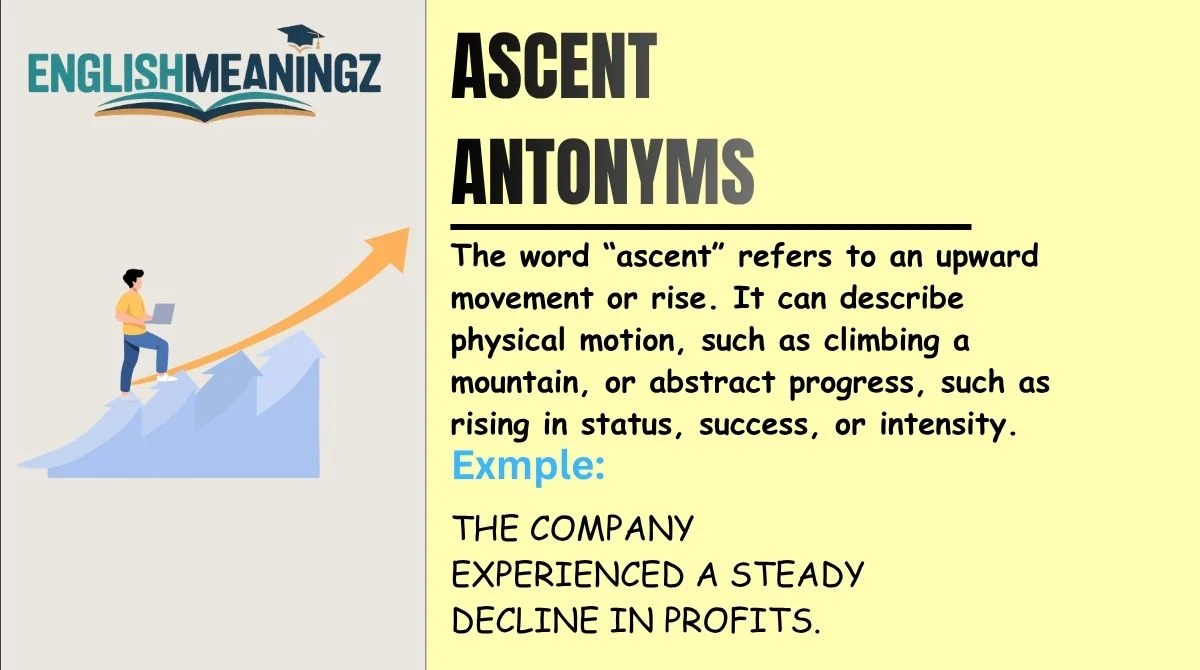
The word “ascent” refers to an upward movement or rise. It can describe physical motion, such as climbing a mountain, or abstract progress, such as rising in status, success, or intensity.
Tone Explanation:
“Ascent” carries a positive, progressive tone. It often implies improvement, ambition, or achievement.
Emotional or Action Intensity:
It suggests upward momentum—growth, elevation, or advancement. Depending on context, it can feel gradual (a steady climb) or dramatic (a rapid rise).
17 Best Antonyms for “Ascent”
Descent
Meaning: Downward movement
Tone: Formal / Academic
Example: The plane began its descent into the city.
Why it’s opposite: It directly contrasts upward motion with downward direction.
Decline
Meaning: Gradual decrease or deterioration
Tone: Formal / Academic
Example: The company experienced a steady decline in profits.
Why it’s opposite: Opposes the growth implied in ascent.
سقوط (Fall)
Meaning: Sudden drop or collapse
Tone: Emotional / Informal
Example: The سقوط of the empire shocked historians.
Why it’s opposite: Emphasizes a sharp downward movement instead of rising.
Drop
Meaning: To fall or decrease quickly
Tone: Informal
Example: Temperatures will drop overnight.
Why it’s opposite: Suggests a reduction rather than elevation.
Downfall
Meaning: Loss of power or failure
Tone: Emotional
Example: His arrogance led to his downfall.
Why it’s opposite: Replaces success with collapse.
Declivity
Meaning: A downward slope
Tone: Academic
Example: The hikers struggled on the steep declivity.
Why it’s opposite: Physical opposite of an upward slope.
Regression
Meaning: Return to a previous, less advanced state
Tone: Academic
Example: The policy caused economic regression.
Why it’s opposite: Opposes forward progress.
Deterioration
Meaning: Worsening condition
Tone: Formal
Example: The building showed signs of deterioration.
Why it’s opposite: Contrasts improvement with decline.
Plunge
Meaning: Sudden, steep fall
Tone: Emotional
Example: Stocks took a plunge after the announcement.
Why it’s opposite: Indicates rapid downward motion.
Sink
Meaning: To go down below a surface
Tone: Neutral
Example: The boat began to sink slowly.
Why it’s opposite: Movement downward instead of upward.
Collapse
Meaning: Sudden failure or breakdown
Tone: Emotional
Example: The structure collapsed under pressure.
Why it’s opposite: Reverses the idea of building up.
Decrease
Meaning: Reduction in size or amount
Tone: Formal
Example: There was a decrease in demand.
Why it’s opposite: Opposes increase implied in ascent.
Falloff
Meaning: Gradual decline
Tone: Informal
Example: There was a falloff in attendance.
Why it’s opposite: Suggests reduction instead of rise.
Declension
Meaning: Downward trend
Tone: Academic
Example: The data shows a clear declension in output.
Why it’s opposite: Represents a consistent drop.
Slump
Meaning: Sudden decline, especially in performance
Tone: Informal
Example: The market entered a slump.
Why it’s opposite: Opposes upward growth.
Degradation
Meaning: Reduction in quality or status
Tone: Formal
Example: Environmental degradation is a global issue.
Why it’s opposite: Contrasts improvement with worsening.
Lowering
Meaning: Making something lower
Tone: Neutral
Example: The lowering of prices attracted customers.
Why it’s opposite: Directly contrasts raising or ascending.
Strong vs Mild Opposites
Not all antonyms carry the same intensity. Some express dramatic contrast, while others suggest a softer shift.
Strong Opposites:
Words like “collapse,” “plunge,” and “downfall” indicate sudden, dramatic reversals. These are powerful and often emotional.
Mild Opposites:
Terms such as “decrease,” “decline,” and “lowering” suggest gradual or controlled downward movement.
Why this matters:
Choosing the right intensity helps match your message. Academic writing often favors mild antonyms, while storytelling may benefit from stronger ones.
Context-Based Opposites
The best antonym for “ascent” depends on context.
- Physical movement:
Ascent → Descent - Career growth:
Ascent → Decline / Downfall - Emotional rise:
Ascent → Slump / Collapse - Economic increase:
Ascent → Decrease / Regression
Using the wrong antonym can confuse readers. Always consider whether the situation is literal, metaphorical, or emotional.
Common Mistakes When Using Opposites
Mistake 1: Using weak contrasts
Incorrect: His ascent turned into a decrease.
Better: His ascent turned into a downfall.
Mistake 2: Ignoring tone
Incorrect: The company’s ascent ended in a slump (in formal report).
Better: The company’s ascent ended in a decline.
Mistake 3: Mixing contexts
Incorrect: The mountain’s ascent became a regression.
Better: The mountain’s ascent became a descent.
Mistake 4: Overusing dramatic words
Using “collapse” everywhere can make writing exaggerated.
Sentence Transformation Examples
Original: The team experienced a rapid ascent in rankings.
Rewritten: The team experienced a sudden decline in rankings.
Original: His career shows a steady ascent.
Rewritten: His career shows a gradual regression.
Original: The airplane began its ascent.
Rewritten: The airplane began its descent.
Original: There was an ascent in temperature.
Rewritten: There was a drop in temperature.
Original: The company is on an upward ascent.
Rewritten: The company is heading toward a downturn.
FAQs
What is the exact opposite of ascent?
The most direct opposite is “descent,” as it reflects downward movement.
Are all antonyms of ascent negative?
Most carry negative or neutral tones because they imply decline or downward motion.
Can ascent be used metaphorically?
Yes, it often describes success, growth, or improvement beyond physical movement.
Which antonym is best for academic writing?
“Decline,” “decrease,” and “regression” are commonly preferred.
What is a strong emotional opposite of ascent?
“Downfall” or “collapse” conveys intense contrast.
Is “fall” always a good antonym?
It works in informal contexts but may lack precision in formal writing.
How do I choose the right antonym?
Focus on context, tone, and intensity. Match the word to the situation.
Conclusion
Mastering antonyms of “ascent” gives you greater control over language. Whether you’re describing physical movement, career progress, or abstract growth, knowing the right opposite allows you to communicate with clarity and impact.
By understanding tone, intensity, and context, you can select the most effective word every time. Strong vocabulary isn’t just about knowing more words—it’s about knowing the right word for the right moment.