Understanding opposites is not just a vocabulary exercise—it’s a strategic tool for clearer, sharper, and more persuasive communication. When you know how to contrast ideas effectively, your writing gains depth, precision, and impact.
Whether you’re crafting essays, reports, or creative content, using the right antonyms helps you express nuance instead of relying on vague descriptions.
In academic and professional communication, precision matters. Words like artillery carry strong connotations of force, aggression, and intensity.
Knowing its opposites allows you to shift tone—from conflict to calm, from destruction to creation. This ability enhances clarity, strengthens arguments, and improves readability across all forms of writing.
What Does “Artillery” Mean?
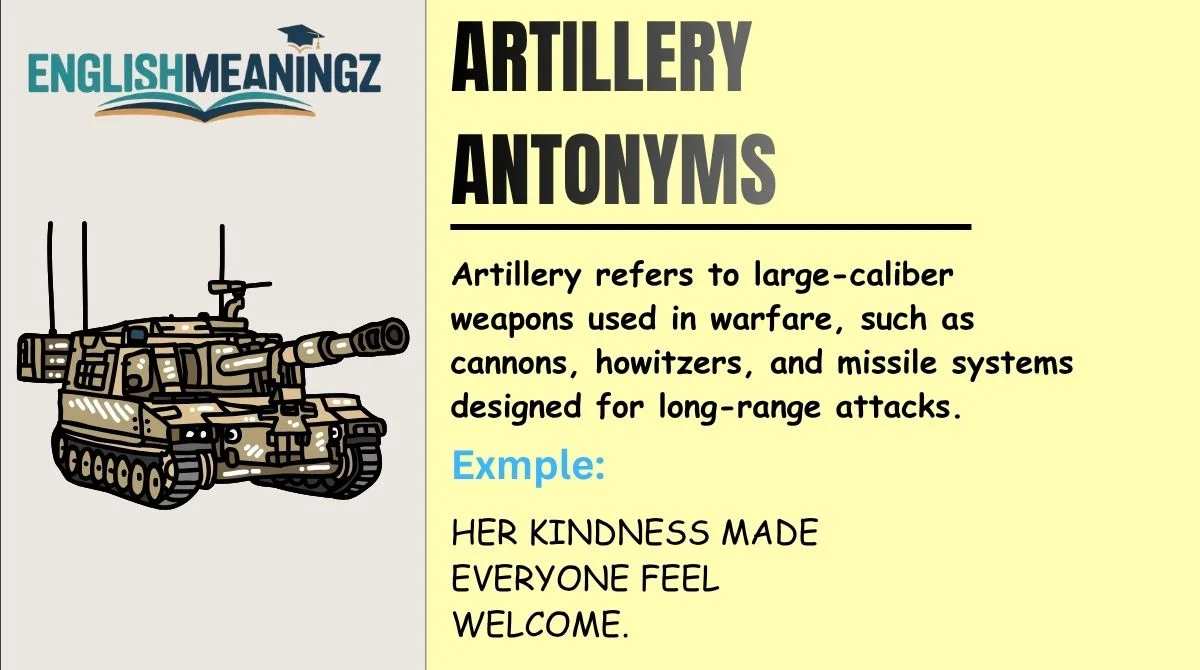
Artillery refers to large-caliber weapons used in warfare, such as cannons, howitzers, and missile systems designed for long-range attacks.
Tone Explanation
The word carries a highly aggressive, forceful, and destructive tone. It often symbolizes overwhelming power, strategic attack, or intense pressure.
Emotional and Action Intensity
- Intensity Level: Extremely high
- Associated Feelings: Fear, dominance, urgency, conflict
- Action Type: Offensive, destructive, large-scale impact
Because of this intensity, its antonyms tend to represent peace, gentleness, protection, or creation.
18 Best Antonyms for “Artillery”
Peace
Meaning: A state of calm without conflict
Tone: Emotional / Academic
Example: The region finally experienced peace after years of conflict.
Why Opposite: Artillery symbolizes war; peace represents its complete absence.
Harmony
Meaning: Agreement and balance among elements
Tone: Formal / Emotional
Example: The team worked in harmony to complete the project.
Why Opposite: Instead of force and destruction, harmony implies unity and cooperation.
Calm
Meaning: A state of tranquility and stillness
Tone: Informal / Emotional
Example: The ocean remained calm at sunrise.
Why Opposite: Artillery brings chaos; calm reflects quiet stability.
Diplomacy
Meaning: Negotiation to resolve conflict peacefully
Tone: Formal / Academic
Example: Diplomacy prevented the escalation of tensions.
Why Opposite: Diplomacy replaces violent force with dialogue.
Protection
Meaning: The act of keeping something safe
Tone: Formal
Example: The laws ensure protection for vulnerable communities.
Why Opposite: Artillery destroys; protection preserves.
Defense
Meaning: Guarding against attack
Tone: Academic
Example: The strategy focused on defense rather than aggression.
Why Opposite: While artillery is offensive, defense is reactive and protective.
Kindness
Meaning: Being friendly and considerate
Tone: Emotional
Example: Her kindness made everyone feel welcome.
Why Opposite: Kindness contrasts sharply with the harshness of artillery.
Care
Meaning: Concern for well-being
Tone: Informal / Emotional
Example: He showed great care in handling the fragile object.
Why Opposite: Care nurtures, while artillery harms.
Support
Meaning: Providing help or assistance
Tone: Neutral
Example: The community offered support during difficult times.
Why Opposite: Support builds up instead of tearing down.
Healing
Meaning: The process of recovery
Tone: Emotional
Example: Time plays a crucial role in emotional healing.
Why Opposite: Healing repairs damage caused by destructive forces like artillery.
Creation
Meaning: Bringing something into existence
Tone: Academic
Example: The artist focused on creation rather than criticism.
Why Opposite: Creation builds; artillery destroys.
Construction
Meaning: Building structures or systems
Tone: Formal
Example: Construction of the bridge took two years.
Why Opposite: Construction represents development, not destruction.
Cooperation
Meaning: Working together toward a goal
Tone: Formal
Example: Cooperation between departments improved efficiency.
Why Opposite: Cooperation replaces conflict with teamwork.
Negotiation
Meaning: Discussion to reach agreement
Tone: Academic
Example: The issue was resolved through negotiation.
Why Opposite: Negotiation avoids the need for force.
Softness
Meaning: Gentle or mild quality
Tone: Emotional
Example: The softness of her voice calmed the room.
Why Opposite: Artillery is harsh; softness is gentle.
Mercy
Meaning: Compassion shown instead of punishment
Tone: Formal / Emotional
Example: The judge showed mercy in the final decision.
Why Opposite: Mercy reduces harm; artillery amplifies it.
Aid
Meaning: Help or assistance
Tone: Formal
Example: International aid helped rebuild the city.
Why Opposite: Aid supports recovery rather than causing destruction.
Relief
Meaning: Removal of distress or hardship
Tone: Emotional
Example: The rainfall brought relief to the drought-stricken area.
Why Opposite: Relief alleviates suffering; artillery causes it.
Strong vs Mild Opposites
Not all antonyms carry equal strength. Some directly oppose the destructive intensity of artillery, while others provide softer contrasts.
Strong Opposites
These represent complete conceptual contrast:
- Peace
- Diplomacy
- Creation
- Protection
- Defense
These words directly counteract the core function of artillery—violence and destruction.
Mild Opposites
These provide indirect or emotional contrast:
- Calm
- Kindness
- Softness
- Care
- Relief
They don’t directly oppose warfare but shift the tone toward gentleness and stability.
Intensity Scale Insight
Think of a scale:
Artillery → Conflict → Tension → Neutral → Calm → Peace
Choosing the right antonym depends on how dramatically you want to shift meaning.
Context-Based Opposites
Antonyms are not always fixed—they depend on context.
Military Context
- Artillery → Defense / Diplomacy
Used in strategic or geopolitical discussions.
Emotional Context
- Artillery (as metaphor for harsh words) → Kindness / Softness
Example: “His words felt like artillery” vs “Her response showed kindness.”
Creative Context
- Artillery → Creation / Construction
Used in writing, art, or innovation discussions.
Social Context
- Artillery → Cooperation / Harmony
Useful when describing teamwork or relationships.
Understanding context ensures that your chosen antonym feels natural and precise.
Common Mistakes When Using Opposites
Using Weak Contrasts
Incorrect: Artillery vs Noise
Problem: Noise doesn’t fully capture the destructive intensity.
Ignoring Context
Incorrect: Using calm in a military strategy discussion
Better: Use defense or diplomacy
Overgeneralization
Incorrect: Assuming every gentle word is an antonym
Not all soft words directly oppose artillery.
Misaligned Tone
Incorrect: Mixing informal antonyms in formal writing
Example: “Artillery vs chill vibes” (unprofessional tone)
Literal vs Figurative Confusion
Artillery can be metaphorical. Misinterpreting it leads to incorrect antonyms.
Sentence Transformation Examples
Original 1
The speech felt like verbal artillery aimed at the audience.
Rewritten: The speech was filled with kindness and understanding.
Original 2
The company launched an artillery of aggressive marketing tactics.
Rewritten: The company focused on cooperation and customer engagement.
Original 3
His criticism came like artillery fire.
Rewritten: His feedback was delivered with care and support.
Original 4
The debate turned into intellectual artillery.
Rewritten: The debate evolved into a calm and constructive discussion.
Original 5
Their strategy relied on financial artillery.
Rewritten: Their strategy emphasized careful planning and protection.
FAQs
What is the simplest antonym of artillery?
Peace is the most straightforward antonym because it directly opposes war and conflict.
Can artillery be used metaphorically?
Yes, it often describes intense verbal attacks or overwhelming force in non-military contexts.
Are all antonyms of artillery related to peace?
No. Some relate to creation, kindness, or support rather than just the absence of war.
What is a formal antonym for academic writing?
Diplomacy and defense are excellent formal alternatives depending on context.
Is calm a strong antonym?
No, calm is a mild antonym because it contrasts emotionally rather than functionally.
How do I choose the right antonym?
Consider context, tone, and intensity. Match the opposite to the situation.
Why are antonyms important in writing?
They improve clarity, enhance contrast, and make communication more precise and engaging.
Conclusion
Mastering antonyms like those for artillery is more than a vocabulary upgrade—it’s a communication advantage.
By understanding the intensity, tone, and context of words, you can transform your writing from basic to powerful.
Whether you’re shifting from aggression to calm or from destruction to creation, the right antonym helps you express exactly what you mean.
The 18 antonyms explored here provide a versatile toolkit for academic, professional, and creative use. Apply them thoughtfully, and your writing will become clearer, more dynamic, and far more impactful.