Understanding opposites is one of the fastest ways to upgrade your writing. When you know not just what a word means—but also what it doesn’t mean—you gain precision, control, and flexibility.
This is especially important with abstract verbs like “interpret,” which often carry nuanced meanings in academic, analytical, and professional communication.
In essays, reports, and even everyday conversations, choosing the right antonym can completely shift the tone of your message. Instead of sounding vague or repetitive, your writing becomes clearer, more intentional, and more persuasive.
Whether you’re a student, content creator, or professional, mastering antonyms helps you express contrast effectively—a critical skill in argumentation and critical thinking.
This guide explores 17 carefully selected antonyms for “interpret,” along with their meanings, tones, and practical usage.
What Does “Interpret” Mean?
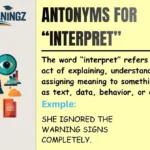
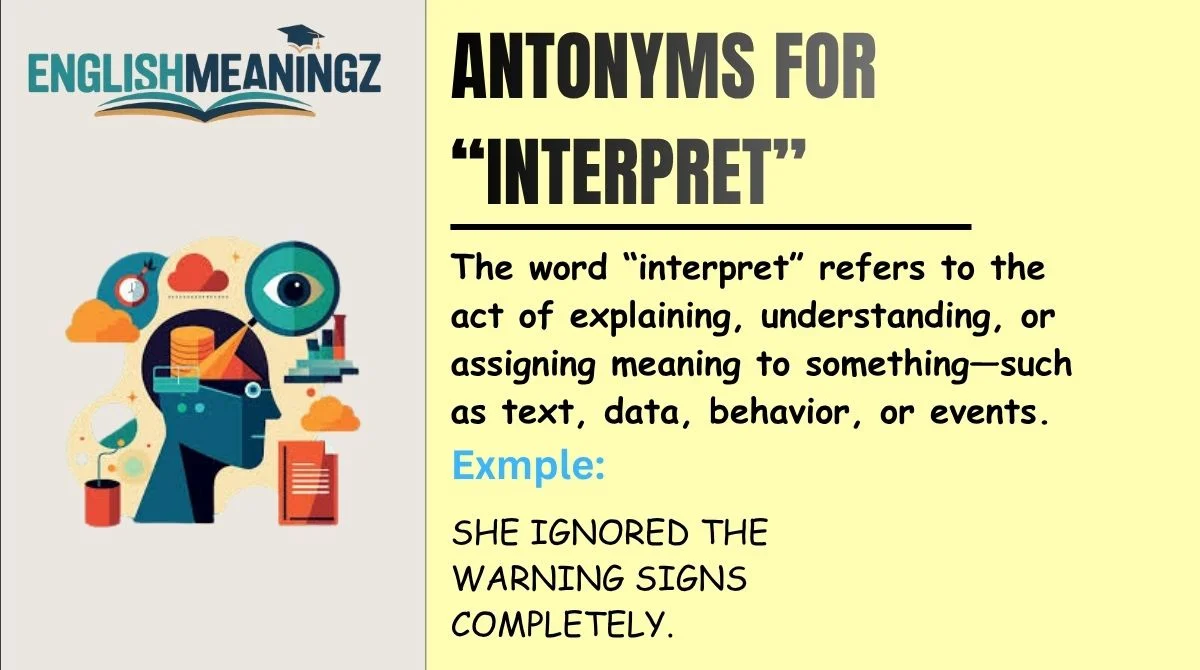
The word “interpret” refers to the act of explaining, understanding, or assigning meaning to something—such as text, data, behavior, or events. It often involves personal judgment, analysis, or perspective.
Definition:
To explain or understand the meaning of something, often based on personal reasoning or context.
Tone Explanation:
“Interpret” is typically neutral to academic. It is commonly used in formal writing, research, and intellectual discussions.
Emotional or Action Intensity:
Moderate. It involves mental effort, analysis, and subjective reasoning rather than direct action.
17 Best Antonyms for “Interpret”
1. Misunderstand
Meaning: To fail to understand something correctly
Tone: Informal / Neutral
Example: He misunderstood the instructions and completed the task incorrectly.
Why Opposite: While interpreting seeks clarity, misunderstanding results in confusion or error.
2. Ignore
Meaning: To deliberately pay no attention to something
Tone: Neutral
Example: She ignored the warning signs completely.
Why Opposite: Interpreting requires engagement; ignoring avoids it altogether.
3. Overlook
Meaning: To fail to notice something
Tone: Neutral
Example: The editor overlooked several grammatical errors.
Why Opposite: Interpretation involves noticing and analyzing; overlooking misses details entirely.
4. Misread
Meaning: To read something incorrectly
Tone: Neutral
Example: He misread the tone of the email as hostile.
Why Opposite: Interpretation aims for correct meaning, while misreading distorts it.
5. Confuse
Meaning: To mix up or fail to distinguish
Tone: Informal
Example: The complex data confused the students.
Why Opposite: Interpretation clarifies; confusion blurs understanding.
6. Distort
Meaning: To twist the meaning of something
Tone: Formal
Example: The media distorted the speaker’s message.
Why Opposite: Interpretation seeks accuracy, while distortion alters truth.
7. Misrepresent
Meaning: To present something falsely
Tone: Formal / Academic
Example: The report misrepresented the actual findings.
Why Opposite: Interpretation explains meaning; misrepresentation changes it unfairly.
8. Obscure
Meaning: To make something unclear
Tone: Formal
Example: Technical jargon obscured the main idea.
Why Opposite: Interpretation clarifies meaning; obscuring hides it.
9. Dismiss
Meaning: To reject or disregard something
Tone: Neutral
Example: He dismissed the theory without analysis.
Why Opposite: Interpretation involves consideration; dismissal avoids it.
10. Neglect
Meaning: To fail to give proper attention
Tone: Neutral
Example: The researcher neglected important data points.
Why Opposite: Interpretation requires focus; neglect avoids responsibility.
11. Misjudge
Meaning: To form an incorrect opinion
Tone: Neutral
Example: She misjudged his intentions completely.
Why Opposite: Interpretation aims for accurate judgment; misjudging leads to error.
12. Simplify
Meaning: To reduce complexity
Tone: Neutral
Example: The teacher simplified the concept for beginners.
Why Opposite: Interpretation often adds layers of meaning, while simplification reduces them.
13. Literalize
Meaning: To take something in a purely literal sense
Tone: Academic
Example: He literalized the metaphor and missed its deeper meaning.
Why Opposite: Interpretation explores deeper meaning; literalizing ignores nuance.
14. Misconstrue
Meaning: To interpret something wrongly
Tone: Formal
Example: Her comments were misconstrued by the audience.
Why Opposite: It directly represents failed interpretation.
15. Reject
Meaning: To refuse to accept
Tone: Neutral
Example: The committee rejected the proposal outright.
Why Opposite: Interpretation considers meaning; rejection blocks engagement.
16. Skim
Meaning: To read quickly without deep understanding
Tone: Informal
Example: He skimmed the article and missed key points.
Why Opposite: Interpretation requires depth; skimming avoids it.
17. Oversimplify
Meaning: To make something too simple, losing meaning
Tone: Neutral
Example: The explanation oversimplified a complex issue.
Why Opposite: Interpretation respects complexity; oversimplification removes it.
Strong vs Mild Opposites
Not all antonyms carry the same intensity. Some are strong opposites, directly contradicting the act of interpreting, while others are mild contrasts, depending on context.
Strong Opposites:
- Misrepresent
- Distort
- Misconstrue
- Misunderstand
These words indicate complete failure or corruption of meaning.
Mild Opposites:
- Ignore
- Skim
- Simplify
- Overlook
These suggest absence or reduction of interpretation rather than direct contradiction.
Understanding this scale helps you choose the right word based on how strong you want your contrast to be.
Context-Based Opposites
Antonyms often depend on context. “Interpret” can mean different things depending on usage:
- In literature: Opposite may be literalize or misread
- In data analysis: Opposite may be ignore or misrepresent
- In communication: Opposite may be misunderstand or dismiss
For example:
- “She interpreted the poem deeply.” → Opposite: “She literalized the poem.”
- “He interpreted the data accurately.” → Opposite: “He misrepresented the data.”
Choosing the correct antonym requires understanding the situation—not just the word itself.
Common Mistakes When Using Opposites
1. Using weak contrasts
Incorrect: He interpreted the text, but she simplified it.
Better: He interpreted the text, but she misread it.
2. Ignoring tone differences
“Skim” is informal, while “misrepresent” is formal. Mixing tones can weaken writing.
3. Choosing unrelated words
Not every contrasting action is an antonym. For example, “write” is not an antonym of “interpret.”
4. Overusing one antonym
Repeating “misunderstand” reduces variety. Use alternatives for stronger writing.
Sentence Transformation Examples
1. Original: She interpreted the speech thoughtfully.
Rewritten: She misunderstood the speech completely.
2. Original: The scientist interpreted the results carefully.
Rewritten: The scientist misrepresented the results.
3. Original: He interpreted the novel with depth.
Rewritten: He skimmed the novel and missed its meaning.
4. Original: They interpreted the instructions clearly.
Rewritten: They ignored the instructions entirely.
5. Original: The critic interpreted the film symbolically.
Rewritten: The critic literalized the film’s message.
FAQs
What is the simplest antonym for “interpret”?
“Misunderstand” is the most direct and commonly used opposite.
Are all antonyms of “interpret” negative?
Most carry a negative tone because they involve failure, distortion, or lack of understanding.
Can “ignore” really be an antonym?
Yes, because interpretation requires engagement, while ignoring avoids it completely.
Which antonym is best for academic writing?
“Misrepresent,” “misconstrue,” and “distort” are ideal for formal contexts.
Is “simplify” always an antonym?
Not always. It can be helpful in teaching but becomes an antonym when it removes meaning.
What is the strongest opposite of “interpret”?
“Misrepresent” or “distort,” as they actively alter meaning.
How can I choose the right antonym?
Focus on context, tone, and intensity of contrast.
Conclusion
Mastering antonyms for “interpret” is more than a vocabulary exercise—it’s a strategic writing skill. By understanding how meaning can be clarified, ignored, distorted, or misunderstood, you gain control over how your ideas are presented and contrasted.
Whether you’re crafting academic essays, professional reports, or SEO content, using the right opposite word sharpens your message and strengthens your argument.
Instead of relying on basic contrasts, you now have 17 precise alternatives that allow you to communicate with clarity, nuance, and confidence.